I've seen this go wrong: a contractor buys "UL-listed" front-lit channel letters from a US vendor at $600 per letter. Two summers in Phoenix. The LEDs dim, flicker, and 30% of the sign is dark by August. The LED chips? Fine. The solder joints? Cooked. The power supply? Baked inside a sealed black aluminum enclosure like a Thanksgiving turkey.
Here's what nobody tells you: an LED rated for 50,000 hours at 25°C loses half that lifespan for every 10°C rise at the junction. That L70 number printed on the module datasheet is a laboratory fantasy. Inside a black-faced channel letter mounted on a south-facing wall in Dallas on July 15th, the ambient temperature at the LED board doesn't sit at 25°C. It hovers between 60°C and 80°C. Suddenly your 50,000-hour LED becomes a 12,000-hour LED — and that's just the chip. The driver board under the same roof gets even hotter, and cheap electrolytic capacitors dry out like dead leaves. Five thousand hours later, the blue channel on your SMD 5050 RGB unit fails, leaving you with a sign that glows pink. Clients love that.
The ugly truth is that 90% of sign companies, even the big ones, treat thermal management as an afterthought. They trust the module manufacturer's spec sheet, stuff the cavity full of LEDs, seal the letter until it's IP68, and ship it. I've been on factory floors for 16 years. I've cut open failed signs shipped back from Dubai and Miami. I've never seen an LED chip actually burn out. I've seen plenty of melted solder, swollen capacitors, and delaminated aluminum-backed PCBs because some genius designed a thermal path thinner than a soda can.
So let's talk for real. I'm the guy at Aochuang Sign who's yelled at suppliers about LED quality, who's refused to ship a double-sided lightbox because the internal temperature during our 12-hour aging test spiked past 85°C. I'll give you what the spec sheets won't.
Look, every LED module has a thermal path. LED chip soldered to a metal-core PCB (MCPCB). That board glued or screwed to an aluminum extrusion or backing plate. That plate then touches the sign body or the open air. Break any link, and your sign cooks from the inside out.
A lot of factories use a standard FR4 fiberglass board for their LED strips because it's cheap. FR4 conducts heat about as well as a wool sweater. The proper spec is an aluminum-core board, at least 1.6mm thick, with a dielectric layer tested for thermal impedance under 0.8°C/W. Cut costs there, and your junction temperature jumps 20°C instantly. I've seen Chinese wholesale modules priced at $0.15 per piece that use paper-thin aluminum and glue that loses adhesion after 50 thermal cycles. They pass a bench test at the factory and fail after one winter in Chicago.
At our facility, when we build back-lit halo letters or front-lit channel letters, the LED strip is spec'd with a 1.6mm aluminum PCB, and we mount it to a dedicated aluminum backplate, not directly to the stainless steel return. Stainless 304, which we use for 10+ years outdoors, has terrible thermal conductivity—roughly 16 W/m·K compared to aluminum's 200. So if you attach LEDs directly to a stainless steel can and seal it up, you've built a slow-roasting oven. We add an aluminum heat-spreader plate, or for back-lit letters where the LED strips sit on the back inside of the return, we use aluminum returns. Ugly truth number two: plenty of premium "stainless steel letter" suppliers skip this step because it adds labor and $3 per foot. That's why their halo-lit signs in Texas develop dim spots shaped like the LED spacing after 18 months.
The power supply is always the weakest link. And I'm not just talking about the no-name driver wrapped in black electrical tape. Even a Mean Well HLG series, which is a good unit, can fail prematurely if you bury it inside a channel letter with zero ventilation and then seal the letter to IP65. Waterproof doesn't mean heat-proof.
Here's a fact with a number: each watt of electrical power that enters an LED system, about 30-40% becomes light, and the rest becomes heat. In a sign pulling 100W, you've got 60W of heat loading trapped in a small aluminum box. When we spec a power supply, we never run it at 100% load. We derate by at least 20%, sometimes 30% for fully sealed units. So a 100W sign gets a 150W driver. That sounds like overkill. It's not. The capacitors will last twice as long running at 70°C instead of 90°C.
I've seen sign shops try to save $40 on a driver and then eat a $3,000 warranty callback six months later. Don't do it. For outdoor signs in hot climates, we recommend putting the power supply in a separate ventilated enclosure, or at least using a remote installation box with a small drain and breathable membrane. Or, if it must be inside the letter, you need a driver rated for 90°C case temperature and you must size it up. We'll build it that way if you ask. Most clients don't ask, because nobody tells them. I'm telling you.
Look, IP66 means the sign survives powerful water jets. It also means you've sealed the cavity so tightly that condensation can't escape. Put a sealed channel letter through a Midwest winter—daytime sun, night freeze—and you'll get water vapor sucked inside through microscopic leaks. Next day it condenses, and now your LED strip is swimming. The IP rating that protects against rain creates a terrarium.
We build to IP65 as standard for outdoor signs, which protects against low-pressure jets and dust, but we often add a tiny 3mm drain hole at the lowest point of the letter, behind a baffle. This breaks the "watertight" rating technically, but it's saved thousands of signs. For coastal installations where salt mist is the enemy, like Miami Beach, we use stainless steel letters in 316 grade with a sealed module encapsulated in silicone, and we still add a Gore-Tex vent plug. That's a 20-30% cost premium over 304, but your halo-lit hotel sign won't corrode from the inside out. I've seen 304 letters in Galveston pit and rust within three years because the client wanted "mirror finish" and nobody mentioned 316 was available.
The ugly truth is: SSL (solid-state lighting) is marketed as "maintenance-free" and "100,000 hours." That's a lie. Even the best LEDs experience lumen depreciation. At 60°C junction temperature, the phosphor coating degrades faster, color shift occurs, and your 6500K cool white becomes a sickly 8500K blue after 15,000 hours. It's still lit, but it looks like a cheap gas station sign. The client demands a replacement. That's a failure, just not a dark sign.
Another total lie: putting more LEDs per letter equals better brightness, so just pack them in. More LEDs means more heat, and if the thermal management isn't designed for the higher density, the whole array degrades faster. You end up with a sign that looks bright for six months, then dims below the spec. I've had fabricators ask us to double the LED quantity in a rimless channel letter to "make it pop." We can do it, but we'll warn them: you've effectively halved the lifespan unless we add active cooling or switch to a higher-efficiency SMD 5730 module with better thermal path. That conversation usually gets ignored. Until the call-back comes.
Here's what I tell anyone ordering from us: for dual-lit channel letters that have LED strips on the face and the back, the thermal load on the back panel strips is brutal because they're tucked behind the acrylic face and the aluminum return. We run thermal simulations using a thermocouple during aging test. If the internal air hits 75°C, we add vent holes or specify a lower-current LED driver to reduce heat. If the client demands maximum brightness and zero vents, they'll get the sign, but our warranty shrinks because we can't fight physics. Most factories won't tell you that. I will.
When you're comparison shopping and ready to order, don't just ask "are your LEDs 50,000 hours?" Ask these five things:
At our factory, we don't claim our signs are magic. We claim we build them honestly. Our 10-step process includes an 8-12 hour aging test at full load, ambient around 35°C. If an internal component exceeds 85°C, we flag it. Our standard LED modules are SMD 2835 with 100-150 lm/W, using good-quality aluminum PCBs. For critical jobs, we can upgrade to Samsung or Osram chips and Mean Well drivers. Our warranty is 2 years on LEDs, 1 year on the power supply. That's realistic. If someone offers you a 5-year no-questions-asked warranty on an outdoor sign in Arizona, they're either charging you double or they'll be out of business in three years.
Look, I've shipped signs worldwide. The ones that fail early are always the ones where the client overrode our thermal recommendations to save $8 per letter. The ones that survive are the ones where the buyer trusted the factory floor dude who said, "This will work, but let's add a $12 aluminum backplate and a vent." I'm that dude. I can build you a back-lit halo sign that looks stunning on a hotel in Dubai—but I'll spec 316 stainless, an oversized driver in a separate weatherproof box, and LEDs running at 70% of rated current. It'll cost more. It will last seven years. That's not a sales pitch; it's a promise.

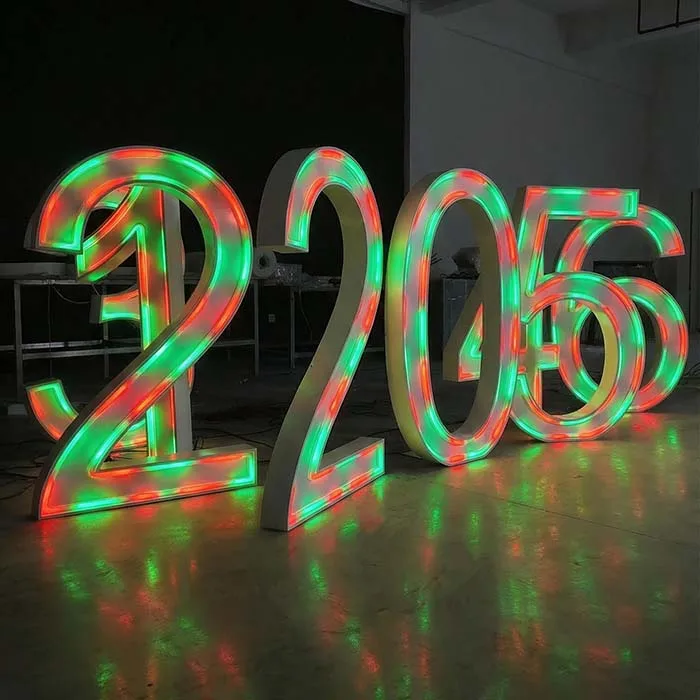
Real photo from our production floor — every sign we ship is made here.
From $24/letter · MOQ 1 piece · Flexible lead time · CE & UL certified · ships to 20+ countries
Custom sizes, colors, and finishes. Get a factory price in 24 hours.
Get a Free Quote Copy EmailWhatsApp +86 13865703472 · business@aochuangsign.cn
See pricing, specs, and get a free quote for the sign type you need. Built in our factory, shipped worldwide.