You're not comparing local fabricator vs China factory. You're comparing two different business models — and if you don't know which one actually saves you money, you'll lose it either way.
I've run a 3,000m² sign factory in Lu'an, Anhui since 2010. We export worldwide. And I've watched sign shops pay $800 for a front-lit letter that costs us $120 to build. But I've also seen importers burn $10,000 on a container of garbage that had to be scrapped. Neither side is all-good or all-bad. The difference is knowing which one solves your specific problem.
Here's what nobody tells you: most "local fabricators" in the US aren't actually fabricating. They're ordering from overseas too, then adding a 400% markup and a 3-day wait while they ship it from their warehouse. The ugly truth is that a lot of storefront installers are really just middlemen. They buy Chinese-made channel letters, add labor for installation and permits, and hand you a bill that looks like they welded it themselves. That's not necessarily a rip-off — you're paying for their liability, their site survey, their relationship with the inspector. But don't kid yourself about "local craftsmanship." So let's break down the real decision. Not emotions. Math and risk.Look, I'll be blunt. Our factory prices on front-lit channel letters run $20-80 per letter, FOB. Halo-lit goes $35-120. A US retail installer charges $200-700 per letter front-lit, and $400-1,000 halo. That's a 50-65% savings on product before shipping and tariffs.
But that $200-700 per letter usually includes installation, wall patching, electrical hookup, and someone to call when the third letter stops lit at 2 AM. You're not paying for the metal and LEDs. You're paying for accountability. And importing doesn't give you that. We can build you a perfect sign, but we can't climb a ladder in Ohio on a Tuesday night.
So the first honest question is: are you buying the product or the outcome? If you need a sign installed and permitted, you're buying the outcome. If you're a sign shop that does your own installation, you're buying the product. Different answers change the whole equation.
I've seen this go wrong: a business owner imported a beautiful 8-foot lightbox, saved $3,000, and then couldn't find anyone to install it. The local electrician refused because the sign wasn't UL-listed. A sign shop quoted $2,500 to "make it compliant" — which meant ripping out the power supply and re-wiring everything. Total savings gone.
That's the real value of a local guy: he knows the local code, pulls the permit, carries insurance, and answers his phone. For a custom sign that requires a site survey, a curved face, or a mounting system nobody's seen before, local is often the only sane choice. He can measure the actual wall, see the conduit layout, and adjust the design on the fly.
Also — and this matters — if a sign fails in month nine, local fixes it before you can file a shipping dispute. Our warranty is 2 years on LED and 1 year on power supply. But we're 7,000 miles away. A local guy can be there tomorrow. That's worth something real.
So I'm not here to trash local fabricators. A good one earns his markup with speed and service. But you need to know what you're paying for. If a local quote is 4x the factory price, ask him what's included. If he says "custom fabrication," ask to see his shop. If he hesitates, he's probably a reseller with a ladder.
Here's what nobody tells you about the better Chinese factories: we're not making junk. We run CNC routers with ±0.1mm tolerance, TIG weld stainless, and do 8-12 hour aging tests on every LED batch. Our stainless steel letters use 304 with 18% chromium and 8% nickel, not the 201 grade that rusts in two years. We've got CE, RoHS, ISO 9001, and we'll show you the certificates with today's date.
We're also obsessed with repeatability. If you order 200 letters today and 200 more next month, they'll match. Same material, same file, same process. A local shop might do that too, but they'll charge you twice the price because their overhead is higher.
And we handle scale. 50+ workers, a 3,000m² facility, and a production line that moves a 10-step process from design to packaging in about 5-15 days. We export worldwide. For a regional chain roll-out or a franchise refresh, a factory like ours is the only way to hit the quantity price point without selling your kidney.
We also know materials. Acrylic from Mitsubishi or Degussa hits 90-92% light transmittance and holds it for 5-8 years. Domestic acrylic goes yellow in 1-2 years. We specify that in every quote. LED modules from Samsung or Osram run L70 for 50,000+ hours. Cheap modules die in 12-18 months. You don't need to guess — you need to ask, and we'll answer.
Look, the import game has teeth. You're going to pay freight, customs clearance, broker fees, and the US Section 301 tariff — about 30% on many Chinese-made signs. Express shipping for small signs runs $30-100. Air freight $4-12/kg. Sea freight $80-200 per cubic meter for LCL, or $1,200-3,000 for a full container. Add in packaging and potential damage, and your "cheap" factory sign isn't as cheap as the first spreadsheet said.
You can still save 30-40% on landed cost compared to wholesale from a local manufacturer. That's real money. But if you don't build the tariff and freight into your quote, you'll be the one explaining to your client why the invoice went up.
There's also the compliance trap. If you're putting signs on commercial buildings in the US, you need UL 48 or ETL listing. True UL certification costs $4,000-15,000 and takes 4-9 months with quarterly factory audits. Most Chinese factories don't have it. ETL is 10-30% cheaper than UL and just as accepted by AHJs. But if a factory says "UL equivalent" — run. There's no such thing.
And don't overspec the hardware. IP65 is dust-tight and water jets from any direction — the minimum for outdoor signs. It will NOT survive a Florida hurricane. For coastal or industrial areas, go IP66 or IP68. That's not a marketing label, it's a test standard. We'll tell you what your site actually needs, not sell you the most expensive box.
I've seen it happen more times than I can count: an importer gets a container of channel letters, unloads them, and finds the acrylic faces are yellowed. The factory used domestic acrylic instead of Mitsubishi or Degussa. The cost difference is maybe 15% on materials. The visual difference is night and day.
How do you avoid that? You order a sample, and you specify the material brand by name. Not "quality acrylic" — that means nothing. Not "premium LED" — that means nothing. You write "Samsung 2835, 100-150 lm/W" on the PO. You write "304 stainless, 1.2mm, brushed #4 finish" on the PO. Then you hold us to it.
The ugly truth is that some factories will sell you a gold-plated prototype and ship you a tin-plated mass production run. That's why we do a 100% QC inspection before packaging. We also invite third-party inspectors to watch the 8-12 hour aging test. We send timestamped videos to clients who ask. Any factory that refuses that is hiding something.
Here's another one: ask about the power supply. We use quality transformers with overload protection. Cheap power supplies cost $4 and fail in six months. Good ones cost $15 and last 5 years. Your sign is only as good as the power supply, and that's not fancy talk — that's the part that burns up and voids the warranty.
Use local when: the sign is a one-off, the site needs a survey, the installation is trickier than a flat wall, the project is under $3,000, or you need it in under three weeks. Deadlines don't survive ocean freight.
Import when: you're ordering multiple signs, you have installers in-house, you can wait about 5-15 days production plus shipping, and the design fits standard manufacturing. Our back-lit halo letters and dual-lit channel letters are perfect for that — premium looks without custom hand-fabrication costs.
And if you're a sign shop that's already installing — importing gives you a 50% product margin while you keep the installation margin. That's the secret of the industry's most profitable shops. They don't choose local OR import. They choose local for the weird custom stuff and import for bread-and-butter letters that don't need an art degree to build.
Here's what we can do: manufacture premium channel letters, metal letters, acrylic light boxes, neon flex signs at prices that make sense for volume. We'll send you samples. We'll show you our production line on a video call. We'll give you a real lead time and hit it. We'll honor our warranty on materials and construction.
Here's what we can't do: install your sign, pull a permit in Austin, Texas, or fix an electrical issue caused by building wiring. We're a factory, not a service company. If you need a white-glove local crew, hire a sign shop. You're not a match for us. No hard feelings.
But if you're a sign shop owner, a contractor, or a business buyer who knows what they want and can manage logistics, we're a damn good partner. Send us your dimensions, your artwork, and the install environment. We'll tell you honestly if our product makes sense, and if it doesn't, we'll tell you that too.
Look, this industry runs on trust and parts per million. The local guy earns his markup with service. The factory earns its price with scale and precision. Both can make you money. Both can burn you. The difference is knowing what you're actually buying — and who's accountable after the invoice is paid. Now go get your sign built.

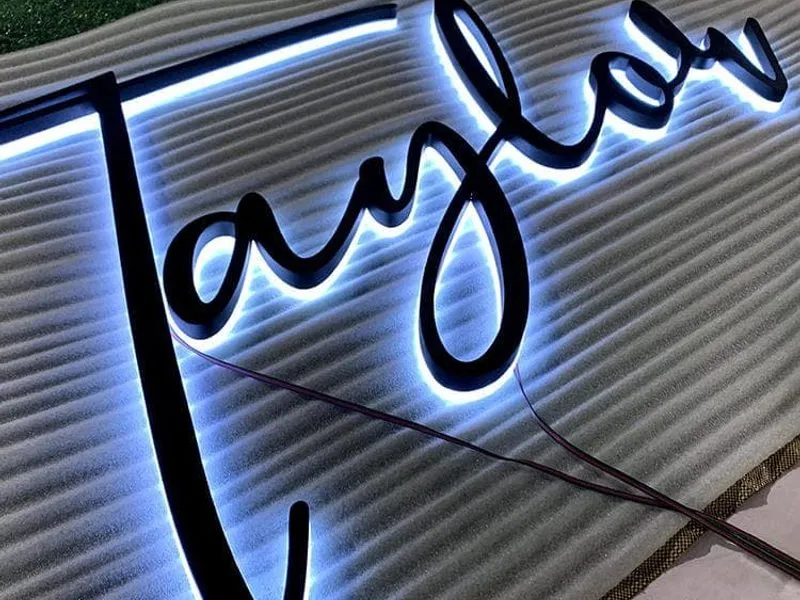
Real photo from our production floor — every sign we ship is made here.
From $24/letter · MOQ 1 piece · Flexible lead time · CE & UL certified · ships to 20+ countries
Custom sizes, colors, and finishes. Get a factory price in 24 hours.
Get a Free Quote Copy EmailWhatsApp +86 13865703472 · business@aochuangsign.cn
See pricing, specs, and get a free quote for the sign type you need. Built in our factory, shipped worldwide.