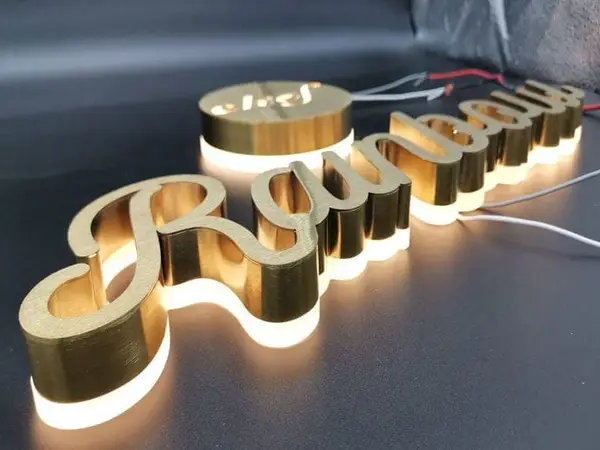
I've watched sign shops pay $800 for a front-lit letter from a domestic fabricator. Same 304 stainless, same Samsung LEDs. We ship that letter for $120.
That's not a sales pitch. That's the difference between buying from a factory that owns its laser cutter and a middleman who owns a truck. I've been on the factory floor since 2010. I've burned my hands on hot acrylic and argued with suppliers about LED quality. Here's what nobody tells you: most metal sign failures happen before the first cut. Wrong alloy. Wrong thickness. Wrong prep. You can't polish your way out of a bad material decision.
Aluminum, stainless, brass. Three different animals. If a supplier tells you they're interchangeable, they're clearing inventory.
Look, aluminum signs: weight one-third of steel, 8-12 year outdoor life if powder coated, naturally rust-proof. Common thickness runs 1.0 to 1.6mm. We cut it, bend it, and it ships cheap. If you're ordering a 304 stainless steel letter for a strip mall in Ohio, you're overpaying for a material that'll outlive the lease.
Stainless 304 is the workhorse: 10+ year outdoor life, 18% chromium, 8% nickel, 7.93 g/cm³. Thickness 1.0-3.0mm. Finishes from brushed #4 to mirror #8 to PVD.
Ugly truth: 316 stainless costs 20-30% more than 304. It has 2-3% molybdenum. That's what lets it survive salt air. I've seen this go wrong: a customer put 304 letters on a Miami Beach restaurant. Three years later, pitting. They would've spent 25% more for 316 instead of paying double to replace.
Brass and copper? Warm classic look. You can't fake that with paint. Brass & copper letters age, but that's the point—if you let them.
Cost check: aluminum letters run $10-25 per letter from the factory. Stainless non-lit $15-40. Brass and copper? Higher. If a quote comes back at $300 for a 12-inch aluminum letter, someone's marking up 10x.
Laser cutting gets ±0.1mm. That's not a brochure number. That's what I set the machine to in the morning and it holds until I leave.
Waterjet is for thick plate. Punching is for volume. Bending is where rookies screw up. You can't just fold 1.6mm aluminum like paper. Springback changes with every batch.
Here's the thing about laser cutting 1.0mm stainless: it's fast, but if your file has open paths, the whole sheet is scrap. We check the DXF before the beam fires.
Punching is great if you're doing 200 identical blanks. The die setup is the cost; after that it's pennies per hit. For one-offs, laser wins every time. Waterjet? Only if you're cutting 6mm plate and laser heat is warping the edge.
After cutting, we TIG weld. That's 1-2 days for most letter sets. Then grinding and polishing, another 1-2. Not glamorous. Loud. But that's how you get crisp returns without visible weld seams.
Skip degreasing and powder coat peels off in sheets. I've had to redo a whole batch because a new guy wiped aluminum with a dirty rag.
Degreasing, abrasive blasting, pretreatment. Three steps that decide whether your sign lasts 5 years or 15. Oil from your hands, mill scale, oxidation—all invisible until they fail.
For powder coat, the metal has to be bone dry and slightly etched. That's why we run it through a wash line, not a bucket.
Abrasive blasting gives the powder coat a mechanical bite. If you skip it on new steel, the finish looks fine for a year, then rust blooms under the coating.
If you're doing baked paint letters, the prep is the same. The paint is only as good as what's underneath.
Screen printing is cheap until you need three colors. UV digital gives you gradients and photos, but direct UV on metal without a primer? Two years and it flakes.
Powder coating is the standard for outdoor metal signs. We spray a thick electrostatic shell and cure it in an oven. We do any RAL color via baked paint — same idea, different binder.
Nobody warns you: mirror-polished letters are gorgeous for six months. Then someone touches them and the fingerprint becomes a permanent fixture. If you want mirror #8, order a clear coat or don't complain about maintenance.
Gold and chrome via electroplating? Looks like money, costs like money. But if your client's brand is luxury, it's the only thing that reads 'expensive' from 50 feet.
UV digital is perfect for prototypes. You want a full-color logo on a sample? One day. But UV inks on metal need a clear coat or they die in the sun.
Look, IP65 sounds impressive. It means water jets from any direction. It does NOT mean your sign survives a Florida hurricane. I've had customers ask for IP68 for a wall sign in Arizona. Waste of money.
Our 10-step process ends with 8-12 hours of aging test and 100% QC inspection. Every letter. Not batch samples. Every single one. That catches dead LED modules before they hit a crate.
CE marking costs 20,000-50,000 RMB. Most factories will say they have it. Ask to see the certificate with today's date. Watch them sweat. I've seen certificates with expired dates and mismatched company names.
QC tolerance for edge burr: if your finger catches on an edge, it's scrap. Warp over 1mm on a 1-meter letter? Scrap. Coating adhesion? Crosshatch test and tape pull. You can't fake that.
We're CE, RoHS, and ISO 9001 certified. Those aren't stickers. They mean our line gets audited, not just talked about.
MOQ is one piece. One. Not 50. I've seen factories tell clients 50 piece minimum because they don't want to switch tooling. That's not an MOQ, that's a brush-off.
Our lead time is about 5-15 days. Design confirmation takes 1 day. Laser cutting 1-2. Bending and welding 1-2. Grinding and polishing 1-2. CNC acrylic face 1 day if it's lit. LED assembly 1-2. Sealing 1 day. Aging test 8-12 hours. Full QC. Export packaging with foam, carton, and plywood crate. That's the whole dance.
Factory-direct pricing: stainless non-lit letters $15-40 per letter. 3D fabricated $40-120. Aluminum $10-25. US retail installed for the same front-lit letter? $200-700. Halo-lit? $400-1,000. I've watched sign shops pay $800 for a front-lit letter. We ship that letter for $120. The savings are 50-65% on product, before you add shipping and the Section 301 tariff around 30%.
Sea freight takes about 65 days. LCL: your crate gets handled 6-8 times between our dock and yours. Every touch is a chance for damage. That's not in the brochure. Air freight is about 10 days at $4-12/kg. Express is about 5-15 days at $30-100 for small pieces. If you need a cast aluminum or bronze sign for a lobby, don't wait until the week before install.
Warranty? 2 years on LED, 1 year on power supply. Those are the parts that fail. The metal won't.
You want a prototype before committing to 20 storefronts? We'll do one piece. That's the point of MOQ 1. Take it, install it, photograph it. Then order the rest.
Q: Can you do one custom sign?
Yes. MOQ is one piece. I don't know where this 50-piece minimum myth came from. If a factory says that, they don't want your job.
Q: How long will my sign last?
Aluminum: 8-12 years. 304 stainless: 10+. 316: 15+ in marine conditions. LED: L70 ≥50,000 hours. But cheap LED modules die in 12-18 months. The biggest variable is the LED, not the metal.
Q: Is IP65 enough for outdoors?
IP65 is minimum. It means dust-tight and water jets from any direction. It does not mean submersible, hurricane-proof, or idiot-proof. For coastal, go IP66.
Q: Why is my factory-direct quote so much cheaper?
Because you're not paying for a domestic fabricator's truck fleet, showroom, and sales guy's golf membership. Factory-direct savings are 50-65% on product. Then add tariff and shipping. Do the math.
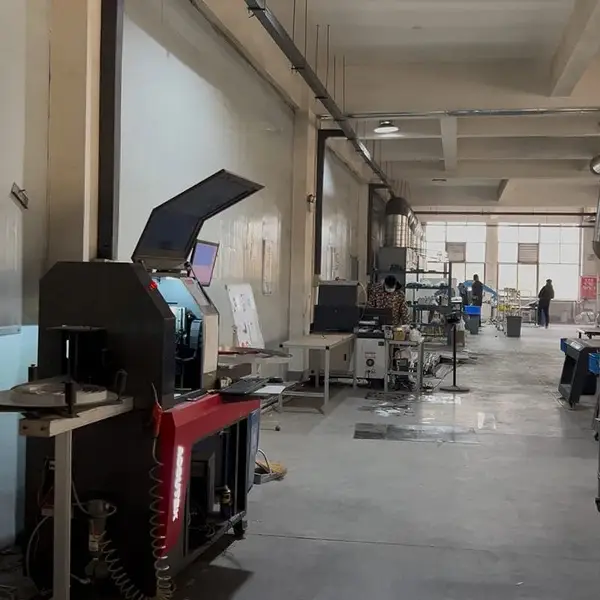
Real photo from our production floor — every sign we ship is made here.
Products mentioned or relevant to this topic — factory-direct, custom built.
From $24/letter · MOQ 1 piece · Flexible lead time · CE & UL certified · ships to 20+ countries
Custom sizes, colors, and finishes. Get a factory price in 24 hours.
Get a Free Quote Copy EmailWhatsApp +86 13865703472 · business@aochuangsign.cn