I've watched a strip mall owner drop $18,000 on a monument sign that started peeling paint in year two. Same letters, same 304 stainless, same Samsung LEDs, from a factory like ours would've been about $6,400 in product. That's the gap. This article is what I'd tell you over a beer after a long day on the floor — not a sales pitch.
Look, monument signs aren't rocket science, but they're the first thing a customer sees. If the letter finish is cheap, the whole business feels cheap. I've been at this since 2010. Our facility in Lu'an runs 3,000 square meters and 50+ welders, cutters, and finishers. We ship one sign or a hundred. MOQ is one piece, and lead time is 7 to 15 days. That's not a brag. It's just what the job requires.
A monument sign is a low-profile, ground-mounted structure. Not a pylon. Think bank branch, medical building, HOA entrance, industrial park. Core types: concrete/masonry base with metal letters, full metal cabinet, HDU foam with stucco, EIFS over steel frame, and stone or brick veneer. For the face, you're usually mounting front-lit channel letters or carved panels. If the sign is part of a larger campus, you'll need a matching wayfinding system, or it looks like an afterthought.
Here's where I see shop owners screw up. They pick a material because it looks good in a magazine photo, not because it survives their climate. Concrete and stone are the heavyweights — they'll last decades, but they're a pain to retrofit for lighting. Brick matches masonry buildings, but you need weeps and proper ties or it cracks. HDU foam is light and carves beautifully, but one hailstorm without mesh and you're patching. EIFS over steel is cheap and fast, but I've seen water get behind it in year three and turn it to mush.
Metal is what I default to. For letters on a monument base, 304 stainless gives you 10+ years outdoor life. 18% chromium, 8% nickel. 316 adds 2-3% molybdenum and gets you 15+ years in coastal or industrial air, but it's a 20-30% cost premium. Aluminum runs 8-12 years, weighs a third of steel, and won't rust. For a cast bronze or aluminum plaque, cast metal signs have that solid, substantial feel no painted panel can match. Stick with 304 unless you're within five miles of salt water. Paying for 316 in Ohio is like buying snow tires in Florida.
I've seen this go wrong: a fabricator quoted a cheap monument sign with a shallow footing because "it's only 8 feet tall." First winter frost heaved it half an inch. The letters looked like they'd been drinking. The fix cost triple the original install. Wind load isn't optional. Your local building department wants stamped calcs for a reason. I'm not an engineer and neither are you. Hire one. Footing depth below frost line, soil bearing capacity, and sign weight all change foundation design. Aluminum weighing a third of steel can reduce footings, but not enough to skip engineering.
NEC Article 600 governs the electrical. ADA requires tactile signs mounted 48-60 inches with non-glare finish and Grade 2 Braille. UL 48 certification runs $4,000-15,000 and takes 4-9 months. CE is 20,000-50,000 RMB. If a factory says they have CE, ask for the certificate with today's date. Watch them sweat.
Here's what nobody tells you: LED quality is the difference between a sign that looks crisp for five years and one that's half-dead in eighteen months. SMD 2835 modules at 100-150 lumens per watt are the industry standard. SMD 5050 handles RGB. SMD 5730 pushes 40-60 lumens per chip — highest brightness, but hotter. Cheap modules from no-name suppliers last 12-18 months, period. Quality ones from Samsung, Osram, or Blueview go 5+ years. L70 rating matters: 50,000 hours before light output drops to 70%. LED warranty is 2 years; power supply is 1 year.
For monument sign faces, you're usually choosing between push-through acrylic letters and back-lit halo letters. Halo is architectural, expensive, looks sharp at night. Push-through is more even. If you're using acrylic, a 3mm face cuts 92% light output and a 2mm face cuts 90%. Your customer won't notice the 2%, but they will notice the 40% cost bump. Color temp: 3000-3500K warm for hospitality, 4000-5000K neutral for corporate, 6000-6500K cool for industrial or highway. Solar is viable for remote monument signs, but you'll need local sunlight data and battery sizing. Don't expect a $50 solar panel to run a 50-watt sign through a Midwest winter.
The ugly truth is IP65 sounds impressive. It means water jets from any direction. It does NOT mean your sign survives a Florida hurricane. Coastal? IP66. Submersible or extreme weather? IP68.
The ugly truth is most sign buyers overpay for domestic fabrication and underpay for engineering. Factory prices for letters: front-lit channel letters run $20-80 per letter, back-lit halo $35-120, stainless non-lit $15-40, 3D fabricated $40-120, aluminum $10-25. Light boxes are $80-250 per square meter. US retail installed for front-lit is $200-700 per letter, halo $400-1,000. Factory-direct saves 50-65% on product. That's not a coupon; that's the actual gap.
Here's what nobody tells you: import costs don't stop at the invoice. Section 301 tariff on US imports is roughly 30%. A $120 stainless letter becomes $156 before freight. Express shipping runs $30-100 for small parcels and arrives in about 5-15 days. Air freight is $4-12/kg and takes about 10 days. Sea freight is $80-200 per cubic meter LCL and takes about 65 days. That $120 letter by sea might land at $170 total. Still half of US retail. The monument base or cabinet is usually built locally because shipping a big concrete block is stupid. But the letters and faces? Import those.
I've seen this go wrong: a contractor ordered sea freight without plywood crating to save $50. LCL freight gets handled 6-8 times between our dock and yours. The letters showed up looking like they'd been through a bar fight. Pay for the crate. It's foam, carton, then plywood. That's standard for a reason.
We run a 10-step process from design confirmation to export packaging. Design confirmation: 1 day. Laser cutting at ±0.1mm: 1-2 days. Bending and TIG welding: 1-2 days. Grinding and polishing: 1-2 days. Acrylic face CNC: 1 day. LED assembly: 1-2 days. Sealing with neutral silicone: 1 day. 8-12 hour aging test. 100% QC inspection. Export packaging. Total: about 5-15 days. MOQ is one piece, so you can order a single replacement letter without a sob story.
For installation, coordinate the base and letters separately. Have your local engineer sign off on footings. Wire to NEC Article 600. If you're mounting stainless steel letters on a brick monument, use stainless anchors, not drywall screws. Check the UL and CE certs from your factory. Most factories say they have them. Ask to see the documents with today's date.
Q: How much does a monument sign cost?
A: Depends. Quit asking for a ballpark that becomes a contract. Letters? Factory front-lit $20-80 per letter. That's product, not installed. Add freight, tariff, local install, engineering. If you can't spec it, you can't price it.
Q: Do I need a permit for a monument sign?
A: Yes. Always. NEC Article 600 for electric, local building department for structure, ADA for tactile if required. "My cousin knows a guy" is not a permit. I've seen unpermitted signs ordered removed at the owner's expense.
Q: What material should I use for a coastal area?
A: 316 stainless. 15+ years marine grade. It's 20-30% more than 304. If you use 304 within sight of salt water, you'll be replacing letters in three years. I've seen it. Don't argue with the ocean.
Q: Can I install it myself?
A: You can also pull your own teeth. But I've seen DIY monument signs blow over because the footing was a Home Depot post hole. Hire a licensed contractor. The liability isn't worth the $2,000 you save.

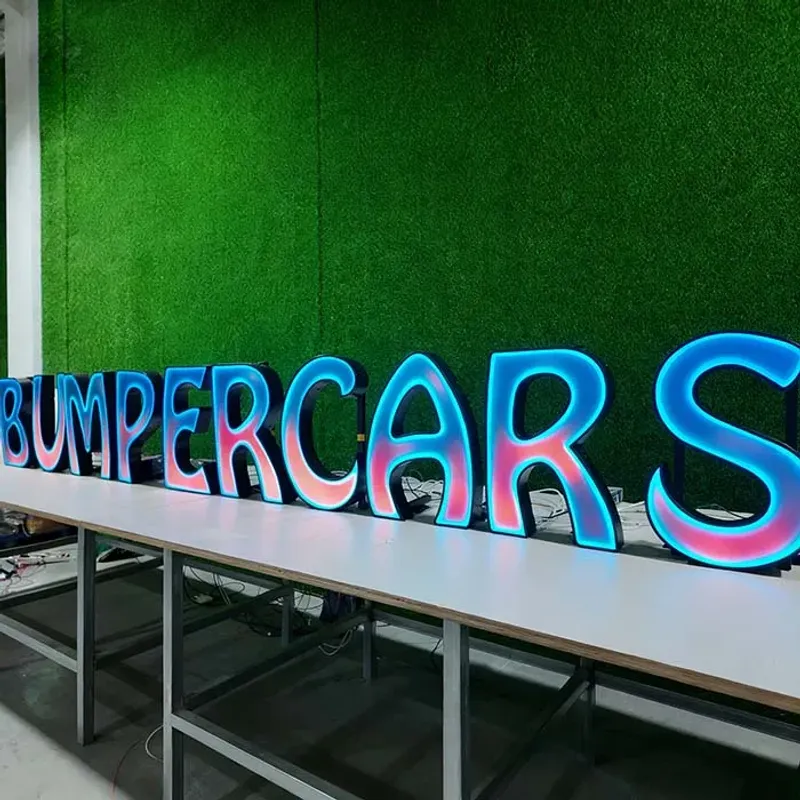
Real photo from our production floor — every sign we ship is made here.
Products mentioned or relevant to this topic — factory-direct, custom built.
From $24/letter · MOQ 1 piece · Flexible lead time · CE & UL certified · ships to 20+ countries
Custom sizes, colors, and finishes. Get a factory price in 24 hours.
Get a Free Quote Copy EmailWhatsApp +86 13865703472 · business@aochuangsign.cn