I lost a $12,000 order last month because a shop down the street undercut me by 60 percent.
They didn't have to build a thing—they had an OEM factory in Lu'an doing it for them. And they weren't buying garbage. Same 304 stainless, same Samsung LEDs. We ship that letter for $120. The other guy charged $800 installed.
That's what OEM signage does to your margins.
Look, if you're not using OEM signage, you're either overpaying or lying about your production capacity. I've been on a factory floor since 2010, and I've watched shop owners finally catch on after the third time a client asks for 50 letters and they quote eight weeks because they're hand-fabricating everything in a two-car garage.
OEM signage is when a factory builds the sign and you put your name on it. That's it. You can private label it, white-label it, or call it your own custom fabrication.
A real OEM partner does more than cut acrylic. The shop I work with operates a 3,000 square meter facility with 50-plus skilled workers, and they still take orders of one piece. That's rare.
Most factories won't answer the phone for less than 50 units. They're set up for injection molding, not laser cutting. Our laser cutting tolerance is ±0.1mm, so a one-off custom letter doesn't need a $2,000 mold. It just needs the file.
If a factory demands a 50-piece minimum for standard channel letters, that's not an OEM partner. That's a production house that wants to fill a container, not build your brand.
Nobody tells you this: the OEM model works because the factory already has the materials, certifications, and labor. You're not paying for their name. You're paying for the 10-step production process that takes 7 to 15 days, then slapping your own nameplate on the crate.
Look, if you're buying front-lit channel letters from a domestic wholesaler, you're paying $200-700 per letter installed. The factory price for that same letter? $20-80. That's not a typo. That's three layers of markup between the factory floor and the sign shop counter.
Then you've got back-lit halo letters, the architectural look that architects drool over. Factory price $35-120 per letter. Retail installed jumps to $400-1,000. You can see the margin right there.
If the client wants metal, use 304 stainless. Factory non-lit letters run $15-40. Grade matters. 304 has 18% chromium and 8% nickel, good for 10+ years outdoors. Step up to 316 for coastal jobs and you add 2-3% molybdenum, which costs 20-30% more but stops pitting in salt air. I've replaced 304 letters near Miami Beach after three years because someone tried to save twenty bucks.
For indoor or lightweight projects, acrylic LED letters are $10-25 per letter factory-direct. Don't spec 5mm acrylic on a 2-foot letter unless you want to pay 40 percent more for a 2 percent light transmittance bump. A 3mm face cuts 92% light output; a 2mm face cuts 90%. Your customer won't notice the difference, but they'll notice the invoice.
Use cases? Storefronts want front-lit. Office lobbies want halo. Hospitals want durable non-lit stainless. Bars want RGB. This isn't complicated until you let a designer talk you into six materials on one sign.
Heads up: CE marking costs 20,000-50,000 RMB. Most factories will say they have it. Ask to see the certificate with today's date. Watch them sweat.
Acrylic is acrylic until it yellows. UV-resistant acrylic from Mitsubishi or Degussa lasts 5-8 years outdoors. Domestic cheap acrylic starts yellowing in 1-2 years. Both hit 90-92% light transmittance on day one. The real difference? You'll be re-facing that sign in 18 months.
Finishes matter more than thickness. 304 stainless comes in brushed #4, mirror #8, PVD, or powder coated. Aluminum is naturally rust-proof and weighs one-third of steel, so 1.0-1.6mm sheet stock typically lasts 8-12 years outdoors. If you don't know which finish to use, you shouldn't be quoting the job.
Then compliance. IP65 means dust-tight and protected from water jets. It won't survive a Florida hurricane. That's the ugly truth. IP66 handles powerful jets, IP68 is submersible—only for extreme weather or marine. And if you're selling in the US, NEC Article 600 applies to the electrical, not the sign body. Your OEM partner should know this without you explaining it.
White-labeling isn't just a sticker on the back. The packing slip, the crate markings, the warranty card, and the instruction sheet all bear your brand. The shop I work with will run a single unit with your logo on the box and your client's name on the packing slip. MOQ is one piece. If a factory tells you white-labeling requires a 500-piece run, they're lying or lazy.
Customization starts with the file. Send us the client's vector logo. We cut it. 3D fabricated letters use a 10-step process: design confirmation, laser cutting, bending and TIG welding, grinding and polishing, CNC acrylic face, LED assembly, silicone sealing, an 8-12 hour aging test, 100% QC inspection, then export packaging. That's not proprietary; it's just work.
Tooling ownership is where rookies get burned. If a factory builds a jig or fixture for your custom shape, you own the CAD file and the physical tooling. Get it in writing before you pay. If they won't put it in the NDA, walk. I've watched sign companies lose their entire product line to a factory that sold their design to a competitor.
Cheap LED modules die in 12-18 months. Ugly truth. SMD 2835 chips from Samsung, Osram, or Blueview last 5+ years with an L70 of at least 50,000 hours. The difference? Solder joints. Dull gray solder means the factory skipped proper lead-free solder. Shiny silver is what you want.
Ask about the aging test. Every sign should run 8-12 hours on the bench before it ships. If they skip that, the first heat cycle in your client's parking lot will reveal dead diodes and you'll eat the warranty replacement. We run every unit through 100% QC inspection, and we warranty LEDs for two years and power supplies for one. That's the minimum.
Another rookie mistake: accepting a sample without asking if the production run uses the same components. Some factories send you a sample with Samsung LEDs and then ship the order with no-name chips because the BOM wasn't locked. Lock the BOM in writing.
I've seen this go wrong: a buyer orders 200 letters, gets quoted $4-12/kg for air freight, forgets the US Section 301 tariff is roughly 30 percent, and then their landed cost is higher than domestic. Do the math before you wire a cent.
A decent OEM shop produces in about 5-15 days. Then shipping: express takes about 5-15 days for $30-100 on small parcels, air freight about 10 days at $4-12/kg, sea freight about 65 days at $80-200 per cubic meter LCL or $1,200-3,000 for a full container. LCL means less-than-container load, and handlers touch your crate 6-8 times between our dock and yours. Every touch can damage it. That's not in the brochure.
Total cost of ownership isn't the unit price. Add freight, tariff, customs broker, possible damage claim, and the two months you waited. If you're buying front-lit channel letters at $40 each but paying $35 each in freight and tariff, you saved nothing. Run the landed cost per letter, not the factory quote.
Look, any factory with an MOQ of one piece, a 7-15 day lead time, and CE, RoHS, and ISO 9001 certifications is built for OEM. If they quote you eight weeks and a 100-unit minimum, they're not a partner.
Start with a sample order. One sign, your logo, your specs. It'll cost you a few hundred dollars and about three weeks door-to-door, and it'll teach you more than a hundred emails. Then ask for the QC report from that exact sample—not the template, the one with the date and the inspector's initials.
UL 48 certification in the US runs $4,000-15,000 and takes 4-9 months with quarterly audits. If a factory says they're UL listed, ask for the file number and check it on UL's website. If they say "we use UL components," that's not a listed sign. Don't let a client find that out during an electrical inspection.
Onboarding doesn't end with the first payment. Lock down the BOM, the tooling ownership clause, the NDA, and the warranty terms. Then order like you mean it. The factory-direct model works because you control the brand, the specs, and the margin. Everything else is just metal, acrylic, and LEDs.
Q: Do I need UL 48 for every sign I sell in the US? A: If it's electric and going on a commercial building, maybe. NEC Article 600 says electric signs need to be listed. UL 48 costs $4,000-15,000 and takes 4-9 months. If you're doing one-off residential, you might get away with an ETL sticker, which runs 10-30% cheaper. But don't assume. Ask your local inspector, not the factory sales rep.
Q: Why is sea freight so slow? A: Because it's a boat on the ocean. LCL crates pass through 6-8 sets of hands, sit in ports, and clear customs. about 65 days is normal, not an exaggeration. If you need it fast, pay for air freight and stop complaining.
Q: Can you match my client's exact RAL color? A: Yes, baked paint can hit any RAL color. But don't expect the paint to match the Pantone swatch you saw on a phone screen. Give us the RAL code, not a photo of a wall at dusk. Rookies send photos and then wonder why the letters look different under LED lighting.
Q: What's the real lead time? A: about 5-15 days production if nothing goes wrong. Then shipping on top. If you approved a design on a Friday after three rounds of changes and expect it Monday, that's not lead time, that's fantasy.

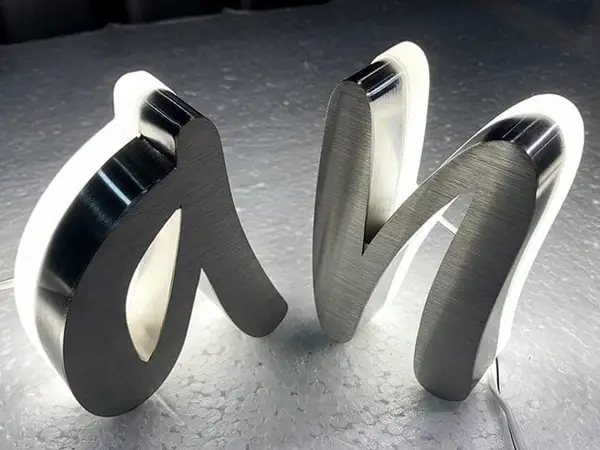
Real photo from our production floor — every sign we ship is made here.
Products mentioned or relevant to this topic — factory-direct, custom built.
From $24/letter · MOQ 1 piece · Flexible lead time · CE & UL certified · ships to 20+ countries
Custom sizes, colors, and finishes. Get a factory price in 24 hours.
Get a Free Quote Copy EmailWhatsApp +86 13865703472 · business@aochuangsign.cn