I got a call last week from a shop in Phoenix. Their channel letter job—installed fourteen months ago—was already flickering. They paid $6,200 for twenty letters, back-lit halo, 304 stainless. Sounded like a deal. Until the LEDs started dying in waves. They bought cheap. They bought twice. That's the ugly truth of this business: you don't save money cutting corners on wholesale channel letters—you just push the cost down the road. I've been on the factory floor since 1997. I've watched good shops go under trying to save two bucks per letter. I'm going to tell you exactly where the trade-offs live, what hurts you, and what's just noise.
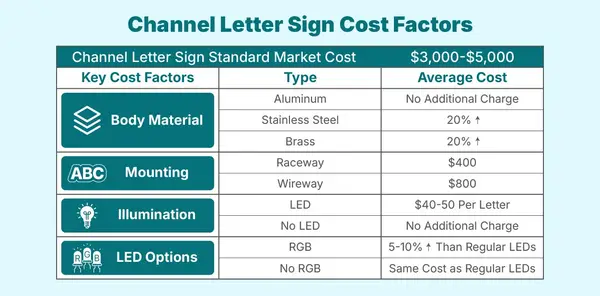
Here's what nobody tells you: that $200-per-letter front-lit sign you see from a domestic fabricator? It's not magic. It's markup. Same 304 stainless steel. Same Samsung LEDs. Same 3mm acrylic. We ship that letter for $120—factory direct, out of Lu'an, China. That's one number you need to memorize: factory-direct pricing on front-lit channel letters runs $20 to $80 per letter. Back-lit halo jumps to $35–$120. Stainless non-lit is $15–$40. That $200 you're paying? The middleman takes the rest.
But price alone is a trap. I've watched sign shops pay $800 for a front-lit letter from a domestic fabricator. Same 304 stainless, same Samsung LEDs. We ship that letter for $120. The difference? The domestic guy bought from me. Marked it up 150%. Then sold it to you. You're paying for his real estate, his sales guy, his three coffee breaks. I'm not saying go factory-direct for everything. But if you're paying more than $80 per letter for a basic front-lit, somebody's getting rich on your ignorance.
The ugly truth is, the real cost isn't in the steel or the LEDs. It's in the joints. It's in the sealing. It's in the aging test. I've seen a $25 letter from a back-alley shop that looked identical to a $60 letter from a reputable factory. Look at the solder joints on the LEDs. Dull gray = won't last 18 months. Shiny silver = proper lead-free solder. That's the first place cheap factories save money—and it's invisible until the sign goes dark.
Acrylic is the easiest place to get burned. Domestic acrylic from Mitsubishi or Degussa—the good stuff—gives you 90–92% light transmittance and UV resistance that holds for five to eight years. The cheap stuff? You get one to two years before it yellows. I've seen it: a beautiful white face turned the color of old newspaper in eighteen months. The factory saved maybe $0.50 per square foot. The sign owner paid $3,000 to remanufacture. So when a supplier quotes you $12 per letter on acrylic faces, ask: "What brand?" If they don't name Mitsubishi or Degussa, walk.
Stainless steel is another minefield. 304 stainless has 18% chromium, 8% nickel—good for ten-plus years in normal outdoor conditions. 316 adds 2–3% molybdenum, making it marine grade for coastal or industrial areas. 316 costs 20–30% more than 304. For a strip mall in Ohio, 304 is fine. For Miami Beach, pay for 316 or you're replacing letters in three years. I've seen this go wrong: a shop bought "316 stainless" from a no-name supplier. Three years later, the letters are pitting. Why? The supplier swapped 201 grade—half the nickel content, no molybdenum. The letter looked the same. Cost 40% less. Failed in three years. You can't test for alloy in the field. You have to trust the mill certificate—or buy from a factory that won't risk its reputation to save $3 per letter.
Aluminum? Light—about one-third the weight of steel. Anodized or powder-coated, it lasts eight to twelve years outdoors. Aluminum channel letters from our factory run $10–$25 each. Great for temporary jobs or interior signs. But don't put aluminum on a storefront in a coastal zone unless it's powder-coated properly. Aluminum is naturally rust-proof, but the coating fails if the prep work is shoddy. I've watched an aluminum sign corrode under the paint because the factory skipped the phosphate wash. Saved thirty minutes of labor. Cost the customer the whole sign in four years.
Look, LEDs are the heart of a channel letter. And there's a 50,000-hour lie floating around the industry. That's the L70 rating—the point at which the LED has lost 30% of its brightness. Quality modules with Samsung or Osram chips—or Lan Jing a good supplier—will actually reach that. Cheap modules? You'll hit 70% brightness in twelve to eighteen months. Then the sign looks dim compared to the Starbucks next door. Then the owner calls you, blaming your installation.
Here's a hard fact: SMD 2835 chips deliver 100–150 lumens per watt—the industry standard for channel letters. SMD 5050 handles RGB. SMD 5730 gives 40–60 lumens per chip, highest brightness you'll get in a standard module. Any factory that can't tell you which chip they're using is selling you garbage. And the difference in cost? About $0.20 per module. That's $2–$4 per letter. The wholesale price for our front-lit letters includes Samsung modules. The cheap competitor's price? Also includes "LEDs"—but you'll replace them in eighteen months.
I've watched sign shops pay $800 for a front-lit letter from a domestic fabricator. Same 304 stainless, same Samsung LEDs. We ship that letter for $120. I've also watched a shop buy $40 LED modules from a Chinese supplier on Alibaba—and then spend $200 on labor replacing them a year later. The real cost of cheap LEDs isn't the purchase price. It's the truck roll. It's the lift rental. It's the pissed-off client who won't pay your invoice until the sign works.
The ugly truth is that IP65 ratings on LED modules don't mean much. IP65 means dust-tight and water jets from any direction. That's the minimum for outdoor use. It does NOT mean your sign survives a Florida hurricane. For coastal or extreme weather, you need IP66 (powerful jets) or even IP68 (submersible). Most channel letter factories use IP65 as default. Ask your supplier: "What's the ingress protection on the modules?" If they don't know, they're using whatever they can get cheapest.
Here's what nobody tells you: that UL certification on your sign? Half the factories you're buying from don't actually have it. They slap a label on. UL 48 costs $4,000–$15,000 per model, takes four to nine months, and requires quarterly audits. Most Chinese factories won't bother. Instead, they print "UL Listed" on the box. If a supplier tells you their sign is UL certified, ask to see the certificate—with today's date. Watch them sweat. The smart move is to use ETL as a UL alternative. It's 10–30% cheaper, same safety tests, accepted by most inspectors. But if the sign must be UL-labeled for the job, buy from a factory that actually holds the listing—not one that stamps it on the back.
CE marking? Costs 20,000–50,000 RMB, about $3,000–$7,000 for a full certification. Most factories will say they have it. Ask to see the certificate—again, with today's date and the product model number. If they show you a PDF from 2018, that's for a different product. CE doesn't automatically transfer to every sign you make. It's per model or per type of assembly.
NEC Article 600 covers electric signs in the US. That's where the inspector will look for proper wiring, grounding, and conduit. If your letters aren't built to NEC 600, you'll fail inspection. Period. And ADA compliance? Tactile signs need to be mounted 48–60 inches above the floor, non-glare surface, Grade 2 Braille. That's for interior wayfinding, not channel letters. But I've seen shops get hit with ADA violations on a lobby sign that was ordered as "ADA-compliant" but had zero tactile features. The fine is worse than the replacement cost.
LCL sea freight: your crate gets handled six to eight times between our dock and yours. Every touch is a chance for damage. That's not in the brochure. The factory packs it with foam, a carton, and a plywood crate. But when the crate sits in a port for three weeks in the rain, then gets forklifted into a truck, then dropped on a dock—things happen. Air freight costs $4–$12 per kilogram and takes ten to twenty days. Sea freight takes fifty to seventy days and runs $80–$200 per cubic meter for LCL. A full container of channel letters? $1,200–$3,000. That's the cheapest way to go, but you're tying up your cash for two months.
Here's the part everyone forgets: US Section 301 tariffs add about 30% to the product cost. That's not optional—it's applied at customs. So that $120 letter from the factory becomes $156 after tariff, plus freight. Still cheaper than $200 domestic, but not the screaming deal you thought. If you're ordering, plan the tariff into your pricing. Don't get surprised at the broker's invoice.
I've watched sign shops pay $800 for a front-lit letter from a domestic fabricator. Same 304 stainless, same Samsung LEDs. We ship that letter for $120. But if you order five letters on air freight, you're paying maybe $60 in tariff and $80 in shipping. That's still $260—less than
Products mentioned or relevant to this topic — factory-direct, custom built.
Factory-direct since 2010. Free quote within 24 hours — no obligation.
Get a Free Quote →MOQ: 1 piece · 7-15 days · 2-year warranty · Worldwide shipping
See pricing, specs, and get a free quote for the sign type you need. Built in our factory, shipped worldwide.