I’ve spent 16 years on concrete floors, smelling burning acrylic and arguing with LED suppliers who think 50 lumens per watt is “good enough.” That’s not a brag. It’s a warning. Because when you order custom channel letters online from some glossy website with stock photos and a 1-800 number, you’re probably paying a reseller who’s never seen a TIG welder. They’ll charge you $600 per letter, then email a real factory like mine and mark it up 300%. I know because they’ve been emailing us for a decade.
We’re Aochuang Sign, in Lu’an, Anhui. 3,000 square meters of production space. 50+ workers who’ve been doing this longer than most sign shops have been in business. Founded 2010, we’ve shipped worldwide, from a tiny coffee shop in Oslo to a casino facade in Macau. You can order direct, and you should. But you should also know what you’re actually buying. That’s what this guide is — no marketing fluff, just the stuff I tell customers on a Tuesday morning after my second coffee.
Here’s what nobody tells you: 70% of the channel letters sold online to small sign shops come from factories cutting corners on three things. LED quality. Metal thickness. And weather sealing. The result? A sign that looks gorgeous on install day and burns out in 18 months. I’ve replaced enough of them to know the pattern.
Look, a $45 front-lit letter can be built two ways. With SMD 2835 modules from a no-name Shenzhen supplier that might hit 80 lumens per watt on a good day, and domestic acrylic that starts yellowing in 12 months. Or with Samsung LEDs at 100-150 lm/W and Mitsubishi UV-resistant acrylic that lasts 5-8 years before it even thinks about fading. The first letter will cost you $45. The replacement will cost you a truck roll, an angry client, and your reputation. You do the math.
The ugly truth is, a lot of buyers don’t even ask. They see a low factory price and hit “order.” Then six months later, their client calls about half the sign being dim. Cheap power supplies with electrolytic capacitors that dry out in a year. I’ve seen this go wrong: a contractor ordered 120 front-lit letters for a retail chain, saved $45 per letter upfront, and paid $22,000 in labor to refit them two years later. All because the factory used LED strips rated for 30,000 hours instead of the 50,000-hour L70 we spec as standard.
That’s why I’m writing this. You can order factory direct and save a bundle — 50-65% versus US retail installed prices is real — but you need to know what to demand. And you need a factory that’ll tell you when you’re about to make a dumb move. Like ordering 2mm acrylic on a letter span over 2.5 meters that’ll sag in a month. I’ll tell you to go 5mm. Even if it costs more. Because I’m not the one who has to face your client.
A channel letter is a 3D sign element with a metal return (the side wall), a face (usually acrylic), and internal lighting. That’s it. But within that simple frame, you’ve got about six distinct types that confuse the hell out of first-time importers. Let’s cut through it.
Front-lit channel letters are the standard. The face is illuminated from inside, the return is painted or unpainted metal. These are your strip mall workhorses. We price them $20-80 per letter factory direct, depending on size, material, and LED count. In the US, that same letter installed runs $200-700. That’s a margin you can eat or pass on to your client.
Back-lit halo letters push light out the back, casting a glow against the wall. The face is opaque metal, often stainless or aluminum, and the LED sits behind the return. Clean, architectural, premium. Direct from us, $35-120 per letter. Retail installed: $400-1,000. The price difference isn’t magic — it’s labor. We’re building these in a lean facility with CNC laser cutters that hold ±0.1mm, and we’re not paying California wages.
Then you’ve got rimless channel letters — no visible metal return, the acrylic extends edge-to-edge — and dual-lit channel letters that glow front and back for 24-hour visibility. Those are more niche, but if you know the demand, they’re in our catalog. The point is, you need to know which type fits your client’s brand, and you need the factory to build it to the right spec, not just whatever’s cheapest.
You’d be surprised how many sign shops don’t know the difference between 304 and 316 stainless. And they don’t ask their supplier. So the factory ships 201 stainless because it’s cheaper, and three years later the sign has rust pinholes at every weld seam. Rookie mistake.
Stainless steel letters in 304 are the baseline for outdoor durability. 18% chromium, 8% nickel. With standard 1.0-3.0mm thickness, they’ll last 10+ years unless you’re right on a coastal highway. Brushed #4 or mirror #8 finishes are the most common. For marine environments — think Miami, Singapore, Dubai — you want 316 with 2-3% molybdenum. It’s 20-30% more expensive, but it won’t pit. I’ve seen this go wrong: a hotel in Galveston ordered 304 letters to save $800 on the package. Replaced them all within five years.
Aluminum letters are a smart choice for weight-sensitive installations. They’re a third the weight of steel and naturally rust-proof, with an 8-12 year outdoor life. Thickness runs 1.0-1.6mm, finish options include anodized, powder coated, and brushed. At $10-25 per letter factory direct, they’re a bargain compared to the $80-200 you’d pay retail. But they dent easier. So for ground-level signage where a shopping cart can hit it, I might steer you toward 304 anyway. That’s the kind of conversation you get ordering from someone who actually welds this stuff.
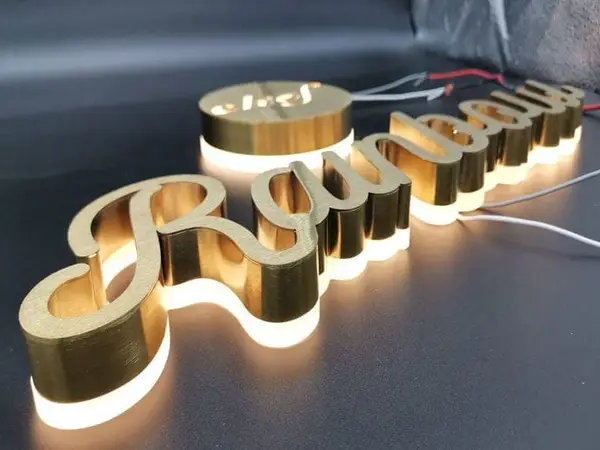
And for something with real gravitas, brass letters exist. They’re $40-120 per letter from us, more for complex fabrication. The patina they develop outdoors is either a feature or a flaw, depending on your client’s taste. I’ve shipped brass to law firms that wanted to look like they’d been there since 1890. It works.
Here’s what nobody tells you: most factory-direct channel letter quotes include LEDs, but they won’t be specific about the brand. They’ll say “5050 chip” or “2835 module” and leave it at that. A 2835 LED from Samsung and a 2835 from some fly-by-night Shenzhen shop are not the same thing. The Samsung module hits 100-150 lumens per watt and survives 5+ years. The cheap one? 12-18 months if you’re lucky.
We use quality modules — Samsung, Osram, or Lan Jing. L70 rated at 50,000 hours. That means after 5.7 years of 24/7 operation, they’ll still be at 70% brightness. For a store running 12 hours a day, that’s over a decade. Cheaper LEDs? The epoxy degrades, the phosphor shifts, and you get that dim, purplish glow that screams “neglect.” I charge more for the good stuff, but I won’t sell the junk. Even if you ask. I’ve told customers no, and lost orders. Fine.
Color temperature matters too. 3000-3500K is warm, good for restaurants and hospitality. 4000-5000K neutral, standard for corporate. 6000-6500K cool white, common for industrial or highway signs where you want clinical brightness. If you order front-lit channel letters from us without specifying, I’ll default to 6000-6500K because it’s the most universal. But I’ll also ask what you’re mounting them on — because cool white on a red brick wall looks harsh, and warm white on aluminum cladding looks dingy. Small detail, huge impact.
You want to know exactly what happens after you send that purchase order. Here’s our 10-step sequence, from artwork to crate.
Total production: about 5-15 days, depending on order complexity and queue. Rush orders happen, but they disrupt workflow. I’ll be straight about timeline. If we’re slammed, I’ll tell you it’s 15 days, not 7. Underpromise, overdeliver is how you keep customers for 16 years.
Look, I’m going to rip the bandage off. CE marking costs 20,000-50,000 RMB and takes 2-8 weeks. We have it. But half the factories claiming CE have a certificate from a testing house that never saw their product, or it’s expired. Ask to see the certificate with today’s date. Or better, ask for the test report referencing the specific LED and power supply used. If they stutter, walk.
Our ISO 9001 is real, audited annually. RoHS compliance on LEDs and materials means no heavy metals that’ll get your shipment flagged at EU customs. For US buyers, you might need UL 48 or ETL listing if your local inspector demands it. That’s a $4,000-15,000 certification process, 4-9 months, with quarterly factory audits. We don’t maintain UL listing by default because the cost would force our prices up for everyone. But we can build to UL standards and coordinate with your chosen lab if you need that sticker. That’s the honest answer.
IP ratings are another mess. IP65 is the minimum for outdoor use — dust-tight and protected against water jets. IP66 means powerful water jets, better for coastal storms. IP68 means submersible, which is overkill for channel letters but tells you the sealing is meticulous. We test every outdoor sign to IP65 water ingress. I’ve seen competitors claim IP68 and then seal letters with hot glue. If you want a sign that survives a Florida hurricane, spec IP66 and let us actually build it right.
Here’s what nobody tells you about ordering factory direct from China: the product price is great, but shipping and tariffs can eat you alive if you don’t plan. You’ve got three options.
Express (DHL, FedEx, UPS): 7-10 days door to door, $30-100 for a small box of letters. Best for samples or urgent small orders. Air freight: about 10 days, $4-12 per kg, works for mid-sized shipments that need speed. Sea freight: about 65 days, but $80-200 per cubic meter LCL (less than container load) or $1,200-3,000 for a full 20’ container. Sea is where the real savings happen on large orders, as long as you’ve factored in the time.
Then there’s the US Section 301 tariff on Chinese signs: around 30%. We don’t hide this. Some shippers under-declare value to dodge tariffs; we won’t. If customs catches undervaluation, your shipment gets seized and you pay penalties. We declare actual value and help with HTS codes. You pay the tariff on your end. Budget for it.
For storefront packages like acrylic light boxes at $80-250/sqm or neon flex signs from $30-200, the bulk you order determines shipping method. A few neon flex signs can go express. A 2-meter-tall light box goes sea freight in a crate. I’ll advise you. No point paying $600 to air freight a $250 light box.
We’re a Chinese sign factory. We don’t install signs in your city. We don’t pull permits. We don’t do site surveys. I’ve had buyers send me a photo of their storefront with a “make it look good” instruction. Can’t do it. I need measurements, wall material, power access. Give me a drawing or a clear spec, I’ll build exactly what you want. Give me a napkin sketch and a prayer, I’ll call you and ask for more. That’s not rudeness; that’s respect.
Our MOQ is 1 piece. Yes, a single letter. But if you order one letter, the shipping cost will be disproportionately high. It’s still your call. I’ll tell you the cost, I won’t judge you for it.
For complex fabricated logos — 3D shapes with multiple layers and internal illumination — our team handles 3D fabricated channel letters from $40-120. Stainless steel or aluminum, polished to mirror or powder coated matte. We’ve done script logos with loops so tight the laser had to be re-calibrated mid-job. But if your design has structural weak points, I’ll flag it. An elegant font that looks great on screen might be impossible to weld in 1.2mm stainless without warping. I’ll suggest alternatives. You can tell me “no, do it anyway,” and I will, but I’ll document that I warned you. That’s how we protect relationships.
Look, I’ve watched sign shop owners order 5mm acrylic returns for back-lit halo letters without thinking about depth. Halo letters need a deep enough return for the LEDs to cast light evenly onto the wall — usually 1.5-2 inches minimum. A 5mm return will just look like a thin line of light and a dark center. Waste of money. I’ve also seen contractors order exposed LED modules without diffusion covers, then wonder why every diode is a visible hot spot. Diffusion is part of the face material choice. These are simple fixes, but only if your factory bothers to point them out.
Another killer: assuming stainless steel is always non-magnetic. 304 is slightly magnetic after welding because the heat rearranges the grain structure. If your client plans to stick a magnet on it for some decorative element, we need to know upfront. There are workarounds — post-anneal or use specific alloys. But if you don’t tell me, and the magnet falls off, that’s not a warranty claim. That’s a communication failure.
The warranty. Ours is 2 years on LEDs, 1 year on the power supply. That’s standard for outdoor electrical signs. A power supply is a wear item; it degrades from heat and voltage spikes. We ship Mean Well or comparable quality drivers. Don’t cheap out on the power supply and expect it to last a decade. I’ve seen it fail at 13 months. Could we offer a 5-year warranty? Sure, but we’d have to bake that risk into the price, and you’d pay 40% more per sign. Instead, we price for what’s realistic and ship spares if you ask.
We’re not the only factory in China. But we’ve been doing this since 2010, under one roof, with the same core management. I know my team’s strengths: our TIG welders can lay a bead so smooth it disappears under brushing, and our laser cutters hold tolerances that make installation alignment trivial. I also know our limits: we don’t do large-scale digital printing, and we’re not a signage design agency. We build what you design. That focus keeps our defect rate low and our lead times honest.
When you order custom channel letters online from us, you’re not getting a template quote from a chatbot. You’ll get an email from a real person who asks about voltage (110V for US vs 220V for EU), mounting method (stud mount, raceway, or direct wall), and whether the letters face south in direct sun (UV exposure matters). Those questions aren’t upselling. They’re me making sure you don’t get screwed.
We ship worldwide, so we handle 220V 50Hz, 110V 60Hz, metric and imperial units, UL and CE requirements, all that. For restaurant chains, we’ve done food menu signs in polished brass with LED backlighting, fully sealed for kitchen humidity. For corporate lobbies, stainless steel letters with brushed finish and halo illumination. The process is the same every time: confirm the spec, build it right, test it, pack it, ship it.
Here’s the math on a 10-letter storefront sign, front-lit, 18-inch tall, 304 stainless returns, white acrylic faces, 6000K Samsung LEDs. Factory price per letter: around $45-65. Total product cost: $450-650. Express shipping: $150-300. Tariff at 30%: $135-195. You’re in for $735-1,145, all in, delivered to your door in 15 days. That same sign from a US manufacturer? $3,000-5,000. Even with shipping and tariffs, you keep 60% of your budget. And the quality is identical — better, sometimes, because your US supplier might be importing from a factory anyway. We just cut out the middleman.
For halo-lit letters, the savings are even more dramatic. A $90 halo letter from us might retail at $700 installed. You still need to install it, but even with a local installer’s labor, you’re ahead by thousands. I’m not saying it’s for every job — emergency rush jobs with a 3-day deadline need a local vendor. But for planned projects with a 2-3 week lead time, factory direct is the only way to make serious margin.
Look, I’m not in the business of making pretty brochures. I make metal and light do what you tell them. If you’re ready to order custom channel letters online, without the fluff and without the hidden fees, send a drawing. I’ll tell you straight if it can be built, what it’ll cost, and when it ships. If not, I’ll tell you why and what to change. That’s been working for 16 years. No reason to stop now.
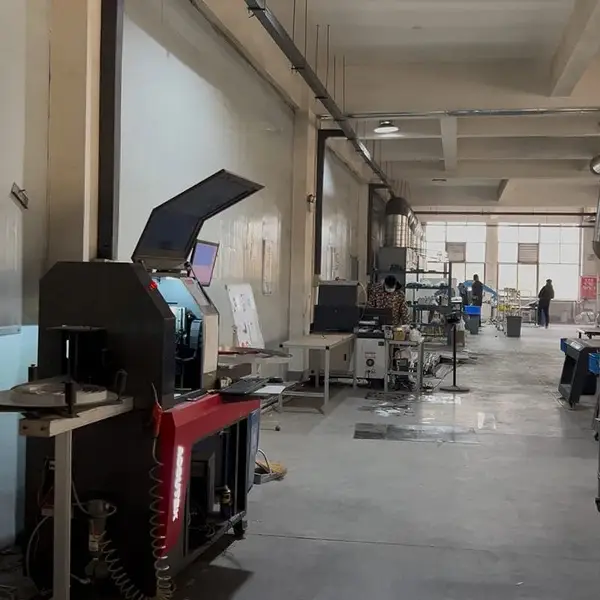
Real photo from our production floor — every sign we ship is made here.
Products mentioned or relevant to this topic — factory-direct, custom built.
From $24/letter · MOQ 1 piece · Flexible lead time · CE & UL certified · ships to 20+ countries
Custom sizes, colors, and finishes. Get a factory price in 24 hours.
Get a Free Quote Copy EmailWhatsApp +86 13865703472 · business@aochuangsign.cn
See pricing, specs, and get a free quote for the sign type you need. Built in our factory, shipped worldwide.