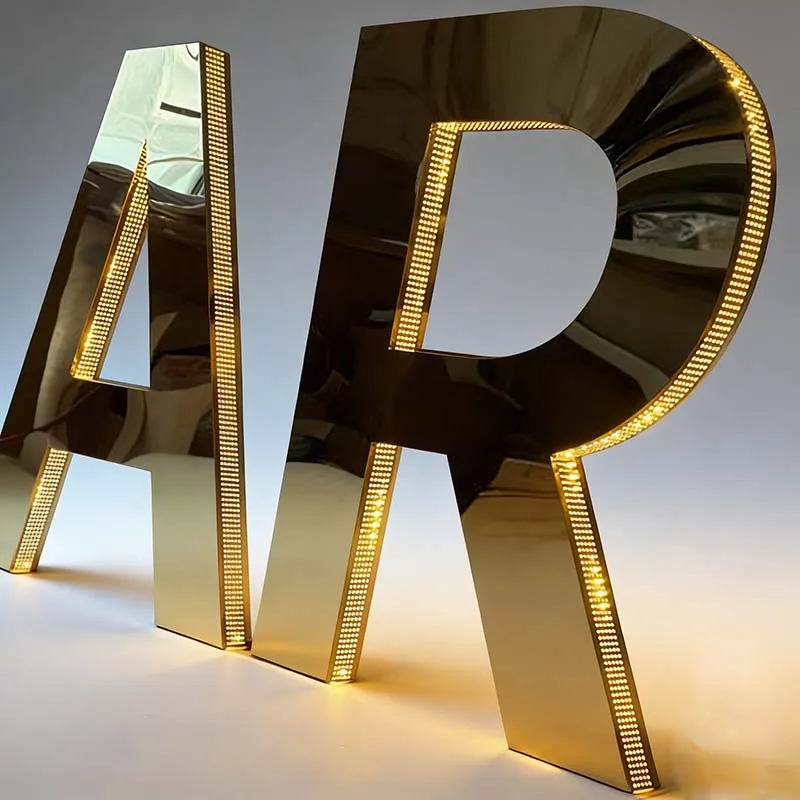
Nobody tells you this: that $120 factory letter looks fantastic—until the freight forwarder's forklift driver has a bad Monday. I watched a $6,000 crate of stainless steel letters turn into scrap because someone saved $8 on plywood. Let's talk real numbers.
I'm running a sign factory floor in Lu'an, Anhui. 3,000 square meters. 50 workers. Certifications on the wall.
We've shipped enough outdoor channel letters to know exactly where the money leaks. It's not the acrylic. It's the decisions people make before they quote.
Channel letters are dimensional letters—a face, a return, and a light source inside. You'll see them on strip malls, gas stations, and corporate office facades. Most storefronts run 12 to 36 inches tall. Go over 2.5 meters and you'd better spec 5mm acrylic, not 3mm, or the face bows like a cheap plastic lid.
Ordering front-lit channel letters for a retail storefront? That's the most common setup. The face spreads LED light through acrylic; the returns are usually aluminum or stainless. Back-lit halo letters work the opposite way—light spills behind the letter onto the wall. That's the look that says "expensive" from the street.
Truth is, the sign type matters less than the material and the LED spec. A $20 front-lit letter and an $80 front-lit letter can look identical in a photo. One lasts 5 years. The other dies in 18 months.
Factory-direct, here's what we're seeing in 2025. Front-lit channel letters run $20–80 per letter. Back-lit halo letters run $35–120. Non-lit stainless steel letters sit at $15–40. 3D fabricated letters run $40–120. Aluminum is the cheap end at $10–25. Light boxes run $80–250 per square meter. LED neon flex runs $30–200 per sign.
Look, those are factory prices. Installed at retail in the U.S., you're looking at $200–700 per letter for front-lit and $400–1,000 per letter for back-lit halo letters. That gap isn't profit. It's labor, lift rental, permits, electrical, and the markup from a domestic fabricator who probably imported the components anyway.
I've watched sign shops pay $800 for a front-lit letter from a domestic fabricator. Same 304 stainless. Same Samsung LEDs. We ship that letter for $120. No joke.
Ugly truth: per-inch pricing is a scam on anything custom. Manufacturers don't quote by the inch. They quote by letter height, material thickness, finish, and LED module count. A 12-inch capital 'A' and a 36-inch script letter with internal returns? Not the same animal.
Material drives base cost. Aluminum weighs about a third of steel and lasts 8–12 years outdoors. Stainless 304 has 18% chromium and 8% nickel, and it's good for 10+ years outside. Stainless 316 adds 2–3% molybdenum for coastal or industrial environments, and it costs 20–30% more than 304. For a strip mall in Ohio, 304 is fine. For Miami Beach, pay for 316 or you're replacing letters in 3 years.
Acrylic quality is the next hidden variable. UV-resistant acrylic from Mitsubishi or Degussa lasts 5–8 years before yellowing. Domestic acrylic? Expect 1–2 years. A 3mm acrylic face transmits 92% of light; a 2mm face transmits 90%. Your customer won't notice the 2% difference, but they will notice the 40% cost bump if you spec 3mm unnecessarily.
LED choice matters more than face thickness. SMD 2835 modules run 100–150 lumens per watt, the industry standard. SMD 5730 chips push 40–60 lumens per chip, the highest brightness for large letters. Quality modules from Samsung, Osram, or Blueview last 5+ years in the real world. Cheap modules? 12–18 months before half the diodes flicker. Ordering acrylic LED letters? Then specify the module brand in the quote.
Nobody warns you: two letters can look the same and quote $40 or $140. It comes down to these seven things.
Certifications are where factories lie. CE marking costs 20,000–50,000 RMB. Most factories will say they have it. Ask to see the certificate with today's date. Watch them sweat.
Here's the part that stings: the letters are only half the bill. That $120 factory letter becomes a $600 installed letter by the time a licensed electrician runs a circuit, the sign company rents a 40-foot lift, and the city inspector demands UL labels. NEC Article 600 governs U.S. electrical signage, and inspectors love quoting it.
Installation variables eat budgets fast. Stud mounting through EIFS or brick requires different anchors. Raceway mounting needs a power source at the wall. Lift access on a busy street means after-hours labor. Permit fees vary by municipality, but every one of them wants a stamped drawing—and sometimes a field inspection.
I've seen this go wrong: a shop ordered 40 letters, saved $8,000 on product, then lost it all on one forklift puncture because the crate wasn't plywood. LCL sea freight means your crate changes hands 6–8 times between our dock and yours. Every touch is a chance for damage. That's not in the brochure.
Shipping costs are real. Express takes 7–15 days and runs $30–100 for small packages. Air freight takes 10–20 days at $4–12 per kilogram. Sea freight takes 50–70 days at $80–200 per cubic meter for LCL, or $1,200–3,000 for a full container. Ordering one sign? Express it. Ordering forty? Sea freight the whole lot and inspect every letter when it lands.
Factory-direct savings run 50–65% on product. That's before U.S. Section 301 tariffs, which claw back roughly 30% on many sign categories. Do the math: a $120 letter becomes $156 after tariff. Add sea freight and you might land at $180–190. The domestic fabricator quoted you $400 for the same spec. You're still ahead.
The savings come from three places. First, no middleman marking up 20–40% to hold inventory. Second, Chinese production labor and materials cost less—but that doesn't mean lower quality. Our factory has ISO 9001, CE, and RoHS, and we run an 8–12 hour aging test on every single sign before it leaves. Third, we build to your spec, not a catalog.
Quickest way to spot bad LED modules? Look at the solder joints. Dull gray joints mean the lead-free solder was botched—those modules won't last 18 months. Shiny silver joints? That's proper lead-free solder—and a module that'll hit L70 at 50,000 hours. I've rejected entire batches for dull solder.
If a factory quote doesn't ask about voltage, UL or ETL requirements, IP rating, letter height, mounting method, and shipping destination, run. That factory is guessing. A legitimate quote takes 1–2 days and includes the 10-step build: design confirmation, laser cutting at ±0.1mm, TIG welding, grinding and polishing, CNC acrylic face, LED assembly, neutral silicone sealing, aging test, 100% QC inspection, and export packaging with foam, carton, and plywood crate.
Our minimum order is 1 piece. Lead time is 7–15 days. Warranty is 2 years on LED, 1 year on power supply. If a supplier quotes you 3 days production on 50 letters, they're cutting corners somewhere. Probably the aging test.
IP65 sounds impressive. It means dust-tight and protected against water jets from any direction. It does NOT mean your sign survives a Florida hurricane. If you're within a mile of salt water, spec IP66 and 316 stainless. Your installer will grumble. Your sign will still be there in 10 years.
What's the cheapest outdoor channel letter material? Aluminum. Factory price $10–25 per letter. But if you put cheap LEDs in aluminum returns, you'll replace the whole thing in 18 months. Don't be that person who saves $30 on modules and then pays $600 in labor to swap them.
How much should I pay per inch for channel letters? Stop asking that. Per-inch pricing is for vinyl banners and lazy estimating. Channel letters are quoted per letter, by height, material, finish, and LED count. A 24-inch front-lit letter in 304 stainless with Samsung LEDs runs $20–80 factory direct. Your local installer charges $200–700 installed.
Do I need UL listed channel letters? If your inspector asks, yes. UL 48 certification costs $4,000–15,000 and takes 4–9 months. If a factory says they have UL, ask for the certificate with today's date. Then ask for a copy of the quarterly audit report. Half the time they go quiet.
Why is sea freight so cheap but takes 50–70 days? Because sea freight moves your crate 6–8 times between our dock and yours. Every lift is a chance for damage. Want it fast? Express is 7–15 days for $30–100 on small signs. Want it cheap? Sea freight LCL is $80–200 per cubic meter, but budget for one damaged letter per crate and thank me later.

Real photo from our production floor — every sign we ship is made here.
Products mentioned or relevant to this topic — factory-direct, custom built.
From $24/letter · MOQ 1 piece · Flexible lead time · CE & UL certified · ships to 20+ countries
Custom sizes, colors, and finishes. Get a factory price in 24 hours.
Get a Free Quote Copy EmailWhatsApp +86 13865703472 · business@aochuangsign.cn