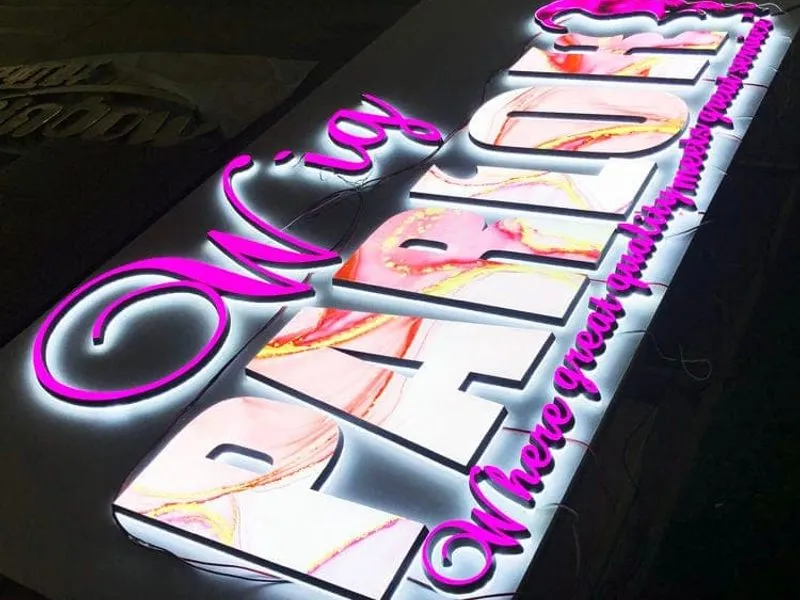
Look, I've been on a sign factory floor since 2010, and "personalized sign manufacturer" means about forty different things depending on who answers the phone. You're not shopping for a widget. You're buying a supply chain relationship, and the wrong one'll cost you a season of re-dos.
I've watched sign shops pay $800 for a front-lit letter from a domestic fabricator. Same 304 stainless, same Samsung LEDs. We ship that letter for $120. That gap isn't factory magic. It exists because most buyers don't know which questions to ask before they quote.
Here's what nobody tells you: a factory's website shows a 3,000m² facility, ISO 9001, and 50+ smiling workers, but none of that tells you if your letters will leak water in six months. Ours is 3,000m² in Lu'an, Anhui. We do have ISO 9001. You still need to dig past the brochure.
Call and ask for a video of the production floor. Not a promo. Live video. If they hesitate, that's your answer. I've done this long enough to know that a factory that won't show you the aging-test rack is hiding cheap LED modules or skipping the 8-12 hour burn-in entirely.
If you're ordering front-lit channel letters for a storefront, ask how they seal the acrylic face. We use neutral silicone, not acidic caulk. Acidic silicone etches acrylic and fogs the face in a year. That's a warranty claim waiting to happen.
MOQ matters. A real personalized manufacturer will take one piece, because custom work means exactly that. We do. If someone tells you their MOQ is 50, they're not personalized. They're stockpiling.
Lead time matters more than you think. A real factory can do about 5-15 days if your artwork is clean, with 50+ workers on the floor. If a "manufacturer" quotes 30 days for standard letters, you're probably talking to a trading company that's reselling someone else's production. Warranty tells you a lot too. Two years on LED, one year on power supply is honest. Ten-year "lifetime" warranties are marketing from a company that hopes you'll lose the receipt.
The ugly truth is most buyers overpay for materials they don't need. For a strip mall in Ohio, 304 stainless will outlast the lease. For Miami Beach, you'd better pay the 20-30% premium for 316 marine grade or you're replacing letters in three years.
Stainless steel letters made from 304 are my default recommendation for exterior signage. 18% chromium, 8% nickel, density 7.93 g/cm³. That's a 10+ year outdoor life if you fabricate with TIG welds and proper grinding. We carry both 304 and 316 in our stainless steel letters. Finishes run brushed #4, mirror #8, PVD, and powder coated. You want mirror #8 for a bank lobby. You don't want mirror #8 on a south-facing wall in Arizona. It'll blind somebody and you'll hear about it.
Aluminum's another animal. It weighs about one-third of steel, rustproof by nature, and gives you 8-12 years outdoors. Common thickness runs 0.040" to 0.063". For non-illuminated letters, aluminum is usually cheaper to ship and easier to mount. I'll pick aluminum over steel when the client's lease is short or the sign's going on a wall that can't take much dead load.
And PVC? Different story.
Don't use it for exterior personalized signs. It warps in heat, gets brittle in cold, and fades like a cheap beach towel. Indoor, maybe. Outdoors, it's a callback waiting to happen. Some factories push PVC because it's cheap to rout, not because it's right for your job. Cheap PVC on an exterior wall is a complaint that hasn't happened yet.
Acrylic faces are where you can shave real money without screwing the customer. A 3mm acrylic face cuts 92% light output. A 2mm face cuts 90%. Your customer won't notice the 2% difference, but they'll notice the 40% cost bump. For any face over 2.5 meters, bump up to 5mm or the thing will bow like a cheap shower curtain. If the job is lit, we usually spec acrylic LED letters with UV-resistant acrylic from Mitsubishi or Degussa. Domestic acrylic yellows in 1-2 years. The good stuff goes 5-8. That's an 8-year visual difference your customer can see from the parking lot.
I've seen this go wrong: a contractor in Texas sent us artwork after paying a broker $4,200 for 14 front-lit letters. The broker's guy in Shenzhen was selling the same product from a factory one province over. We shipped the exact same letter set for $1,860, landed, with better LEDs. The contractor's silence on the phone told me everything.
Brokers aren't evil. They're just another mouth to feed. Factory-direct pricing on front-lit channel letters runs $20-80 per letter depending on size and finish. A broker marks that up 50-65% before it even hits your invoice. You're not buying expertise. You're buying a forwarding phone number.
The time cost is real too. When I send an email to the floor at 9pm, the guy who welds the return reads it at 8am. A broker reads it whenever he's done with breakfast. That's why factory-direct lead times stay about 5-15 days and broker orders drift to 30.
Factory direct isn't always smooth. You'll need to be your own QC, your own customs broker, and your own project manager. But saving 50-65% on product usually buys a lot of patience.
Look, artwork files are where everything goes wrong. A client sends a JPEG they pulled from a business card and expects a 6-foot illuminated sign. That's not a file. That's a prayer. We need vector files, exact PMS or RAL colors, and a scale reference if the letter height isn't specified.
Our workflow from confirmed artwork to crate is 10 steps. Design confirmation takes one day. Laser cutting holds ±0.1mm. Then TIG welding, grinding, polishing, CNC acrylic, LED assembly, sealing with neutral silicone, an 8-12 hour aging test, and 100% QC. That's not optional. We run every single sign through the aging test, because cheap LEDs die at hour 11.
Proofing is a two-way street. I don't send a proof until I've confirmed stroke thickness, return depth, mounting pattern, and whether the power supply goes inside the letter or remote. If the client signs a proof without reading the notes, I'm not the one who gets to be angry later. You are, but you signed it.
Color temperature is part of the proof, not an afterthought. 3000-3500K warm is for hospitality. 4000-5000K neutral is for corporate and retail. 6000-6500K cool is for industrial and highway work. The wrong color temperature makes a $5,000 sign look like a $500 sign.
Here's what nobody tells you about compliance: a CE mark costs 20,000-50,000 RMB and takes two to eight weeks. Most factories will tell you they have it. Ask to see the certificate with today's date. Watch them sweat. I've seen that silence stretch across an entire meeting.
For the US market, NEC Article 600 applies to any electric sign. UL 48 is the standard, but it'll run you $4,000-15,000 and four to nine months, with quarterly audits. ETL is a legitimate alternative at 10-30% cheaper. If a supplier claims UL without a listing number on file, walk away. That's not paperwork. That's your liability walking into a courtroom.
IP ratings are another place buyers get fooled. IP65 sounds impressive. It means dust-tight and water jets from any direction. It does NOT mean your sign survives a Florida hurricane. IP66 handles powerful jets, coastal conditions. IP68 is submersible, and unless your sign is going on a fishing pier, you don't need to pay for it.
Quickest way to spot bad LED modules: look at the solder joints. Dull gray means they used cheap solder and that board won't last 18 months. Shiny silver is proper lead-free solder. Quality modules from Samsung, Osram, or Blueview will give you 5+ real years. Cheap modules die just after the one-year mark, which is exactly when your warranty evaporates.
LED specs are concrete, not marketing. SMD 2835 runs 100-150 lumens per watt and is the industry standard. SMD 5050 is RGB capable. SMD 5730 puts out 40-60 lumens per chip, highest brightness. L70 is at least 50,000 hours on a decent module. If a factory can't tell you which SMD they're installing, they're installing whatever was cheapest last month.
ADA requirements trip up a lot of buyers too. Tactile signs need to mount 48-60 inches above the finished floor, have a non-glare finish, and use Grade 2 Braille. That's not a suggestion. It's a building inspector with a clipboard and a bad mood.
Look, if you don't calculate landed cost, you're not a buyer. You're a gambler. Factory price for a back-lit halo letter runs $35-120. US retail installed is $400-1,000 for that same halo letter. The product itself isn't the expensive part. Shipping, customs, and your time are.
Express from our shop to the US takes about 5-15 days and costs $30-100 for small orders. Air freight runs about 10 days at $4-12 per kilogram. Sea freight is about 65 days; LCL costs $80-200 per cubic meter, and a full container runs $1,200-3,000. Most small sign shops ordering ten letters should not fill a container. You'll pay more per cubic meter than the letters are worth.
Then you hit the Section 301 tariff—about 30% on many fabricated sign products from China. Someone will tell you they can label the shipment as "gifts" or misdeclare value. That's the oldest rookie mistake in the book. Customs isn't stupid, and your insurance claim won't survive a false declaration when the crate gets dropped.
Here's what I actually tell buyers: a $120 factory letter can become a $260 landed letter after freight, tariff, and packaging. That's still $540 cheaper than the $800 domestic alternative. The math works if you order enough to spread the fixed costs. One letter? Maybe not. Twelve letters? Absolutely.
Packaging is the hidden fee nobody budgets. We don't ship anything without foam, carton, and a plywood crate for sea freight. LCL sea freight means your crate gets handled six to eight times between our dock and yours. Every touch is a chance for damage. That's not in the brochure, but it is in your replacement cost.
Can I really order just one sign? Yes. MOQ is one piece at a real personalized manufacturer. If someone tells you 50, they're not set up for custom work.
Why is your quote cheaper than my local guy? Because you're buying from the factory floor, not a retail shop with a showroom lease and three project managers. The 50-65% savings is real, but so is the freight and tariff you'll need to do yourself.
How long does shipping actually take? Express, about 5-15 days. Air, about 10 days. Sea, about 65 days. Pick the wrong one and you'll be explaining to a client why their grand opening sign is still on a boat in the Pacific.
What's the difference between 304 and 316 stainless again? I said it above, but fine. 304 is a 10+ year outdoor metal. 316 has molybdenum and costs 20-30% more. Coastal or industrial? Pay for 316. Ohio strip mall? 304 is plenty.

Real photo from our production floor — every sign we ship is made here.
Products mentioned or relevant to this topic — factory-direct, custom built.
From $24/letter · MOQ 1 piece · Flexible lead time · CE & UL certified · ships to 20+ countries
Custom sizes, colors, and finishes. Get a factory price in 24 hours.
Get a Free Quote Copy EmailWhatsApp +86 13865703472 · business@aochuangsign.cn