Look, I’ve been on this factory floor since 1998. I’ve burned my knuckles on acrylic, argued with suppliers about LED binning, and watched a strip-mall pharmacy install a sign that couldn’t survive a Midwest thunderstorm. The ugly truth is most drugstore exterior signage is built to a price, not a standard. That’s a damn problem when you’re selling blood pressure meds and insulin.
Pharmacy signage isn’t like a burger joint sign. Fail there and someone misses lunch. Fail here and someone misses their prescription—or worse, they take the wrong one because they couldn’t read the store name from the road. The compliance requirements alone (ADA, NEC, local codes) would make a rookie cry. But the real cost? A sign that falls apart in 18 months, looks like garbage in year two, and gets you sued in year three. I’ll walk you through what actually matters, starting with the stuff that keeps you out of court.
Here’s what nobody tells you: your pharmacy sign has to do three things at once—be readable from 50 feet away, survive the elements for a decade, and not violate a single line of the Americans with Disabilities Act. Miss one and you’re either losing customers or losing your shirt in fines.
Visibility. You need color temperature in the 4000-5000K range—neutral white that cuts through headlight glare. Warm 3000K looks cozy but washes out under streetlights. Cool 6500K gives you that hospital vibe. Great for surgical centers. Bad for a Walgreens. Use SMD 2835 LEDs at 100-150 lumens per watt. That’s what works. Don’t let anyone upsell you to 5730s for a front-lit channel letter—that’s overkill and it generates heat you don’t need.
Compliance. ADA isn’t optional. Mounting height: 48 to 60 inches to the center of the sign. Grade 2 Braille. Non-glare finish. I’ve seen a $50,000 renovation held up because someone used glossy acrylic on a monument sign. Check it before you order.
Durability. For the sign cabinet, 304 stainless (10+ years outdoors) is your baseline. If you’re within five miles of saltwater, upgrade to 316—costs 20-30% more but you won’t be replacing letters in three years. Aluminum works for light boxes but dent it once and it’s junk. Acrylic face? Use 3mm minimum for any sign over 2.5 meters. 2mm might save 40% upfront, but it’ll warp and yellow in two summers. Mitsubishi or Degussa acrylic: 5-8 years UV resistance. Domestic stuff: 1-2 years before it looks like a bad tan.
The ugly truth is most sign shops will quote you the cheapest option because they’re scared of losing the bid. I’ve watched a contractor spec domestic acrylic for a 24-hour pharmacy in Phoenix. Six months later the face was milky and the LEDs were bleeding through. That’s not a sign—that’s a liability.
For the letters themselves, you’ve got options. Stainless 304 brushed #4 finish—clean, easy to maintain, 10-year life. If you’re on the coast, 316 with PVD coating adds another five years. Aluminum is fine for channel returns but only if you’re anodizing it—paint chips in three years. And for the love of god, don’t use wood or MDF on an exterior pharmacy sign. I’ve seen it. It rots.
Here’s a hard fact I live by: 3mm acrylic cuts 92% light transmittance. 2mm cuts 90%. Your customers won’t notice the 2% difference, but they will notice the 40% cost bump. So use 3mm for the face and save the 2mm for indoor directories. And if the supplier says “high-grade acrylic” with no brand name, ask for the datasheet. If they can’t produce one, walk.
I’ve seen this go wrong more times than I can count: a pharmacy chain orders 50 halo-lit letters with “super bright LEDs.” Six months later, half the letters are dead. The problem? They bought modules with cheap solder joints. Quickest way to spot bad LEDs: look at the solder points on the back. Dull gray = no lead-free solder. That means corrosion in 18 months. Shiny silver = proper process. Demand it.
Your LED modules should be SMD 2835 for most jobs—100-150 lm/W, L70 rating of 50,000 hours minimum. That’s about 5.7 years of continuous operation. Quality chips from Samsung or Osram will actually hit that. Cheap modules from no-name factories? 12-18 months and you’re swapping them out. For RGB or color-changing signs, SMD 5050s are fine but expect lower efficiency.
And about IP ratings: IP65 means dust-tight and protected against water jets from any direction. It does NOT mean your sign survives a Florida hurricane or a Chicago blizzard. For coastal or heavy-weather areas, spec IP66 or IP68. The extra cost is nothing compared to replacing a whole sign every 18 months. Here’s the truth: a good LED module costs $0.50 more per letter than a bad one. That $0.50 saves you $50 in labor later.
Look, I work in China now, but I’ve been on both sides. I know local fabricators charge $200 to $700 per letter for a front-lit channel letter. My factory ships the same job—same 304 stainless, same Samsung LEDs—for $20 to $80 per letter. That’s a 50-65% savings on product alone. Before you scream “quality,” we’ve been exporting worldwide since 2010. CE, RoHS, ISO 9001 certified. Our lead time is 7 to 15 days. MOQ: one piece. You want a single letter? We’ll do it.
But here’s the catch nobody mentions: shipping. Express (7-10 days, $30-100 for small crates) works for single signs. Air freight ($4-12/kg) for mid-sized jobs. Sea freight is where the value lives—$80-200 per cubic meter LCL for a about 65 days trip. But LCL means your crate gets handled 6 to 8 times between our dock and yours. Every touch is a chance for damage. We pack in foam, then carton, then plywood crate. But if your freight forwarder drops it? That’s on you.
And don’t forget the US Section 301 tariff: about 30% on Chinese-made signs. Still, total cost including shipping and tariff is often half of what a domestic shop charges. But you have to plan for it. If you need UL listing, that’s another $4,000-15,000 and 4-9 months. ETL is 10-30% cheaper and UL-recognized. CE marking costs 20,000-50,000 RMB (about $3,000-7,000) and takes 2-8 weeks. Most factories claim they have CE. Ask to see the certificate with a current date. Watch them sweat.
Here’s what nobody tells you about pharmacy signage: it’s not just ADA. NEC Article 600 governs electric signs. That means proper grounding, wire sizing, and disconnect switches. If your sign isn’t UL-listed, your local inspector might red-tag the whole project. I’ve seen a 24-hour pharmacy lose two days of business because the sign wasn’t on the approved list.
ADA compliance is more than Braille. The sign must be non-glare (satin finish acrylic or matte applied vinyl), mounted 48-60 inches to center, with Grade 2 Braille. A lot of “ADA-compliant” signs I see have dots that are too shallow—you need 1.5mm height. Check with a fingernail. If you can’t feel it, the inspector will. And please, don’t use a glossy face on a monument sign. That’s a lawsuit waiting to happen when a visually impaired person can’t read the text.
For outdoor weatherproofing, the seal matters more than the IP rating. We use neutral silicone on all joints, then run an 8-12 hour aging test at 100% power. If the seal fails during that test, it’s rebuilt. Most shops skip this step. Don’t be most shops.
You can buy the best sign in the world, but install it wrong and it’s junk. The ugly truth is that 80% of sign failures I see are installation problems, not manufacturing defects. Wrong sealant (don’t use acid-cure silicone on acrylic—it crazes), bad mounting points (check your building’s structural capacity), or wiring that’s under-gauge (NEC requires 12 AWG for most sign circuits).
Warranty: you should get 2 years on LEDs and 1 year on the power supply from any decent factory. After that, it’s on you. Plan to replace modules every

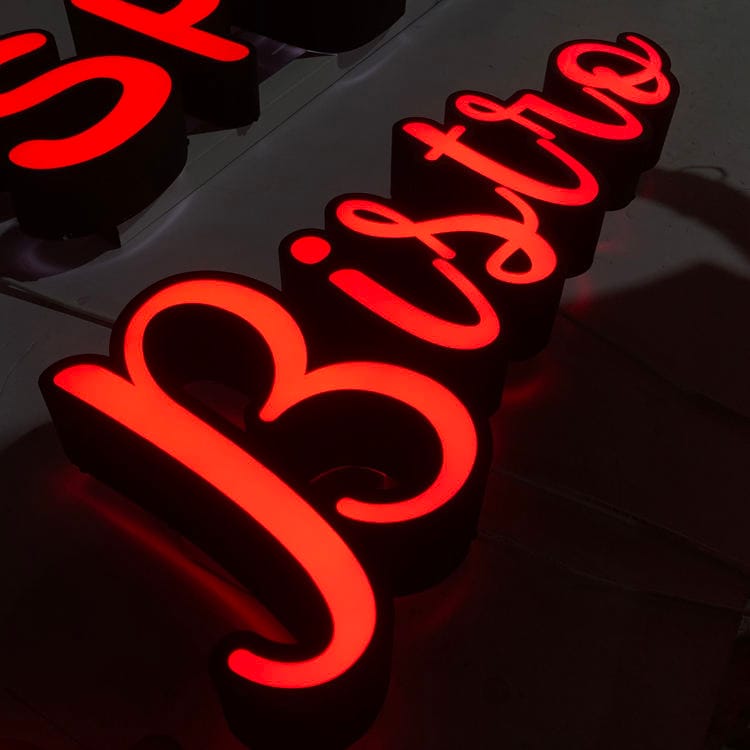
Real photo from our production floor — every sign we ship is made here.
Products mentioned or relevant to this topic — factory-direct, custom built.
From $24/letter · MOQ 1 piece · Flexible lead time · CE & UL certified · ships to 20+ countries
Custom sizes, colors, and finishes. Get a factory price in 24 hours.
Get a Free Quote Copy EmailWhatsApp +86 13865703472 · business@aochuangsign.cn
See pricing, specs, and get a free quote for the sign type you need. Built in our factory, shipped worldwide.