You Called Who for a Nationwide Sign Program?
Look, I’ve seen this go wrong a hundred times. A retailer decides they want a uniform sign program across 200 stores. They call three domestic sign shops, get quotes for $400 per letter, and then the procurement guy says, “Why don’t we just buy direct from China?” And suddenly you’re calling me. I get it.
The ugly truth is most nationwide rollouts fail not because of the sign itself, but because nobody thought about consistency. Not in the design, not in the materials, not in the install. And consistency isn’t a checkbox. It’s a system.
Here’s what nobody tells you: you need a bible. A spec book that reads like a contract, not a suggestion. Every store gets the same acrylic (Mitsubishi 3mm if you want it to last 5 years, not 18 months). Every LED module is Samsung or Osram SMD 2835, 100-150 lm/W. Not “equivalent.” Not “high quality.” I’ve burned my hands testing knockoffs that claim 50,000 hours but die at 12 months. Don’t be that guy.
I’ve watched a national chain order 300 front-lit
channel letters from a broker who sourced five different factories. The color temperature varied by 600K across stores. One store looked like a hospital, the next like a dive bar. You can’t have a brand when your sign colors don’t match. Period.
Specs That Make or Break a Program
You want a nationwide rollout that doesn’t fall apart in year two? Start with the enclosure. For outdoor channel letters, you’re looking at 304 stainless steel, 1.2mm thick minimum. The knowledge base says 1.0-3.0mm. I say 1.2mm is the sweet spot – thin enough to form, thick enough to take a shipping dent. Under 1.0mm and your letters bend just looking at them. Over 2.0mm and you’re paying for airplane parts.
For inland stores, 304 works. But if any store is within 5 miles of salt water, you need 316 stainless. That extra 2-3% molybdenum costs 20-30% more, but you’ll save 10+ years of replacement. I’ve seen 304 letters on a Miami Beach store start pitting in 3 years. The client called me screaming. I told him, “You didn’t want to pay for 316. Now you pay twice.”
Now, the acrylic face. Mitsubishi or Degussa UV-resistant acrylic has 90-92% light transmittance and holds its clarity 5-8 years. The cheap domestic stuff turns yellow in 1-2 years. For a national chain, yellow equals brand failure. Period. I’ve argued with suppliers who swore their “high-transparency” acrylic was fine. I asked for their UV test data. Crickets.
LEDs? Don’t even start. The industry standard SMD 2835 at 100-150 lm/W is fine for 80% of signs. If you need RGB, use SMD 5050. But here’s the brutal truth: L70 rating of 50,000 hours means nothing if the driver is junk. I’ve seen a batch of “Samsung” modules where the solder joints were dull gray – that’s cheap lead-free solder that cracks after 1000 thermal cycles. Proper modules have shiny silver joints. Look for it. Reject everything else.
The Factory-Fresh Lie: Production and Quality Control
Here’s the thing nobody in a glass office understands: a sign is only as good as its factory inspection. At Aochuang Sign, we run a 10-step process that ends with an 8-12 hour aging test and 100% QC. That’s not a sales pitch, that’s survival. I’ve watched other factories skip the aging test to save a day. Their signs fail in the field within 6 months.
Quickest way to spot a factory that cuts corners: ask about their silicone. Neutral cure silicone is the only sealant that works with acrylic and metal – it doesn’t corrode or bond improperly. If they shrug, run. I’ve seen signs sealed with acid-cure silicone that ate through the aluminum returns in 18 months.
For a national rollout, you need a single source. Not three factories in different provinces who all “can do it.” Because when one guy bends a letter 2mm off spec, and the next uses a different LED driver voltage, and the third uses 1.5mm aluminum instead of 1.2mm stainless… you get a mess. Your installation crews will hate you. Your brand manager will cry.
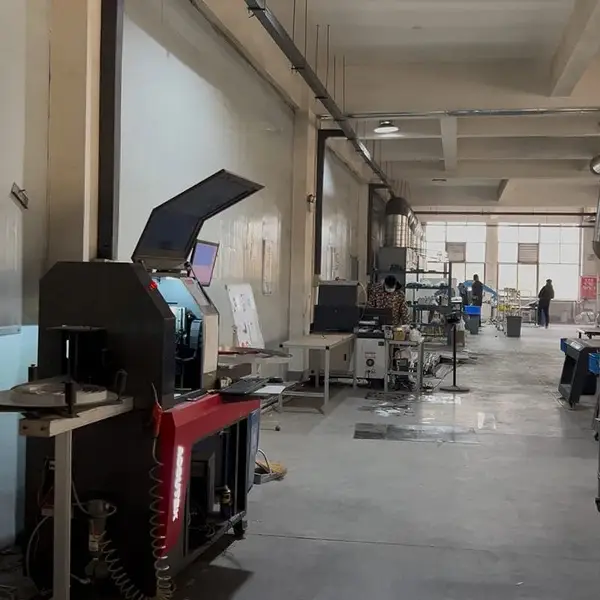
That’s why at Aochuang, we produce everything under one roof – 3,000m², 50+ workers, worldwide shipped to. You get consistency because the same crew does the laser cutting (±0.1mm), TIG welding, grinding, and assembly. We share a photo of the QA checklist with every shipment. You see the serial numbers of the LEDs. You see the silicone batch number. That’s how you control a program across 300 stores.
Shipping and Tariffs: The Unseen Variance Killers
Look, I’ve shipped signs worldwide. The biggest consistency killer isn’t fabrication – it’s freight. Here’s what nobody tells you: LCL (less container load) freight handles your crate 6 to 8 times between our dock in Lu’an and your store in Oklahoma. Every pinch, drop, or rain splash introduces variance. A dented letter means an installer has to rebuild it on site, which means it won’t match the others.
For a national rollout, never do LCL if you can avoid it. Consolidate into a full container (FCL). It’s $1,200-3,000 for a 20-foot container, but the crates stay stacked, shrink-wrapped, and dry. Or use air freight if you’re in a hurry – $4-12 per kg, about 10 days. For a chain of 200 stores, that’s 6-10 FCLs. Worth every penny.
And then there’s the Section 301 tariff – about 30% on Chinese-made signs. You have to factor that into your program cost from day one. Don’t wait until the Pro-forma invoice arrives. I’ve had clients cancel half an order because they forgot about the tariff. Then they scramble for domestic suppliers at $200-700 per letter – 50-65% more than factory direct. That’s how budgets blow up.
If you need UL certification (covers 85% of US code requirements), that’s $4,000-15,000 and 4-9 months. Plan for it. ETL is a cheaper alternative, 10-30% less and faster. But don’t pretend “CE” is enough for the US. I had a guy wave a CE cert at me and claim it covered everything. I asked him if he knew NEC Article 600. He didn’t. CE is fine for Europe. For the US, you need UL or ETL. End of story.
Installation Consistency: The Part Everyone Forgets
You get 200 perfect signs on a pallet. Then your install crew shows up with 8 different drill patterns and 3 different caulking guns. Now the signs aren’t level.
The solution is a detailed installation manual that includes: mounting templates printed on 1:1 scale, torque specs for the stainless bolts (10Nm, not “tight enough”), and a color card for the silicone (must match the acrylic, not clear). I’ve seen crews use white silicone on a red sign. Looks like a cheeseburger.
Also, if your sign includes LED, installers need to know the color temperature (e.g., 4000K neutral for corporate retail). One guy wires 3500K, another uses 6500K. Now your stores look like a zebra. Put the spec on the sign itself – heat-stamped on the interior. No excuses.
Brutal Honesty: The Four Lies You’ll Hear
“Our factory has CE.” Ask for the certificate number and the issuing body. Most factories buy a counterfeit stamp. CE costs 20,000-50,000 RMB (about $3,000-7,000) and takes 2-8 weeks. If they can’t show you the cert dated within the last year, they’re lying.
“We offer free samples.” All samples are made by the best guy in the factory. Production never matches. That’s why we do paid samples from the actual production line – same process, same crew.
“L70 at 50,000 hours is standard.” That’s the lab value. Real life accelerates by a factor of 2-3x in heat and humidity. Hope for 3 years of solid light. Budget for replacement modules.
“IP65 is weatherproof.” It means dust-tight and water jets from any direction. It does NOT mean your sign survives a Florida hurricane. For coastal areas, you need at least IP66 or even IP68 if the sign is in a flood zone. I’ve seen IP65 signs fill with water in a heavy rain. The homeowner called me threatening a lawsuit.
FAQ – Because I’ve answered these a thousand times
What’s the minimum order quantity for a national program?
At Aochuang, we do one piece MOQ. I don’t care if you need 1 letter or 10,000. But for a program, don’t order piecemeal. Order all 200 stores’ signs at once. You get economies of scale, consistent production runs, and you avoid tariff surprises. We’ve shipped worldwide, and the biggest mistake is splitting the order. You end up with two different batches of LEDs. Don’t.
How do I guarantee my red is the same red across 10 different store locations?
You don’t trust your eyes. You give us a Pantone number and a physical color chip. We calibrate our CNC and spray booth to that chip. For stainless, we use RAL code for powder coating. For acrylic, we use Mitsubishi’s solid core colors – they have a ±1 Delta E batch consistency. If you order from multiple factories, you’ll get variation. That’s why we do it all in one place.
What’s the real lead time I should plan for?
I quote about 5-15 days production. That’s the honest number. But add 5-10 days for shipping, plus customs clearance 2-5 days. For a program, budget 30-45 days from order to door. If you’re rushing it in 20 days, you’re getting express air freight which can cost $100 per sign. For a national rollout, air is stupid. Plan ahead.
Should I or shouldn’t I go with UL certification for a nationwide chain?
If you’re in the US and your sign touches power, yes. For you, it’s thirty cents more per letter. For me, it’s a $10,000 investment and quarterly audits. But when your local inspector says “no UL sticker, no permit,” you’ll wish you had it. ETL is acceptable in most jurisdictions. Ask your local codes. Don’t skip it. I’ve seen whole store openings delayed because the sign wasn’t labeled properly. That’s on you.
Now get your spec book done, call a factory that gives a damn, and stop buying signs from a broker who can’t tell you the difference between 304 and 316. I’ve got steel to cut.