You've landed the contract for a 50-store retail chain rollout. The client wants every location to look identical—same LED color temperature, same bend radius on the stainless letters, same mounting height. But you're dealing with 50 different building codes, 50 different local permit offices, and 50 different electrical inspectors who all have their own pet peeves.
Here's the hard truth I've learned over 15 years in this industry: pure centralization sounds great in a PowerPoint but falls apart on the loading dock. The smartest operators I know use a hybrid model—centralized specs plus regional vendor networks. It cuts freight costs by 30-40%, speeds up permitting by weeks, and still keeps the brand tight. Let me show you how.
The obvious play is to hire one national sign company. They handle everything. But here's the problem: that single vendor might have a killer shop in Dallas and a mediocre one in Boise. You're only as strong as your weakest regional crew.
I've watched a chain spend $12,000 on rush shipping because the national vendor's Midwest installer couldn't get a permit sorted in three weeks. Meanwhile, a local shop two blocks from the store could have done the same install in five days with no freight cost at all.
The numbers back this up. A typical front-lit channel letter from a factory runs $20-80 per letter. Add installation from a national vendor at $200-700 per letter, and you're looking at a 10x markup on labor alone. Regional installers often charge 15-25% less because they don't have the overhead of a national operations center.
But—and this is the big "but"—you can't just hand a regional installer a photo and say "make it look like this." You need a spec sheet so tight it could survive a hurricane. That's where the hybrid model wins.
Every location gets the same digital spec package. No exceptions. This isn't a suggestion—it's the difference between a consistent brand and a patchwork mess.
Your spec sheet must include:
Include a physical sample board with actual materials. Send it to every regional vendor before they quote. Let them touch it, bend it, and hold it up to the light. This eliminates 90% of interpretation errors.
Don't just hire the cheapest bidder. Use a tiered qualification system based on your rollout volume:
| Tier | Annual Volume | Requirements | Pricing Benefit |
|---|---|---|---|
| Platinum | $500k+ | ISO 9001 certified, 5+ years in business, dedicated project manager, 24-hour response time | Master service agreement: 15-20% off list, priority production slots |
| Gold | $100k-$500k | CE or ETL certified, 3+ years, quarterly audit compliance | Bulk pricing: 10-15% off list, standard lead times |
| Silver | Under $100k | Proof of liability insurance, 2+ references, pass initial sample audit | Standard pricing, no volume discount |
For a 50+ store rollout, you want at least two Platinum vendors in different regions. A factory like Aochuang Sign (3,000m² facility, 50+ workers, exports worldwide) can serve as your core manufacturer with MOQ of just 1 piece and lead times of about 5-15 days. They handle the fabrication; your regional installers handle the site work.
Here's how it works in practice:
Step 1: You negotiate a master service agreement with a factory for all signage production. Factory-direct pricing saves 50-65% compared to US retail. A front-lit channel letter that would cost $200-700 installed from a US vendor costs $20-80 from the factory. Your margin is the difference.
Step 2: You ship signage to regional hubs. Sea freight for a full container (FCL) runs $1,200-3,000 and takes about 65 days. For smaller batches, air freight at $4-12/kg gets it there in about 10 days. Or use express couriers at $30-100 for small orders in 7-10 days.
Step 3: Regional installers pick up from the hub and handle site work. They know the local permit office. They know which inspector demands stainless standoffs and which one is fine with aluminum. They have relationships with the general contractor on site.
Step 4: You enforce compliance through a digital audit checklist. Every install gets photographed from 12 specific angles. The photos go into your project management system within 48 hours. Any variance triggers a rework order before the next store opens.
This model works because it separates the two biggest cost drivers: fabrication (which benefits from scale and offshore labor arbitrage) and installation (which benefits from local knowledge and speed).
Permitting is where rollouts die. I've seen a 12-week project stretch to 8 months because someone forgot the local fire marshal requires a specific type of non-combustible substrate.
Build a permitting playbook for each jurisdiction:
A regional installer who's done 50 jobs in that city already knows the permit clerk's name. That's worth its weight in stainless steel.
You can't inspect quality from a desk. But you can build a system that catches problems before they multiply.
Here's my non-negotiable QC process:
I've run this system for a 200-store fast-casual chain. Our defect rate dropped from 8% to 1.2% in the first year. The cost of the QC program was $15,000. The cost of rework it prevented? Over $180,000.
Here's a realistic cost breakdown for a 50-store rollout with 8 letters per store:
| Cost Category | Per Store (50 stores) | Total |
|---|---|---|
| Front-lit channel letters (8 letters, factory-direct) | $160-640 | $8,000-32,000 |
| Freight (air, about 10 days) | $200-600 | $10,000-30,000 |
| Regional installation labor | $800-2,000 | $40,000-100,000 |
| Permitting and expediting | $500-1,500 | $25,000-75,000 |
| Project management (12 months) | $300-500 | $15,000-25,000 |
| QC audits and travel | $200-400 | $10,000-20,000 |
| Total per store | $2,160-5,640 | $108,000-282,000 |
Compare that to a fully centralized model where a national vendor handles everything: $4,000-8,000 per store. The hybrid model saves 30-45% on installation alone.
Don't forget the US Section 301 tariff on Chinese imports—roughly 30%. Factor that into your factory pricing negotiations. A good factory will quote FOB (free on board) pricing, and you calculate the tariff on top. Some factories like Aochuang offer CE, RoHS, and ISO 9001 certifications, which can smooth customs clearance.
You need a centralized project management system that every vendor and installer can access. Spreadsheets and email threads are how mistakes happen.
Your system should track:
I recommend a system that sends automated alerts when a sign has been in the "aging test" stage for more than 15 days, or when a permit application has been pending for more than 3 weeks. These are the bottlenecks that kill timelines.
1. How do I ensure consistent signage quality when using different local installers across states?
The answer is a rigid spec sheet plus a remote audit system. Create a digital checklist with 12 required photos per install: front view, side view, back view, close-up of the LED modules, close-up of the sealant, mounting bracket detail, electrical connection, distance from ground, distance from adjacent signs, overall storefront context, night illumination shot, and the installer holding a business card next to the sign for scale. Train your local installers once—in person, at their shop—and then enforce the checklist. Any variance triggers a phone call within 24 hours. After three violations, that installer is off the approved list.
2. What is the best way to negotiate bulk pricing with manufacturers for a 50+ store rollout?
Start with a letter of intent for 50 stores, but negotiate in tranches. Offer the manufacturer a 10-store pilot at standard pricing to prove their quality and lead times. If they hit all milestones (7-15 day production, 100% pass on QC, no shipping damage), then negotiate the remaining 40 stores at a 15-20% volume discount. Use the factory's MOQ of 1 piece as leverage—they're already set up for low volumes, so they're flexible. Mention that you're open to long-term partnership and potential referrals to other chains. Factories like Aochuang, with 50+ skilled workers and 21-country export experience, value repeat business over one-off profits.
3. How can I avoid permitting delays that slow down the entire rollout schedule?
Parallel processing is your friend. Don't wait for permit approval before ordering signs. Order production based on a "permit risk assessment" for each location. If a store is in a city with straightforward zoning (like most suburban strip malls), order the signs immediately after site survey. For locations in historic districts or cities with sign review boards, delay production until the permit is issued. Build a buffer of 2 weeks into the schedule for the high-risk locations. Also, use the same regional installer who has experience with that specific jurisdiction—they'll know exactly which drawings the inspector wants to see.
4. Should I use a single national sign company or multiple regional vendors? Pros and cons?
Use the hybrid model: one national manufacturer for fabrication, multiple regional vendors for installation. The pros: you get factory-direct pricing (50-65% savings), consistent product quality from a single source, and local installation expertise. The cons: you need to manage the coordination between the factory and the installers, and you carry the logistics risk. A single national vendor simplifies communication but costs 30-50% more and may have weak regional coverage. In my experience, the hybrid model gives you the best of both worlds if you invest in a good project management system and enforce strict spec sheets.
5. What digital tools help me track signage production, shipping, and installation status in real time?
Use a cloud-based project management platform like Asana, Monday.com, or Smartsheet with custom fields for each sign. Create a dashboard that shows: production stage (with the 10-step factory process), shipping status (with container tracking numbers), site readiness (green/yellow/red based on permit status), and installation completion (with photo upload deadlines). Integrate it with a shared Google Drive or Dropbox for photo storage. For larger rollouts (100+ stores), consider a dedicated signage management platform like SignTracker or SignAgent. The key is that every vendor—factory, freight forwarder, regional installer—has read/write access to their section, and you have visibility across the entire pipeline.
The hybrid model isn't the easiest path. It requires more upfront work on specs, more vendor management, and a thicker skin for enforcing quality. But for a 50+ store rollout, it's the difference between a project that comes in on time and under budget, and one that bleeds money through rush shipping and rework. I've seen both. The choice is yours.

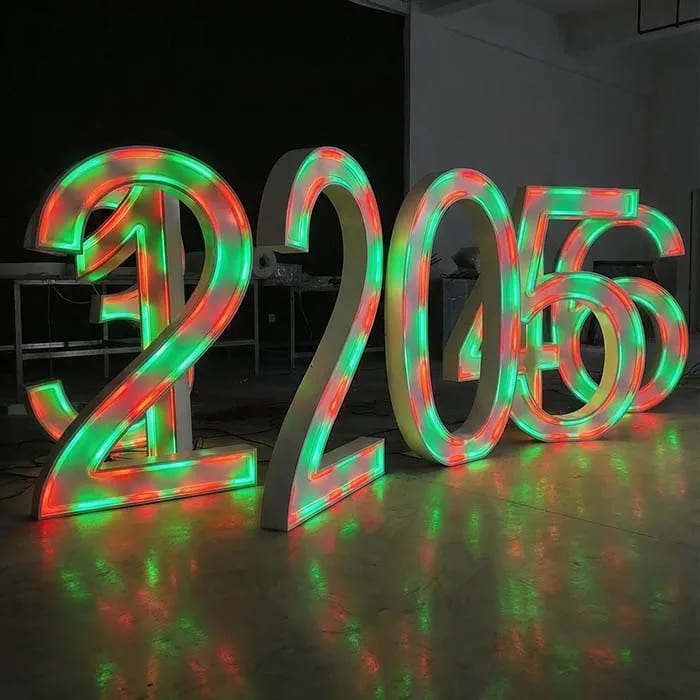
Real photo from our production floor — every sign we ship is made here.
Products mentioned or relevant to this topic — factory-direct, custom built.
From $24/letter · MOQ 1 piece · Flexible lead time · CE & UL certified · ships to 20+ countries
Custom sizes, colors, and finishes. Get a factory price in 24 hours.
Get a Free Quote Copy EmailWhatsApp +86 13865703472 · business@aochuangsign.cn
See pricing, specs, and get a free quote for the sign type you need. Built in our factory, shipped worldwide.