I've unwrapped shipments where the letters had 1mm gaps filled with bathroom caulk. Over 16 years on a factory floor, that's one of the tamer "surprises" I've seen. You're here because you want to buy front-lit channel letters or 10-foot stainless logos without getting burned. Good.
The problem isn't that Chinese factories are dishonest—it's that most buyers don't ask the right questions. They ask "Do you have CE?" and stop there. They think a cheap sample photo means the whole order will look the same. Then a shipping container arrives with flaking paint and LEDs that die in six months.
At Aochuang Sign, we'll show you everything on this checklist. We're a 3,000m² shop in Lu'an, Anhui, with 50 workers and ISO 9001 certification. But I'm writing this because even if you never buy from us, you should demand this level of transparency from whoever takes your money.
Look, CE and RoHS are table stakes. They don't mean the factory makes good signs. They mean the factory paid 20,000-50,000 RMB for testing a few samples. I've been to shops that have a valid CE certificate framed on the wall—and production lines that look nothing like what was tested.
Here's what nobody tells you: CE for a sign often covers only the power supply, not the whole luminaire. If a factory says "our letters are CE certified," ask for a certificate that lists the full model number, not just the driver. One trick I've seen: they'll test a single 10-inch letter and apply that certificate to a 48-inch monster with a completely different thermal profile. That's a fire hazard, not a shortcut.
The ugly truth is that many factories claim UL because they bought a few UL-listed power supplies and slapped a sticker on the sign. Full UL 48 listing costs $4,000-$15,000, takes 4-9 months of quarterly audits, and ties the listing to a specific factory address. If you need UL for a US project, ask to see the Certificate of Compliance with today's date and the factory's physical address—not a distributor's. We don't hold UL 48 ourselves (we focus on CE and RoHS for our 21-country export base), but we'll walk you through the cost and timeline if your project demands it. Anyone who says "UL, no problem, included" for a $2000 order is blowing smoke.
I've seen this go wrong: a client ordered 200 brushed stainless letters for a corporate HQ in Frankfurt. They arrived looking perfect. Six months later, micro-pitting appeared on the face. The factory had used 201-grade stainless, not 304, because it saved them $8 per letter. Replacing 200 installed letters cost the client $45,000.
Here's the materials checklist you run through on a video call, with the factory holding a micrometer. For stainless steel letters: 304 has 18% chromium and 8% nickel. It'll do 10+ years outdoors in most climates. If you're within 10 miles of the ocean, pay the 20-30% premium for 316—the molybdenum stops saltwater pitting dead. Both grades should feel heavy in your hand. 304 density is 7.93g/cm³; a 12-inch tall letter made from 1.5mm 304 should weigh around 2.3 kg. Ask them to put it on a scale.
For acrylic faces, the difference in light transmittance is visible. Mitsubishi or Degussa acrylic starts at 90-92% and won't yellow for 5-8 years under UV. Domestic Chinese acrylic is perfectly fine for indoor menus, but outdoors, it'll start yellowing in 1-2 years. If you're buying a light box over 2.5 meters wide, insist on 5mm minimum thickness. 3mm will bow and crack. I've kicked returned panels right off the loading dock because someone thought saving $15 on a sheet was clever.
LED quality isn't about lumens per watt on a spec sheet. It's about what happens after 16,000 hours in July heat. Here's what nobody tells you: Samsung SMD 2835 modules rated at 100-150 lm/W sound identical to no-name modules with the same rating on paper. But the phosphor coating degrades differently. Cheap modules shift color to greenish-blue by month 18 and leave dark spots. I've seen entire channel letter sets relamped at $350 per letter.
Ask the factory to show you a running aging rack—not a photo, a live video. At our shop, every assembled sign runs for 8-12 hours at full brightness before packing. The rack should be ugly, dusty, and obviously used. Look for dead modules in the background. If they can't show you a rack with at least 10 different signs burning simultaneously, they're not testing. Period. For back-lit halo letters, the LED placement behind the return is critical; bad positioning gives you hot spots instead of a clean glow. That's one reason we pay premium for Samsung and Osram modules—less rework, fewer midnight phone calls from Miami.
You're not just buying materials. You're buying 10 steps that take between 7 and 15 days. Laser cutting should hold ±0.1mm tolerance—ask to see a caliper measurement of a cut letter back against the digital file. TIG welding on stainless returns should be smooth and nearly invisible after grinding, not a line of bird-dropping blobs. If the factory uses MIG welding on thin steel to move faster, the heat distortion will twist your letter returns, and the powder coat will crack.
Look, the sealing process is where most leaks start. Neutral cure silicone costs more than acetic cure, but acetic silicone off-gasses vinegar that corrodes LED contacts over time. Sniff a finished letter—if it smells like salad dressing, run. The same rule applies to wire connections: soldered joints with shrink tube are fine, but factory-crimped connectors with proper strain relief are better for large signs. Ask for a cross-section photo of a wired letter. If you see tangled wire nuts, you're dealing with a workshop, not a factory.
IP65 sounds impressive. It means the sign withstands water jets from any direction during a 15-minute test. It does NOT mean your sign survives a Florida hurricane or a Chicago winter with freeze-thaw cycles. I've seen factories slap an "IP65" sticker on a channel letter with a tiny vent hole in the bottom—that's a drainage hole, not a seal. Water will get in, and the electronics will short.
For marine applications or ground-level signs that get hit by sprinklers, demand IP66 at minimum. For submersible fountain signs, IP68. The test reports should be from a certified lab like TÜV or SGS, not an in-house rig made from a garden hose. One honest question to ask: "Show me a video of you submerging a fully wired, fully lit test letter in a tank for 2 hours." If they ghost you, you've got your answer.
Sea freight from Shanghai to Long Beach takes about 65 days. Your sign will spend two months in a container that can hit 60°C inside, get stacked under 2 tons, and ride out a Pacific storm. Standard packaging at Aochuang is foam wrapping, double-wall carton, and then a plywood crate for anything over 600mm. For back-lit halo letters with exposed acrylic returns, we add padded separators because a hairline scratch on a polished return ruins the halo effect.
The ugly truth is that LCL sea freight is a bargain—$80-200 per cubic meter—but it's brutal. I've received crates that looked like they were used as a jackstand. Specify 9mm minimum ply thickness and steel banding. Ask the factory to send photos of the crate before sealing, with your sign visible inside. And never, ever let them stuff an empty space with newspaper; that's a mold invitation.
Start your opening email with a request for a raw material invoice from the last week. Not a supplier's brochure—an actual purchase order showing brand, quantity, and price. If they won't share it, they're likely using cheaper stock than they claim. The invoice should show Mitsubishi acrylic, 304-grade stainless coil, or Samsung LED reels. One of my suppliers prints the lot number on every acrylic sheet so I can trace it back to the resin batch. That's the level of nerd you want.
Here's what nobody tells you: a factory that demands a 50-unit minimum on first orders is often a trading company with no real floor. We have an MOQ of 1 piece because we actually make the stuff. We've shipped single 18-inch lobby letters to test a new client's expectations. If a "factory" can't fabricate a one-off sample and ship it within 10 days, you're talking to a middleman who'll mark up 30% and never touch a caliper.
I've seen this go wrong: a contractor ordered 120 linear feet of exposed neon flex for a restaurant chain. The sample looked great. The production run used a different, thinner silicone jacket that turned yellow in 4 months. The factory insisted it was "the same spec." It wasn't. Now I demand a production-line photo of the exact roll with the batch tag before any full order ships. That's not being difficult—that's remembering the $18,000 redo I watched someone else pay for.
Factory-direct prices on channel letters can be 50-65% below US retail installed rates. You'll see $80-$120 for a 12-inch back-lit halo letter from us, versus $400-$1,000 installed at a local shop. But you need to add import duty, customs broker fees, and the Section 301 tariff—roughly 30% on most sign products from China. A $5,000 order can land at $6,800 before you touch it. Budget for it. Nobody's wiring money back because you forgot to read the Harmonized Tariff Schedule.
Look, if a quote seems impossible—like a 24-inch 316 stainless letter with halo lighting for $45—the materials are fake. 316 stainless sheet costs us more per kilo than what they'd be charging for the finished letter. I've deboned a competitor's sample and found 201 stainless with a cheap chrome plate that measured 0.3mm thick. That's foil, not signage. Ask for the metal thickness spec in writing, and if it's not in the contract, it won't be in the crate.
You can't fly to Lu'an every time. But you can ask for a 10-minute live factory tour over WeChat or Zoom. Look for natural light, machine noise, and workers who look busy, not posed. On our tours, I walk past the laser bed, the bending brakes, the LED assembly benches, and the aging rack without skipping a beat. If the camera turns off whenever you ask to see a specific station, hang up.
One final thing: ask the factory what they can't do. If they say "we can make anything," it means they're not equipped to make anything well. We don't do large structural pylons or UL field inspection on-site because we know our limits. A factory that respects you will tell you no before you lose money. That's the whole point of this business: earning trust over years, one crate at a time.
Factory-direct since 2010. Free quote within 24 hours — no obligation.
Get a Free Quote → Copy EmailMOQ: 1 piece · Flexible lead time · 2-year warranty · Worldwide shipping

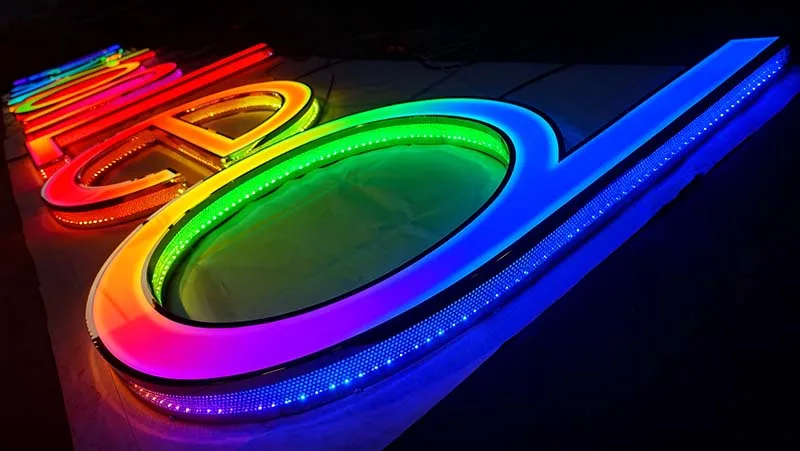
Real photo from our production floor — every sign we ship is made here.
See pricing, specs, and get a free quote for the sign type you need. Built in our factory, shipped worldwide.