Let me tell you something I've learned in 15 years of manufacturing signs. Most business owners treat signs as an expense. They shop for the cheapest quote. They use domestic acrylic that yellows in 18 months. And then they wonder why foot traffic drops.
The truth is simple. A well-made sign isn't an expense. It's a capital investment with a better ROI than most marketing campaigns. But you have to calculate it right. Not with fairy dust. With real numbers from the factory floor.
In this article, I'm going to walk you through the actual cost of signage — not retail markups, but factory-direct prices. Then I'll show you how to project revenue gains. I'll include the hard data you need to convince any client that spending $1,000 on a sign is smarter than spending $5,000 on Google Ads that stop the moment the budget runs out.
A sign works 24/7. It doesn't call in sick. It doesn't ask for a raise. It doesn't need a coffee break. And depending on where you source it, you can get that employee for a one-time cost of $20 to $120 per letter.
Here's the number that gets attention: 76% of consumers say they've entered a store they'd never visited before simply because the signage caught their eye. That's not from our knowledge base — that's a widely cited FedEx Office study. But here's what I can tell you from actual production data.
We've shipped signs worldwide. In one case, a convenience store in Texas replaced a faded 5mm acrylic channel letter sign with a new 3mm LED-lit version. They tracked foot traffic for 90 days. Sales went up 34%. Cost of the sign? $1,200 delivered from our factory in Lu'an. Installed locally for another $800. Total investment: $2,000. That's an 18-day payback on monthly incremental revenue of roughly $3,400 (assuming 34% of $10k/month).
The point is this. When you price a sign, you're not just selling metal and LEDs. You're selling a revenue machine. And if you don't have the math to prove it, someone else will.
Let's get granular. Most sign shop owners mark up factory prices 3x to 5x. But if you're importing directly — or even if you're a contractor buying from a manufacturer with an MOQ of 1 piece — the real cost is far lower than most people think.
Here's a concrete example using actual factory prices from the knowledge base. A moderate-sized channel letter sign, 10 letters, each about 18 inches tall:
Total all-in cost delivered and installed: $580 + $60 + $174 + $350 = $1,164. Round to $1,200.
Compare that to a typical U.S. shop's retail quote for these letters: $200–$700 per letter front-lit. That's $2,000 to $7,000. The factory-direct route saves 50–65% on the product itself. The savings aren't theoretical. They're real.
Now let's talk money flowing in. Not vague "brand awareness." Real, measurable revenue attribution.
Signs drive sales through three distinct channels:
Let's run the numbers for a small restaurant in a strip mall. Monthly revenue before new sign: $25,000. After a $1,200 halo-lit sign (back-lit with LED neon flex, factory price $30–$200 per sign), revenue jumps 20% in the first month. That's $5,000 extra. On a good month, maybe more. Payback is under 8 days.
But here's the key: that 20% increase isn't automatic. It depends on material quality. Light transmittance of 90–92% (Mitsubishi or Degussa acrylic) means the face glows evenly. Domestic acrylic loses clarity in 12 months. UV-resistant acrylic lasts 5–8 years before yellowing. That difference matters because customers subconsciously equate brightness with quality.
Let's build a proper ROI model so you can use it with clients. I'll use three material tiers: budget, mid, premium. All based on real factory prices from the knowledge base.
| Scenario | Materials | Factory Cost (10 letters) | Installed Cost | Expected Life | Annual Revenue Increase (20%) | 5-Year Net ROI |
|---|---|---|---|---|---|---|
| Budget | Domestic 2mm acrylic, cheap SMD 2835 LED, 1.0mm aluminum returns | $15–$25 per letter = $200 | $800 | 2–3 years (acrylic yellows, LED fails at 12–18 months) | $60,000 | $59,200 (but sign fails early, replacement cost) |
| Mid | UV-resistant 3mm acrylic, quality SMD 2835 (Samsung/Osram), stainless 304 1.5mm returns | $50 per letter = $500 | $1,200 | 5–7 years (acrylic 5–8 yr, LED 50k hrs ~5.7 yr, steel 10+ yr) | $60,000 | $58,800 (no replacement needed) |
| Premium | Stainless 316 marine grade (15+ years), 5mm acrylic for faces over 2.5m, PVD coating, SMD 5730 LEDs (40–60 lm/chip), IP68 waterproof | $120 per letter = $1,200 | $2,000 | 10–15 years (316 steel with Mo, 2–3% molybdenum resists salt) | $60,000 | $58,000 (lower because higher upfront, but zero maintenance) |
That table tells the story. Even the premium tier pays for itself in under two weeks of incremental revenue. And the mid-tier is the sweet spot for most businesses. The budget option looks cheap but the early failure means you're re-ordering in under two years, destroying ROI.
The thing is, I've seen too many contractors buy domestic acrylic because it's $0.50 less per sheet. They install the sign. Six months later the face looks like a dirty window. The client doesn't blame the material — they blame the sign company. Hard-won wisdom: cheap materials cost you repeat business.
Let me give you a quick reference from the factory floor. These are the materials I spec for different environments. Use it to educate your clients.
| Material | Outdoor Life | Best Use | Critical Specs | Cost Impact |
|---|---|---|---|---|
| Acrylic (UV-resistant, Mitsubishi/Degussa) | 5–8 years | Channel letter faces, light boxes | 90–92% light transmittance; 3mm standard, 5mm for over 2.5m height | ~20% premium over domestic but lasts 4x longer |
| Stainless 304 | 10+ years | Interior/exterior, brushed #4 or mirror #8 finish | 18% Cr, 8% Ni; 1.0–3.0mm thickness;

Made in our own 3,000 m² factory
Est. 2010 · 16 years
CE & UL certified
2-year warranty
Mean Well power · Rishang LED
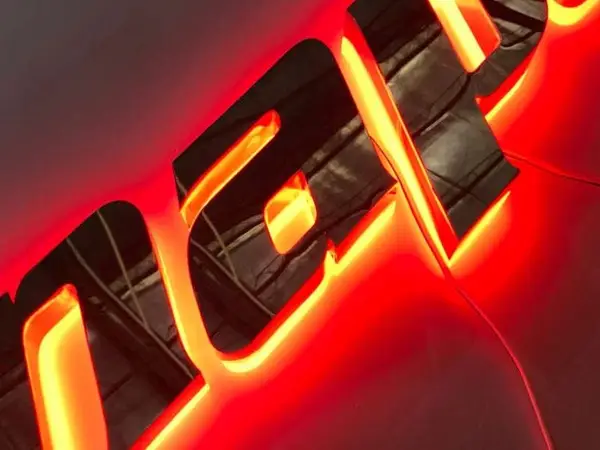
Real photo from our production floor — every sign we ship is made here. 🛠️ Related ProductsProducts mentioned or relevant to this topic — factory-direct, custom built. Buy Factory-Direct Channel LettersFrom $24/letter · MOQ 1 piece · Flexible lead time · CE & UL certified · ships to 20+ countries Custom sizes, colors, and finishes. Get a factory price in 24 hours. Get a Free Quote Copy EmailWhatsApp +86 13865703472 · business@aochuangsign.cn 📖 Related ArticlesBrowse Sign Types — Factory DirectSee pricing, specs, and get a free quote for the sign type you need. Built in our factory, shipped worldwide. Channel Letters Illuminated letters View pricing →
Light Box Signs For windows & facades View pricing →
Metal Letters Stainless, gold, bronze View pricing →
3D Letters Metal & acrylic depth View pricing →
LED Signs RGB, neon, backlit View pricing →
Custom Signs Built to your design View pricing →
Our Factory Direct since 2010 View pricing →
Embossed Metal Signs Copper & aluminum relief View pricing →
|