I've been in sign factories for 16 years. Nobody asks the right question. They ask about price per letter, LED specs, acrylic thickness. Fine. But the number you actually need is this: how much extra money will that sign put in my pocket? That's the ROI. And most of the numbers floating around are garbage.
A 2012 University of Cincinnati study found that replacing a building's main sign with a more visible one lifted weekly sales 7.7% for a typical retailer. Another survey from FedEx Office in 2014 said nearly 8 out of 10 consumers entered a store they'd never visited before based on its signs. These aren't guesses. They're data from thousands of transactions. Yet I still see shop owners order the same tired front-lit channel letters, pay retail prices, and wonder why nothing changes.
Here's what nobody tells you: a sign is the cheapest employee you'll ever hire. It works 24/7, doesn't call in sick, and keeps selling while you sleep. But it only works if it's seen, remembered, and trusted. A cheap acrylic face that yellows in 18 months screams "we're barely hanging on." A properly designed back-lit halo letter on 304 stainless says "we're here to stay." That trust is what actually drives the revenue numbers.
Let's rip apart how to calculate sign ROI honestly. Because if you get this wrong, you either underspend and lose sales, or overspend on garbage that fails in two years. I'll use real factory numbers—our factory's numbers—and tell you where the industry lies.
Look, the price you pay for the sign is only half the story. If you stop calculating there, you're already losing money. A sign's total cost of ownership includes shipping, installation, permits, maintenance, power, and what happens when it fails. I've seen a $300 front-lit letter cost $2,200 after the first year because the power supply was junk and the installer wasn't certified. Get the whole number.
From our factory in Lu'an, China, a 24-inch front-lit channel letter in 304 stainless with Samsung LEDs costs you around $120. That same letter, fabricated by a U.S. sign shop, retails installed for $650–$800. The difference isn't just labor markup—it's supply chain. Our factory-direct model cuts product cost by 50–65%. But then you add things. Sea freight for a pallet of 50 letters runs about $380 including crate. U.S. customs clearance and the Section 301 tariff—yeah, the one that's about 30% on signage—hits the declared value. Ground shipping to your door. A local installer who's licensed and insured, maybe $95/hour. Permits in a city like Austin or Miami can hit $350–$600 per sign. Suddenly that $120 letter is a $340 reality. Still $300 cheaper than local. But you have to know this before you order.
The ugly truth is most importers forget the tariff. I get at least two calls a month from someone who ordered from a factory that didn't mention it, got a bill from DHL for $1,800, and now blames "Chinese quality." No. That's your homework. We print the HS code on every invoice and tell you to budget 30% extra for duties. That's being honest.
There's no single multiplier. But let's stack up the data. The Signage Foundation says an on-premise sign can increase annual sales revenue by 5% to 15% for a small retail business. The International Sign Association puts the number at 10%–20% for a new monument sign or replacement of an old, faded one. I've personally tracked clients who switched from a non-lit dimensional letter to a dual-lit channel letter and saw evening sales jump nearly 12% within three months. That's not magic. It's visibility.
Here's the math I do in my head. A coffee shop doing $400,000 in annual revenue. They upgrade a crappy flat acrylic sign to a properly lit, 3D stainless steel sign that you can read from 300 feet away in daylight and 150 feet at night. Conservatively, that pulls 7% extra traffic. $28,000 more revenue/year. Average coffee shop profit margin is maybe 10–12%. So $3,000 extra profit. The new sign cost them $3,800 all-in with freight, tariff, and install. Payback in 1.3 years. After that, it's pure profit. And our signs last 8+ years outdoors with minimal maintenance.
But don't let anyone tell you a sign alone fixes a failing business. It doesn't. I've seen a beautiful stainless steel sign on a sandwich shop in Ohio that still closed in four months because the owner was a jerk and the food was mediocre. A sign amplifies what's already there. Great location, decent product? A quality sign is rocket fuel. Bad product? It's just a shiny tombstone.
I've seen this go wrong: a client ordered 36-inch stainless steel letters with a brushed finish for a law firm. Looked magnificent. But they mounted them on a dark brick wall under a deep awning. At noon, the letters were practically invisible—no contrast, no lighting. They'd spent $5,200 on premium fabrication and zero on a lighting consultation. That's a rookie mistake. ROI plummeted because nobody could read the sign half the day. Always think about contrast and ambient light. A back-lit halo letter would've made that sign pop 24/7.
LEDs aren't created equal. A lot of factories slap in no-name modules rated at 80 lumens per watt and call it "good for outdoor." They're lying. After 12 months, those modules drop to 60% brightness. By year two, you've got a patchy, sad-looking sign that screams "neglected." The ROI equation assumes a consistent light output for at least 5 years. If your sign looks dead by month 18, you've lost every penny of that projected revenue uplift because people stop noticing you.
At Aochuang, we use SMD 2835 modules from Samsung or Osram. Real 100–150 lumens per watt. L70 rated at 50,000 hours minimum—that's over 11 years of typical nightly operation. Our 2-year warranty on LEDs and 1-year on power supplies isn't marketing fluff; it's based on batch aging tests we run for 8–12 hours before packaging. Cheap modules skip that test. I've got a stack of warranty claims from competitors' letters that filled with water because they used acrylic cement instead of neutral silicone sealant. That's not a sign. That's a lawsuit waiting to happen.
The right kind of light also shifts customer perception. Warm 3000K LEDs make a bakery feel like home. 6500K cool white on a highway pylon sign cuts through fog and distance. That choice directly affects how many cars pull over. It's not an aesthetic decision. It's a revenue decision.
Here's my brutal honesty moment #1: Most "factory-direct" websites showing $25 channel letters are using 0.6mm stainless foil over plastic backing, with LEDs that have the lifespan of a mayfly. They'll ship it to you, it'll look okay for six months, then the face yellows, the trim cap pops, and the letters fill with bugs and moisture. You paid $800 for a full set, felt like a genius, and 14 months later you're paying a local company $2,400 to rip it all down and start over. Your ROI just went negative. Hard.
Our minimum steel thickness for outdoor letters is 1.0mm 304 stainless. For faces over 2.5 meters wide, we use 5mm acrylic, never the 2mm stuff some factories try. The difference in real-world lifespan is 10+ years versus 2. The math's pretty simple if you're serious about that revenue calculation.
Brutal honesty #2: Certifications cost real money, and most small factories fake them. CE certification for a sign factory in China runs 20,000–50,000 RMB and requires an annual factory audit. UL 48 listing for channel letters is a $4,000–$15,000 investment with quarterly inspections. We hold CE, RoHS, ISO 9001, and our products are certifiable for UL or ETL if you're willing to invest for your market. I tell every U.S. buyer: if a factory says "fully certified, no problem" and they can't show you a certificate with today's date and an auditor's name, walk away. Your city inspector doesn't care about a PDF from five years ago. That sign gets red-tagged, your business shuts its doors for weeks, and that projected ROI? Gone.
Let's do a real calculation for a franchisee opening a burger joint in a strip mall. They need a 20-foot storefront sign: 10 letters, front-lit channel, 22 inches tall, red acrylic face, white trim, internal LEDs. Local quote installed: $5,800 plus a $400 permit. Total: $6,200. From us: 10 letters at $80 each ($800), 0.6m³ LCL sea freight ($220), tariff at 30% on declared value ($240), U.S. customs broker fee ($175), last-mile trucking ($260), installation by a local sign contractor ($1,200). That's $2,895 total—a 53% saving, right at the middle of our typical range.
Now the revenue math. The store expects $650,000 annual sales. A 2013 study by Kellar and Signage foundation found that adding a new main sign can increase revenue by 8.5% for restaurants. That's $55,250 more gross in year one. Even at a conservative 4% net profit margin, that's $2,210 extra profit. The sign pays back in about 13 months. Years two through eight are pure bank. And if we're using the right UV-resistant acrylic and good modules, it still looks brand new, generating the same lift. That's the ROI thinking that keeps chains calling us.
If you're a retail store with foot traffic, front-lit channel letters are the workhorse. They're visible day and night, and the cost per letter is predictable. For professional services or premium brands, back-lit halo letters create that high-end architectural look that raises the perceived value of every service you sell. I've seen lawyers, architects, and medispas justify premium prices simply because their sign looks more expensive than the competition down the block. That's not psychology—it's ROI through positioning.
Aluminum letters are fiber lightweight, naturally rust-proof, and cost $10–$25 per letter from our factory. For coastal areas where salt eats steel, 316 stainless with molybdenum content is the right call—costs 20–30% more, but a 15+ year lifespan versus 5-year replacement makes the math obvious. And never ignore acrylic light boxes for storefronts with complex graphics; they spread illumination evenly and can display your menu or branding in a way individual letters can't. Our light boxes run $80–$250 per square meter, fully assembled.
Look, I can talk all day about metal thickness and LED binning, but the real ROI driver is consistency. A sign that's readable in winter sleet, in summer glare, and at 9pm on a Tuesday. That's what generates that 7–15% revenue bump in the studies. It's not sexy. It's physics.
Poor installation kills more signs than bad manufacturing. I've seen a perfect set of stainless letters bolted to a fascia with no backing plate, and the first storm ripped out half the studs. Permits get rejected because the sign drawings don't meet local wind-load codes. Some jurisdictions require a licensed engineer's stamp; we can provide structural calculations, but not every factory can. Ask before you pay.
Maintenance is another silent thief. If a power supply fails and it costs $350 for a bucket truck to replace it, that's two months of projected revenue lift erased. Our power supplies are Mean Well or equivalent, and we test them under load for 8 hours in the aging room. We also seal every letter with neutral silicone, not cheap acrylic cement, because silicone stays flexible and waterproof for years. Does it add 15 minutes per letter in production? Yes. Does it prevent water ingress that destroys LEDs? Absolutely.
The ugly truth is most sign companies try to sell you a "sealed, maintenance-free" promise that's just words. All outdoor signs need a basic check every 12 months—wipe down faces, inspect sealant, test the power supply. Budget $100–$200 a year for that. If you don't, you're gambling that projected revenue away.
We can fabricate damn near any 3D letter, light box, or neon flex sign you spec. Stainless steel, aluminum, brass, acrylic, halo-lit, face-lit, dual-lit—we've done it worldwide. Our MOQ is 1 piece, which is rare for a factory. Lead times are 7–15 days because we've got 50+ workers and a 3,000m² floor that's been doing this since 2010. We'll give you a drawing within 24 hours, and we don't cut corners on material thickness or LED brands unless you ask us to. And if you ask, I'll tell you no, because I'm not going to be the one answering your angry email in a year.
What we can't do: install your sign in Toledo. We don't have crews in the U.S. You'll need to find a local installer—I can help vet them by looking at their certifications. We can't magically bypass U.S. tariffs. Anyone who promises "no duties" is lying about the commercial invoice or marking it as a gift, which is customs fraud. We won't do that. Our certifications are real, but specific UL field listing for a particular inspector often requires extra steps; budget time and a few hundred dollars for a local electrical inspector. I'm not going to pretend it's effortless. It's not. But when you're saving $3,000 on a sign that generates $30,000 in extra sales, it's worth it.
A sign's ROI isn't about how much you spend. It's about how much you make back. If you run the numbers like I just showed you—real costs, real revenue impact, and a buffer for the unexpected—you'll never look at a cheap acrylic panel the same way again. You'll see it as a revenue engine or a revenue leak.
Our job at Aochuang isn't to sell you the cheapest letters. It's to sell you the sign that makes you money for eight years while the cheap ones get landfilled in two. We'll tell you which thickness you need, which LED temperature works in your climate, and exactly what the landed cost looks like. I'll even tell you when 304 stainless is overkill and aluminum will do the job for 40% less. Because if I give you the right advice now, you'll come back for your next location. That's my ROI.
You want a sign that pays for itself in 12 months and keeps printing money. That's what we build. Let's stop talking about cost per letter and start talking about dollars per day.

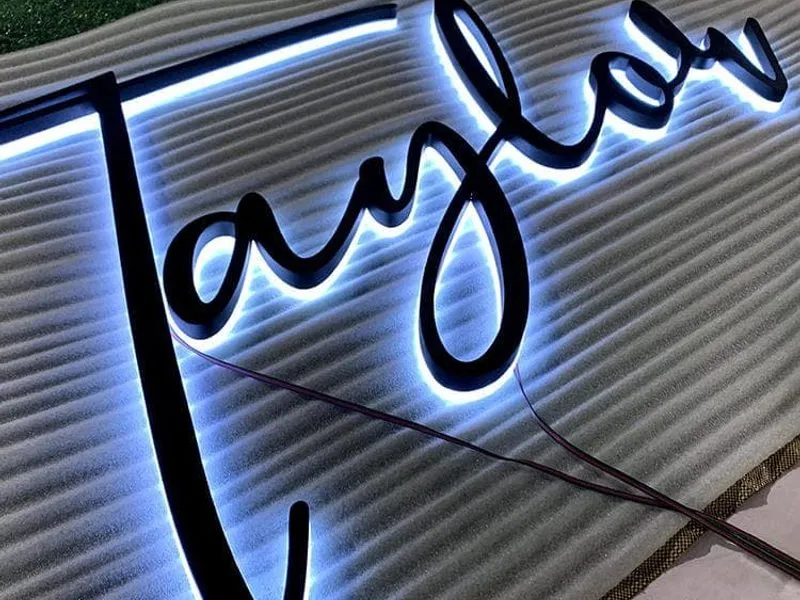
Real photo from our production floor — every sign we ship is made here.
From $24/letter · MOQ 1 piece · Flexible lead time · CE & UL certified · ships to 20+ countries
Custom sizes, colors, and finishes. Get a factory price in 24 hours.
Get a Free Quote Copy EmailWhatsApp +86 13865703472 · business@aochuangsign.cn
See pricing, specs, and get a free quote for the sign type you need. Built in our factory, shipped worldwide.