I've watched sign shops pay $800 for a front-lit letter from a domestic fabricator. Same 304 stainless, same Samsung LEDs. We ship that letter for $120.
That's the kind of number that makes Reddit threads blow up. Small business owners post about getting burned by cheap signs that yellow in a year, or paying three times what they should have because they didn't know where to look. I've been installing commercial signs for two decades across thirty-plus states. I've seen every permit nightmare, every mounting surface that shouldn't exist, every rookie mistake that costs real money. So let me tell you what those Reddit posters are missing — and what the manual won't cover.
I've installed this in strip malls in Ohio and on beachfront storefronts in Florida. The problems are the same, just the salt changes the timeline.
First hard fact: quality LED modules with Samsung or Osram chips have an L70 rating of at least 50,000 hours. That's about 5.7 years of continuous use before brightness drops to 70%. The cheap modules you see on Reddit for 80% less? They die in 12 to 18 months.
Quickest way to spot bad LED modules: look at the solder joints. Dull gray = won't last 18 months. Shiny silver = proper lead-free solder. I've seen small business owners brag about saving 60% on LEDs, then six months later they're posting on Reddit asking why half their sign is dark. The response from the "experts" is always the same: "Should've bought quality." But they didn't know how to tell the difference.
Here's what the permit office won't tell you: That cheap warranty that says "5-year LED life" is worthless unless the certification backs it up. Most of those claims come from factories using generic chips that list L70 at 30,000 hours — if they even measure it. If you want real numbers, ask for the LM-80 test report. If the sales guy doesn't know what that is, run.
Pro tip: SMD 2835 modules give you 100-150 lumens per watt. That's the industry standard for channel letters. SMD 5730 is brighter per chip (40-60 lumens per chip) but runs hotter. For a small business sign that's on 12 hours a day, stick with 2835. You won't need the extra brightness, and your power supply will thank you.
Don't make the mistake I made: assuming "acrylic" is all the same. It's not. Mitsubishi or Degussa UV-resistant acrylic sheets hold their clarity for 5 to 8 years. Domestic acrylic? You're lucky to get 2 years before yellowing. The light transmittance on quality acrylic is 90-92%. The cheap stuff starts at 85% and drops fast.
Common thicknesses are 2mm, 3mm, and 5mm. If your sign face is over 2.5 meters wide, you need 5mm minimum. I've seen Reddit posts from guys who used 3mm on a 3-meter letter because the online calculator said it was fine. The first strong wind bent the face inward and cracked it. No warranty covers wind damage.
Stainless steel 304 has 18% chromium and 8% nickel. It lasts 10+ years outdoors in most climates. 316 adds 2-3% molybdenum and pushes lifespan past 15 years in coastal environments. The cost premium is 20-30%. For a strip mall in Ohio, 304 is fine. For Miami Beach, pay for 316 or you're replacing letters in 3 years. I've replaced too many 304 letters on the Gulf Coast to count. The pitting starts around year 4.
Aluminum weighs one-third of steel and is naturally rust-proof. Anodized or powder-coated aluminum holds up 8-12 years outdoors. For small signs (under 2 feet tall), 0.040-inch thickness is enough. For bigger faces, jump to 0.063. I've installed this in a dozen states and aluminum is my go-to for budget-friendly signs that don't look cheap. Just don't use it if your lettering has sharp bends — it cracks easier than stainless.
Here's where Reddit really gets it wrong. Everyone loves the idea of cutting out the middleman. Factories like Aochuang (founded 2010, 3,000 square meters, 50+ workers, exports worldwide) offer front-lit channel letters at $20-80 per letter, back-lit halo letters at $35-120, stainless non-lit at $15-40. Compare that to US retail installed at $200-700 per letter for front-lit. You save 50-65% on product. That's real.
But the shipping and tariffs will bite you. Section 301 tariffs on Chinese-made signs add about 30% at customs. Even then, you're still ahead — assuming you account for freight. Express shipping (7-10 days) costs $30-100 for small packages. Air freight (about 10 days) runs $4-12 per kilogram. Sea freight (about 65 days) is $80-200 per cubic meter for LCL, or $1,200-3,000 for a full container.
Here's the brutal honesty: LCL sea freight involves your crate getting handled 6 to 8 times between the factory dock and your front door. Every touch is a chance for damage. I've seen crates dropped, crushed, and water-damaged. That's not in the brochure. If you order a sign worth $300 and the shipping costs $200, you still save compared to domestic, but you have to be smart about packaging. The factory should use foam plus carton plus plywood crate. If they skip the plywood, add 20% for risk.
CE marking costs 20,000 to 50,000 RMB for certification. Most factories will say they have it. Ask to see the certificate with today's date on it. Watch them sweat. If they can't produce it within 10 minutes, they're lying. UL certification for the US is $4,000-15,000 and takes 4-9 months with quarterly audits. That's why many small businesses skip it. But if your local building inspector requires UL labeling, you're stuck. ETL is a valid alternative at 10-30% cheaper.
I've installed this in cities where the permit process took longer than the fabrication. Reddit posts love to focus on design and cost, but nobody talks about NEC Article 600. That's the National Electrical Code section governing signs. It's not optional. Every sign installed in the US must comply. That means proper grounding, correct wire gauge, and structural support that can handle wind loads.
IP65 sounds impressive. It means dust-tight plus water jets from any direction. It does NOT mean your sign survives a Florida hurricane. For coastal areas, you need IP66 (powerful jets) or IP68 (submersible). I've seen a small business owner post on Reddit about his IP65 sign getting destroyed in a tropical storm. He didn't know the difference. Now he does.
ADA rules require tactile signs mounted 48 to 60 inches above the floor, with non-glare finish and Grade 2 Braille. If you're making interior room signage for a retail space, this is non-negotiable. I've had jobs held up for weeks because the Braille dots were too tall or the contrast wasn't right. Reddit advice often ignores this completely. If your sign is for a publicly accessible building, you need ADA compliance. Period.
Don't make the mistake I made: assuming the factory handles all certifications. They'll provide the IP rating and maybe CE or RoHS. But local code requirements? That's your problem. In Chicago, you need a structural engineer stamp for any sign over 10 square feet. In San Francisco, seismic calculations are required. The factory in China doesn't know your local code. Don't blame them.
I've installed this in rain, snow, and 100-degree heat. Here's what I've learned: the sealing is everything. Use neutral silicone, not acetic acid-based (vinegar smell). Acidic silicone corrodes aluminum frames. The factory should seal the sign on day one, then let it cure for 8-12 hours in an aging test. If they skip that step, your first rainstorm finds the gaps.
The production process at a decent factory like Aochuang takes about 5-15 days: design confirmation (1 day), laser cutting with ±0.1mm accuracy (1-2 days), TIG welding (1-2 days), grinding and polishing (1-2 days), CNC acrylic cutting (1 day), LED assembly (1-2 days), sealing (1 day), aging test, QC inspection, then plywood crate packaging. If any factory tells you they can do it in 3 days, they're cutting corners.
Pro tip: request photos of the QC inspection. You want to see the sign lit up on a test bench, with the backlight uniform and no dead pixels. If they send you a picture of a sign sitting on a warehouse floor, that's not QC.
Mounting is where most rookie mistakes happen. Channel letters need standoffs that allow airflow behind the sign. If you mount them flush against the wall, moisture gets trapped and the LEDs burn out faster. I always leave at least 2 inches of clearance. For halo-lit letters, you need a clear acrylic backer that lets the light escape. Stainless steel returns should be at least 1.0mm thick; any thinner and they'll warp during installation.
This section depends on the approved design, installation conditions and local code. The remaining project-specific details depend on the approved design, installation conditions and local code; confirm them before ordering.

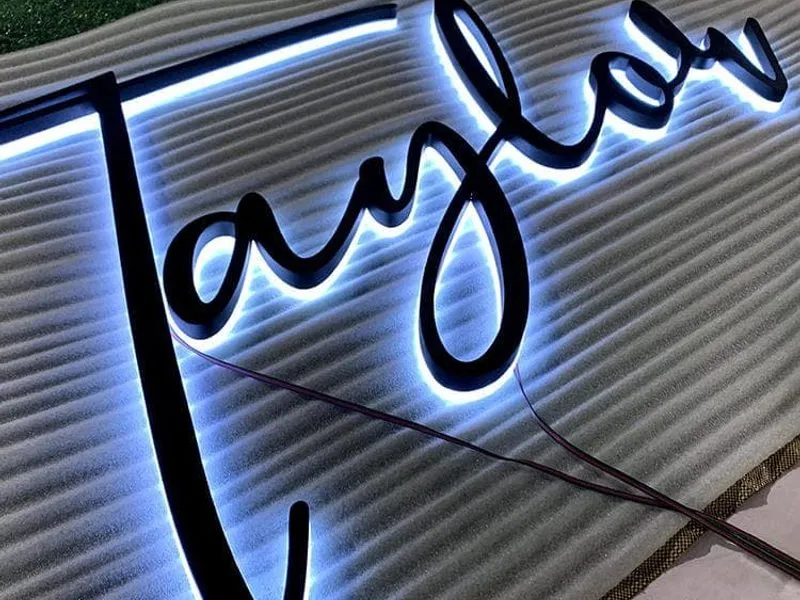
Real photo from our production floor — every sign we ship is made here.
Products mentioned or relevant to this topic — factory-direct, custom built.
From $24/letter · MOQ 1 piece · Flexible lead time · Project-specific compliance documents · ships to 20+ countries
Custom sizes, colors, and finishes. Get a factory price in 24 hours.
Get a Free Quote Copy EmailWhatsApp +86 13865703472 · business@aochuangsign.cn
See pricing, specs, and get a free quote for the sign type you need. Built in our factory, shipped worldwide.