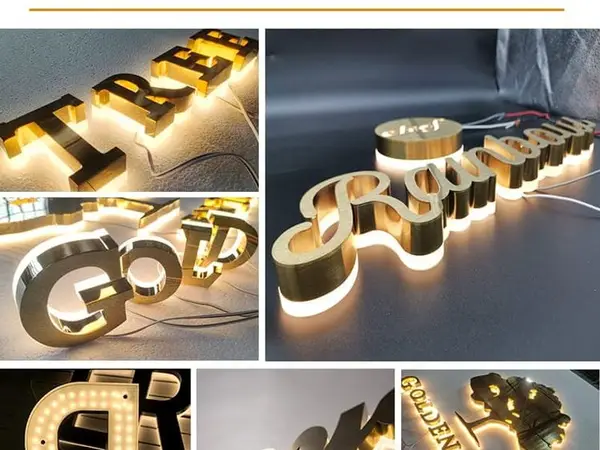
I've been bending metal and wiring LEDs since 1997. I've seen the trend swing from neon gas tubes to SMD channel letters to flexible LED neon. Everyone wants their storefront to pop without looking like a carnival ride. Two main ways to do it today: SMD LED inside a rigid channel letter, or LED neon flex that gives a continuous ribbon of light. You're here because you're comparing which one wins on brightness, uniformity, and what it'll actually cost you.
Let’s cut through the spec sheet nonsense.
I'll give you the real numbers off our factory floor. I'll tell you where each technology falls on its face. And I'll show you the price difference between buying from a US sign shop and buying direct from our plant in Lu'an.
Here's what nobody tells you: both SMD channel letters and neon flex use the same basic SMD LED chips. The difference is packaging. In channel letters, we mount SMD 2835, 5050, or 5730 modules on a PCB, stick them to the back of the letter can, and cover with an acrylic face. In neon flex, we embed those same SMD chips inside a round, milky silicone jacket so the light diffuses sideways, mimicking old-school neon gas but without the glass and high voltage.
So it's not LED vs LED. It's point-source vs glowing line. The real battle is about how the light hits the customer's eye.
SMD 2835 delivers 100-150 lumens per watt. 5730 pushes 40-60 lumens per chip, so you can get a lot of punch from a small module. In a 12-inch front-lit letter, we'll use three modules at 1.5W each, giving you 450-675 lumens total. That's enough to read the sign from 200 feet away on a sunny day. Neon flex, assuming 120 LEDs per meter and 8W/m, gives around 800 lumens per meter. A 12-inch section gets you about 240 lumens, but because it's a continuous surface, it looks surprisingly bright up close — but not a highway-distance beast.
I've seen this go wrong: a sign shop ordered front-lit letters with clear 2mm acrylic and sparse LED spacing to save money. At night, you could count every diode from the sidewalk, like a constellation. The store owner ripped them out after a month. Don't be that guy.
The ugly truth is most cheap neon flex LED you find on marketplaces will yellow in 12-18 months. The silicone casing turns the color of old scotch tape, light output drops 40%, and the warranty is worth the paper it's written on.
Look, uniformity is where neon flex wins hands down.
Build a channel letter with a proper opal acrylic diffuser (3mm minimum, 5mm for letters over 2.5 meters), space the modules right, and you can get a clean face that doesn't show spots. But achieving absolutely zero hotspots across every letter shape takes testing. Neon flex is inherently uniform because the silicone diffuser blends the light into a seamless ribbon. No matter how tight the radius, you won't see individual chips. For scripts and thin strokes, there's no contest: neon flex is the smoother look.
However, that smoothness costs you brightness per linear inch. A neon flex sign at 240 lumens per foot won't punch through heavy sunlight like a 500-lumen channel letter can.
Our front-lit channel letters use high-transmittance acrylic (90-92% light transmission) with built-in diffusion if requested. We can also add a layer of translucent vinyl to kill hot spots. But I'll be straight with you: on letters taller than 4 feet, even with opal acrylic, you might catch a slight gradient at the edges if the sun hits it just right. That's physics.
I've walked past a bank branch that used neon flex for their entire brand name — three-foot letters. Looked spectacular at dusk, but at noon in direct sun, it was faint compared to the neighboring hardware store's SMD channel letters. They were fine with it because their vibe was soft and premium. You need to know your context.
Here's where I can save you real money.
If you go to a US sign contractor, a front-lit channel letter installed can run $200-700 per letter. Halo-lit even more. A custom neon flex sign shaped to a script might be $400-$1,000 depending on size. Now, factory-direct from Aochuang Sign, our prices are the cost of steel, acrylic, LEDs, and labor. Front-lit channel letter: $20-80 per letter, depending on height and finish. A full neon flex sign for a storefront word like 'Bloom' typically runs $30-200 for the whole piece. That's a 50-65% savings on product, and you can use a local installer for mounting. Our front-lit channel letters start at $20 for a basic 10-inch capital letter in red acrylic with 2835 LEDs, going up to $80 for a 24-inch letter in brushed stainless steel return with high-output 5730 modules.
Our neon flex signs can replicate your cursive logo exactly, and we charge by the complexity and length, not some arbitrary 'per letter' multiplier.
Don't forget shipping. about 65 days ocean freight, but still way cheaper than local retail. A crate with 10 neon flex signs might cost $200 in sea freight.
Look, if your client needs a sign for a highway-facing store, go SMD front-lit.
The brightness and directional throw of a front-lit channel letter with 2835 or 5730 modules will be visible from half a mile. You can even do dual-lit letters that shine both ways. Neon flex is indirect by nature; its light spreads 360 degrees inside the tube, so a lot of lumens are wasted towards the wall or sky. For a strip mall where foot traffic is 20 feet away, neon flex creates an inviting, boutique feel. I'd use it for coffee shops, salons, hipster bakeries. For a gas station on a highway, no — stick to SMD.
Neon flex does have a cool factor that's hard to ignore. It mimics neon glass without the fragility. But the electrician in me knows that a rigid metal channel letter with a sealed face and a Mean Well power supply can outlast the building if maintained. Neon flex's silicone, even the good stuff, has a shorter lifespan under UV. We warranty LEDs 2 years on channel letters, 1 year on neon flex signs because of the casing degradation risk.
The industry lie you'll hear: 'Our neon flex is IP68 rated and lasts 10 years outdoors.' I call BS. IP68 means it's submersible, but the silicone still ages. Our neon flex is IP65 genuine, and I tell customers to expect 3-5 years of top performance before the casing might start yellowing or lose some clarity. We use high-quality silicone from a supplier that makes automotive seals, not the cheapest stuff. But I won't promise a decade. Any factory that does is betting you won't be there to call them on it.
Here's what nobody tells you about neon flex: it's a nightmare to repair.
With a channel letter, if an LED module fails or a power supply dies, you unscrew the face, swap the module, and seal it back up. The letter itself doesn't get ruined. A neon flex sign is a single molded piece. If a section in the middle of an 'S' goes dark, you have to cut out that segment and splice, which always leaves a visible seam, or replace the entire sign. I've had sign shops call me furious because they specked neon flex for a 40-foot lobby sign and a year later a tiny section died. It looked like a missing tooth.
UL listing: for channel letters, it's doable. We've gone through the process. Neon flex UL is rarer and more expensive because the materials must be tested as a system with the power supply. If your inspector demands UL 48 for an outdoor sign, SMD channel letters are the easier path. Our factory holds CE, RoHS, ISO 9001 — that covers safety and quality, but not North American UL. If you need UL/ETL, factor $4,000-$15,000 for certification. It's not impossible, just a reality check.
Rookie mistake: buying SMD channel letters without thinking about the power supply wiring. You need a licensed electrician to run 12V or 24V circuits. If you try to wire a whole storefront with 120V directly to the letter, you'll fry it. We ship with compatible waterproof power supplies, but installation requires competence. I've seen signs that never lit up because some handyman cut corners.
I'm not here to sell you both and say they're perfect. They're not.
We manufacture both types daily. For SMD front-lit letters, we use Mitsubishi or Degussa UV-resistant acrylic for long-term outdoor use, Samsung or Osram LED modules, and TIG-welded stainless steel or aluminum returns. We can hit ±0.1mm tolerances on the laser cutting. Uniformity is good, not perfect—if you want the smoothest light and your letters are under 24 inches and you're okay with lower luminance in full sun, go neon flex. If you need maximum pop and longevity, order the SMD front-lit channel letters.
We can't do a 10-foot neon flex letter with zero supports; the silicone droops. We can't do SMD letters that rival the seamless glow of neon flex on a 2-inch stroke. But we can give you an honest recommendation based on 16 years of seeing what lasts and what gets ripped out.
Call it old-school. I call it not wanting your sign to be my problem call in 18 months.
So which one do you pick?
If you're a sign shop or contractor, ask your client one question: Do they want to be seen from the highway (SMD front-lit) or admired up close (neon flex)? For franchises with brand standards, channel letters are the safe bet. For trendy one-off stores that change in 5 years, neon flex gives that Instagram-worthy look without the glass tube fragility.
Cost-wise, our factory can ship you a complete set of 10 front-lit letters for less than what you'd pay for 2 local. Our neon flex signs, crafted to your vector file, start at $30. The real savings let you mark up and still beat competition. Use the contact form to send your specs, and I'll tell you straight what'll work—and what I wouldn't take your money for.

Real photo from our production floor — every sign we ship is made here.
Products mentioned or relevant to this topic — factory-direct, custom built.
From $24/letter · MOQ 1 piece · Flexible lead time · CE & UL certified · ships to 20+ countries
Custom sizes, colors, and finishes. Get a factory price in 24 hours.
Get a Free Quote Copy EmailWhatsApp +86 13865703472 · business@aochuangsign.cn
See pricing, specs, and get a free quote for the sign type you need. Built in our factory, shipped worldwide.