I've been on sign shop floors since 1997. I've built channel letters with SMD 2835 modules before the term "SMD" was cool, and I've wrestled with neon flex when it was just a fragile rubber tube and a prayer. This isn't a theoretical comparison. I've watched both fail. I've also watched both make a storefront look like a million bucks.
Most articles you'll read were written by someone who never stripped a wire. They copy spec sheets. They miss the three things that actually matter on a real building: brightness at 20 feet, light uniformity after 2 years, and the cost to replace the whole thing when the landlord complains. I'll cover those.
I'll also be blunt about what my factory, Aochuang Sign in Lu'an, Anhui, can do well and what we won't touch. If you're a sign shop owner, contractor, or an importer comparison shopping, you need that level of honesty. Let's go.
Look, comparing SMD LED and neon flex by raw lumens is like comparing a flashlight to a glow stick. They work differently. SMD modules are directional. Each diode punches light forward through an acrylic face or throws it onto a wall. Neon flex is diffused. Its silicone or PVC jacket spreads light sideways, creating a continuous line that looks brighter than a point source, even when the absolute output is lower.
We use SMD 2835 modules in our front-lit channel letters and back-lit halo letters. Those chips run 100-150 lumens per watt. In a tightly packed letter with a good diffuser, you can hit 800-1,200 lux on the face at 1 meter. That's commercial-grade. But the uniformity depends entirely on module spacing. Stagger them wrong, and you'll see hot spots from three stores away. We CNC-mill acrylic bases with pre-drilled layout holes to keep spacing exact, but I've seen shops freehand it in a van. It shows.
Neon flex brightness runs 200-500 lumens per meter, depending on the LED pitch. Ours is 120 LEDs/m. It's not going to win a lumen war against a fresh set of SMD modules. But it wins the perception war on small to medium signs viewed up close, because the light is seamless. There's no stutter. The human eye loves a continuous glow.
Here's what nobody tells you: if you're lighting a channel letter taller than 2 meters with neon flex, you'll need multiple parallel rows to match a single SMD strip. That eats cost. For giant pylon signs, SMD modules are still king. For a delicate script logo under a restaurant awning, neon flex often looks richer.
I've seen this go wrong: a client orders white front-lit letters with ultra-bright SMDs but skips the diffuser acrylic. What arrives looks like a dot-matrix printout from 1985. You have to push the LEDs back from the face. Our standard front-lit letters use a 30-40mm depth and 3mm opal acrylic with at least 90% light transmittance. That combo masks the hard edges of each SMD chip while still hitting strong output.
Neon flex has the opposite problem. Uniformity is near-perfect on day one, but after 18 months under the Arizona sun, the jacket can start micro-crazing or yellowing. UV hits PVC hard. We stock UV-stabilized silicone neon flex that adds about 15% to material cost and pushes outdoor life to 4-5 years before a noticeable color shift. Standard PVC neon flex, the kind you find on marketplace apps for $2 a meter, will start yellowing in 8-10 months. Don't use it for a permanent storefront.
Another uniformity killer: bending radius. Neon flex hates tight curves. Force it under a 2cm radius, and the internal LEDs can twist, creating a permanent dim spot. Our factory pre-bends neon flex for small script using a heat jig, so the tube isn't stressed. But if you're doing field installation on a masonry wall, budget for a few extra meters to get looped returns clean.
I pay raw material prices every Tuesday. Let me put real numbers on the table—not MSRP, not manufacturer's suggested fantasy, but what leaves our dock in Anhui.
An SMD-illuminated front-lit channel letter, 12-inch height, 304 stainless steel return, 3mm acrylic face, Samsung or OSRAM LEDs, runs $20-80 per letter factory price. That includes CNC cutting, TIG welding, grinding, LED assembly, silicone seal, and an 8-hour aging test. The same letter installed by a US sign company often lands at $200-700. Our front-lit channel letters page shows exactly what I'm describing.
A complete neon flex sign, say a "Yoga" script in a single line, 24-inch width, UV silicone jacket, 120 LEDs/m, mounted on an aluminum backplate with a clear acrylic face, costs $30-200 from our factory. Check our neon flex signs for examples. Importing that same sign, including air freight at $4-12/kg and the Section 301 tariff bump (roughly 30%), still leaves you at half the typical US retail. The savings aren't magic; they're geography and volume.
Look, I have to say this: some importers will quote you $18 per square meter for light box panels with SMD strips and claim they're waterproof. I've opened those boxes. The LED solder joints are bare. One rain season and they're toast. My factory uses conformal coating on all outdoor SMD circuits whether you ask for it or not, because I'm not going to argue about corrosion warranty in year two. That adds to our base price. Cheap cuts corners, and corners leak.
Our aging procedure isn't glamorous. We power every sign for 8-12 hours straight, checking voltage drop and hot spots with a thermal camera. SMD modules, if they're genuine Samsung 2835s, will run L70 ≥50,000 hours. That's more than 5 years of overnight operation. The real failure point is usually the power supply, which we cover with a 1-year warranty (LEDs get 2 years). I've seen cheap generic power supplies cook themselves in 3 months because some genius put them in a sealed box with zero ventilation.
Neon flex lifespan depends on the jacket and the LED driver. We've had UV-stabilized silicone neon flex signs still looking clean after 5 years in coastal Malaysia. Salt spray is brutal. I recommend stainless steel letters for the backplates in those environments, 304 at minimum, and 316 stainless for anything within 500 meters of breaking waves. Neon flex on a marine-grade aluminum backer works too, but the mounting hardware must be stainless or it'll leave rust trails.
The ugly truth is that IP ratings are frequently lied about. IP65 means dust-tight and protected from water jets. It does not mean submersible. Most of our SMD modules meet IP65. Our neon flex achieves IP67 if properly end-capped. But I've stood in my factory and watched a "waterproof" connector from a budget supplier start bubbling when I hit it with a standard pressure washer. If you're mounting a sign at ground level near a landscaper's sprinkler system, seal the connections yourself and use dielectric grease. I tell every client that.
Here's my steel-rule guide, earned across a couple hundred exports:
Choose SMD channel letters if you need maximum punch at long distance, want 3D depth on the building facade, or plan to back-light the wall (halo effect). Our back-lit halo letters are a top-seller for architecture firms because they upscale a brand without changing the logo. Also, if you need a color temperature exactly 4000K for corporate signage, SMD modules with tight binning deliver that. Neon flex color temps tend to drift warmer when dimmed.
Choose neon flex signs if you need a cursive script, a delicate logo, or a warm, uniform glow that photographs beautifully on Instagram. Restaurants, spas, bakeries love our food menu signs with neon flex borders. The light feels organic. For a storefront where passersby are only 3-5 feet away, neon flex's lack of bezel shadow is a quiet luxury. But be prepared for slightly higher factory cost per meter compared to raw SMD strips, and factor in professional installation unless you order pre-assembled backplates.
If you need a sign that works in daylight and at night, something like a dual-lit channel letter that shines forward and backward, SMD is the only rational choice. Neon flex can't punch a halo efficiently without complex routing.
We run a 3,000m² factory in Lu'an with 50+ hands. We keep Mitsubishi and Degussa acrylic in stock, 304 and 316 stainless from 1.0mm to 3.0mm, Samsung and Osram LEDs, Mean Well power supplies. Our MOQ is one piece. I'm serious. Want one 12-inch letter to test? We'll build it. Lead time runs about 5-15 days, and we export worldwide under CE, RoHS, and ISO 9001. No UL yet—that's a $4,000-15,000, 4-9 month process with quarterly audits. I'm transparent about that. If your project mandates ETL or UL, tell us before we cut metal; we can sometimes route through a partner lab, but it'll add cost and time.
We do SMD-based channel letters (front-lit, back-lit, rimless, dual-lit), neon flex signs, acrylic light boxes, and fabricated metal letters. We don't do traditional glass neon. Glass neon requires a bender, not an assembly line, and shipping it across the ocean is a heartbreak. I'll never pretend we're a glass shop. Our neon flex uses chip-driven LED strips inside silicone. It's energy-efficient, non-breakable, and qualifies as "neon alternative." So if your client insists on real ionized glass, I'll tell you to find a local neon artist and wish you luck.
Look, I've spent 16 years watching sign trends come and go. The fundamentals don't change. Buy LEDs based on diode brand, not module price. Test every seal. Never trust an IP rating from a factory you haven't visited. And if someone tells you a neon flex sign will maintain perfect color for 10 years outdoors, check their warranty. Ours is finite because I know what UV does to silicone in the real world.
One last thing: whether you go SMD or neon flex, pay for the 8-hour aging test. I insist on it. Most factory defects—dry solder joints, tiny acrylic cracks, uneven phosphor coating—show up in the first four hours. If your supplier won't burn-in the sign before shipping, you're the one who'll find the failure at 9 PM on a Saturday, with the store owner screaming. I've been that contractor before. Never again.

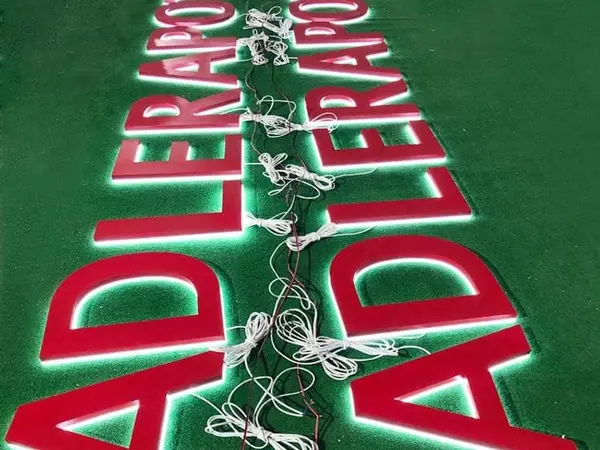
Real photo from our production floor — every sign we ship is made here.
Products mentioned or relevant to this topic — factory-direct, custom built.
From $24/letter · MOQ 1 piece · Flexible lead time · CE & UL certified · ships to 20+ countries
Custom sizes, colors, and finishes. Get a factory price in 24 hours.
Get a Free Quote Copy EmailWhatsApp +86 13865703472 · business@aochuangsign.cn
See pricing, specs, and get a free quote for the sign type you need. Built in our factory, shipped worldwide.