
Nobody ever lost a bid because the letters were too bright. They lose bids because the letters look like a string of Christmas lights instead of a sign.
Look, a channel letter is just a can with a light inside. The aluminum or stainless steel returns contain the glow, and the acrylic face diffuses it. If the module inside throws harsh points of light, you see dots through the face. If the module throws a smooth band, you see an even wash.
That's the whole SMD-versus-COB fight in one sentence. Stroke width and return depth matter more than the marketing sheets admit. A 1.5-inch stroke at a 3-inch return needs a different module than a 5-inch stroke at a 5-inch return. Put the same SMD strip in both and one looks fine while the other looks like a Lite-Brite.
SMD 2835 modules run 100 to 150 lumens per watt. Quality modules from Samsung, Osram, or Blueview last over 5 years, but cheap no-name modules die in 12 to 18 months. The LED you pick is doing the same job as the ballast in an old fluorescent sign—it's invisible until it fails.
If you're quoting front-lit channel letters for a storefront, don't let the module decision be an afterthought. The module type changes your acrylic face spec, your power supply sizing, and whether the installer wastes half a day patching dark spots.
Look, an SMD module is just a tiny diode glued onto a board. Solder it to a PCB, coat it with phosphor, and you've got a point source of light. That's the industry standard for a reason.
The workhorse is the SMD 2835: 100-150 lm/W, happy in most front-lit applications. If you need RGB, grab the 5050. If you need raw punch for a massive sign, the 5730 gives you 40-60 lumens per chip, and it shows. But raw lumens don't fix bad pitch.
Here's the brutal part: most sign shops space SMD modules too far apart because the module supplier's spec sheet says "up to 6-inch pitch." That spec is for a 5-inch-deep letter with a 3mm acrylic face. Use that spacing on a 2.5-inch return and your customer gets dots. I don't care what the datasheet says.
Quickest way to spot bad LED modules: look at the solder joints. Dull gray solder means the lead-free alloy was cooked too long or mixed wrong. That module won't last 18 months. Shiny silver joints mean proper solder and a clean reflow. Learn to look.
SMD makes sense when you have depth. A standard front-lit letter with 3-5 inch returns gives the light room to bounce around, so individual diodes blend into a smooth acrylic face. And if one module dies, you cut it out and wire in a replacement. Service techs like that. And a dead module costs you the module plus the service call. For dual-lit channel letters, SMD white works fine for the front face while a separate halo module handles the back glow.
Here's what nobody tells you: COB isn't brighter. Smoother.
A chip-on-board module packs dozens of tiny LED dies under one continuous phosphor strip, so instead of dotted points you get a glowing line. That's why COB wins on shallow returns. You can put a COB strip in a 1.5-inch stroke with a 2-inch return and get an even face that SMD at standard pitch can't touch.
I've seen this go wrong: a shop stuffed COB modules into a plastic return with no metal backing because the spec sheet looked cool. Six months later the acrylic was yellow and half the diodes were dead. COB generates serious heat per linear inch. It needs an aluminum or steel backer to pull that heat out. Skip the heat sink and you've bought a six-month sign.
Thermal limits are the ugly side of COB. The denser packaging looks great on the face, but it concentrates heat in a smaller area. Quality modules handle it. Cheap COB modules don't. And when a COB segment dies, you often replace the whole strip, not just one diode. Service guys hate that.
COB is the right call when the design is shallow or slim. If you're building rimless channel letters, where the return is almost flush with the face, COB hides its lack of depth. But don't assume COB is a premium upgrade for every job.
The ugly truth is that COB marketing has convinced some shops that SMD is obsolete. For a 5-inch-deep letter, SMD 2835 with proper pitch is cheaper, easier to service, and just as bright. You're not gaining lumens with COB; you're gaining uniformity in tight spaces.
SMD 2835 at 100-150 lm/W gives you a known quantity. Decent modules carry an L70 rating of 50,000 hours or more. COB modules with good phosphor can match that, but they don't automatically beat it. What changes is how the light leaves the module, not how many lumens it makes.
Power draw is roughly the same per lumen for both, in my experience. The difference is layout. COB lets you run fewer mounting rows through a shallow return and still get even light. SMD needs more rows or tighter pitch. That can change your driver count and your wiring time.
Don't obsess over lm/W. Obsess over beam angle and pitch under the actual return depth. I've watched shops chase 150 lm/W modules and ignore the fact that the 120-degree beam angle was too narrow for a 2-inch return. Hotspots killed the sign.
For 3-inch and 5-inch strokes with 3 to 5-inch returns, SMD 2835 from Samsung, Osram, or Blueview still wins on total installed cost. For 1.5-inch strokes or recessed looks, COB earns its keep because you can't fake even diffusion without depth.
Here's what nobody tells you: module cost is not the biggest line item. Labor is.
SMD modules are cheaper per meter, but they need more wire connections and more mounting clips if you're fighting hotspot risk. COB costs more up front, but a single continuous strip can be faster to install in a shallow return. One COB run replaces two or three staggered SMD rows. That labor difference matters when you're paying an installer by the hour.
I've watched sign shops pay $800 for a front-lit letter from a domestic fabricator. Same 304 stainless, same Samsung LEDs. We ship that letter factory-direct for $120. Across a six-letter storefront, that's the difference between a healthy margin and a job you took just to keep the lights on.
Factory-direct pricing on front-lit channel letters runs $20 to $80 per letter, depending on size and return. Back-lit halo runs $35 to $120. US retail installation for the same letters is $200 to $700 per letter. You're saving 50-65% on product before you even touch shipping.
My factory's lead time runs about 5-15 days, MOQ is one piece, and the warranty covers 2 years on LED, 1 year on power supply. Don't let a local supplier charge you a rush fee for something that leaves our dock in less than two weeks.
Use SMD 2835 when the return is 3 inches or deeper and the stroke is over 2.5 inches. That covers most storefront channel letters. Put modules at 4-inch pitch for a 3-inch return, 5-inch pitch for a 4-inch return, and only go 6 inches if the letter is 5 inches deep. That's my floor rule, not the module vendor's marketing.
Use COB when the return is shallower than 3 inches, when the stroke is narrow, or when the architect wants that rimless channel letter look with no visible return. COB also works if you're building shallow light boxes where SMD would leave dot patterns on the diffuser.
Color temperature matters as much as module type. 3000-3500K warm white suits restaurants and hotel canopies. 4000-5000K neutral works for corporate and retail. 6000-6500K cool is for industrial parks and highway signs where your eyeballs don't need warmth, just legibility. I've seen a coffee shop install 6500K cool white and then wonder why the storefront felt like a gas station.
For dual-lit channel letters, run SMD white inside for the front face and a separate halo module on the back. Don't try to make one COB strip do both jobs. It won't.
Ask for the CE certificate with today's date. CE marking costs 20,000 to 50,000 RMB, and most factories will say they have it. A stack of paper from 2019 doesn't mean this batch passed anything.
If you need UL for the US market, UL 48 runs $4,000 to $15,000 and takes 4 to 9 months. ETL is a legit alternative and costs 10-30% less. Don't let someone sell you "UL-compliant modules" without the listing. That's not a thing.
Outdoor signs need IP65 at minimum. IP66 is for coastal or high-pressure wash. IP68 is for submersion, which you don't need unless the sign sits in a fountain. Saying a sign is waterproof because the power supply box is sealed is a rookie lie.
My factory puts every sign through an 8 to 12 hour aging test before QC inspection. That catches infant failures before they get crated. If your supplier doesn't do a burn-in, you're doing their QC on your customer's wall.
The warranty covers 2 years on LED, 1 year on power supply. If someone offers 10 years on a cheap COB strip, read the fine print. The warranty covers the diode, not the labor to reinstall the sign, and not the freight from Ohio back to China. That's the ugly truth.
One last thing: buy from a factory that owns the process. Laser cutting, bending, welding, LED assembly, sealing, aging test, QC, export packaging. If they sub out half the steps, batch consistency goes out the window. Your first order looks great, your third order goes dark in six months.
Q: Which is better, SMD or COB?
Better for what? SMD is better for deep letters and serviceability. COB is better for shallow returns and even light. If you ask me "which is better" without telling me the return depth, I'm going to assume you haven't measured the can.
Q: Can I use COB modules outdoors?
Yes, if the modules are IP-rated and the sign is sealed properly. But COB's heat concentration means you need a metal backer. Stick a COB strip in a plastic return and it's a matter of when, not if, it fails.
Q: How many SMD modules per letter?
Depends on stroke width, return depth, acrylic thickness, and the module's beam angle. Anyone who gives you a one-size-fits-all count without seeing the drawing is guessing. I don't guess on signs that have to last 5 years.
Q: Why do factory-direct channel letters cost so much less?
Because you're not paying a domestic fabricator's overhead, and you're not paying a middleman. A front-lit letter that leaves my factory for $120 gets installed in Ohio for $800. That's not magic. That's the supply chain.
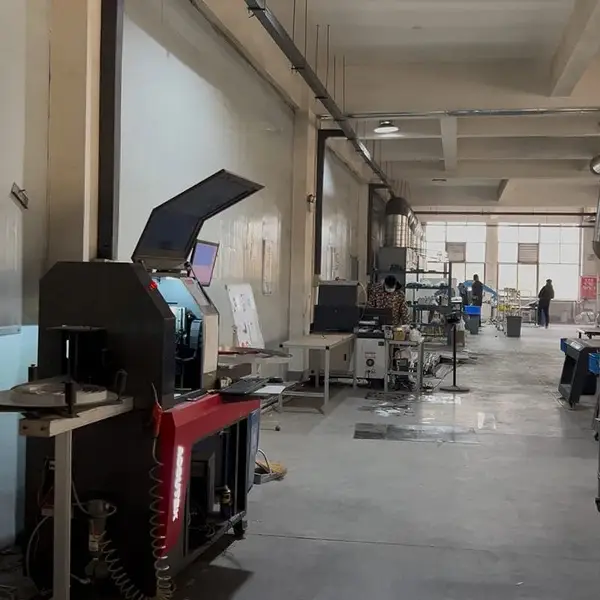
Real photo from our production floor — every sign we ship is made here.
Products mentioned or relevant to this topic — factory-direct, custom built.
From $24/letter · MOQ 1 piece · Flexible lead time · Project-specific compliance documents · ships to 20+ countries
Custom sizes, colors, and finishes. Get a factory price in 24 hours.
Get a Free Quote Copy EmailWhatsApp +86 13865703472 · business@aochuangsign.cn