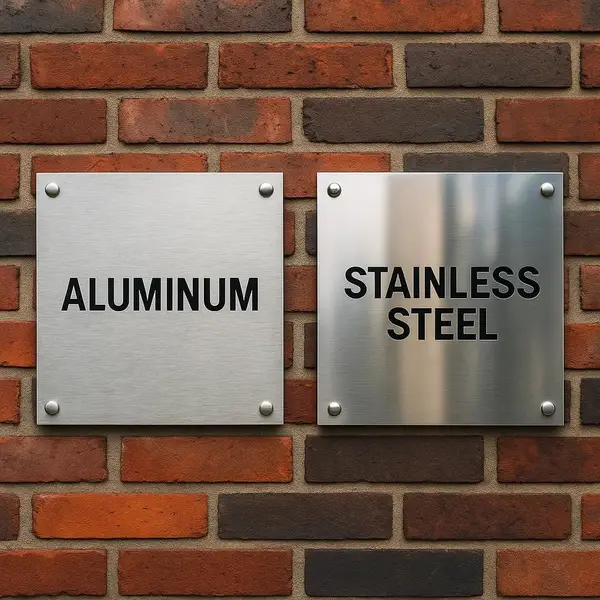
I've stood in a dozen sign shops while some sales guy slides a sample across the table. "Aluminum's lighter. Stainless is stronger." That's not useful. What matters is what your sign will look like in five years, how much it costs to hang, and whether it survives the first winter salt bath. I'm not selling you either material. I'm giving you the numbers I wish someone had handed me fifteen years ago.
Here's the math: aluminum weighs about one-third of stainless steel. Density of 304 stainless is 7.93 g/cm³. Aluminum's around 2.7. That sounds great until you realize light doesn't mean cheap installation if the structure flexes. For a 2.5-meter-tall letter, you need at least 1.6mm aluminum or 1.0mm stainless to avoid flapping in wind. But thickness alone isn't the story — not even close.
Most buyers don't realize that the real cost isn't the raw sheet. It's the labor to weld it, the mounting hardware to hang it, and the replacement cycle when corrosion chews through it. I've watched a client save $200 on an aluminum sign and then spend $600 in year three to replace the letters. That math doesn't need a calculator.
Stainless 304 contains 18% chromium and 8% nickel. That's the baseline for outdoor. It gives you about 10+ years of life in normal conditions — urban, suburban, not splashing in the Atlantic. Aluminum's natural oxide layer holds up for 8 to 12 years. So on paper, they're close. In reality, that gap widens fast when you add chlorides.
Let me break this down: aluminum doesn't rust. It oxidizes white and powdery. That layer can seal off further damage, but in marine environments, pitting happens underneath. I've seen aluminum signs in Miami Beach turn into lacework in four years. Stainless 304 lasts longer, but even it gets surface pitting near the coast. That's where you need 316 stainless. It's got 2-3% molybdenum bolted into the alloy. That extra ingredient costs 20-30% more than 304, but for a sign on a boardwalk within a mile of saltwater, it's the only choice — or you're replacing letters in three years.
I had a client in Tampa who insisted on 304 because the budget was tight. "It's stainless, it won't rust," he said. Two years later, the letters had orange freckles. Not rust-through, just unsightly. He paid me to grind and repassivate them. Total cost: seventy percent of the original sign. He should've bought 316 from the start. That's a cheap lesson if you listen.
The spec says IP65 means dust-tight and protected against water jets from any direction. That sounds like it covers outdoor use. But IP65 does not mean your sign survives a Florida hurricane. It doesn't mean seawater spray won't wick into the seal. I've seen IP65-rated signs fail after one nor'easter because the installer forgot to silicone the weep holes. The rating is a test, not a guarantee.
Let's run a 10-year cycle on a typical 1.2-meter channel letter set, front-lit, with Samsung LEDs, installed on a building facade in a Midwestern city — moderate weather, no coastal salt. I'll use factory-direct pricing from our shop because that's where the savings live. Aluminum letters: $10–$25 per letter from the factory. Stainless non-lit: $15–$40. But we're comparing the same finish class: powder-coated aluminum vs. brushed stainless. That adds $5–$10 per letter for prep and coating on aluminum.
Here's the kicker: stainless weighs more. A 1.2-meter stainless letter might weigh 12 kg. Aluminum version: 4 kg. Installation labor often charges by the hour. Heavier letters need stronger brackets, maybe even a structural engineer for the mounting. That can add $100–$300 to installation. Over ten years, you probably don't replace stainless. Aluminum may need a new powder coat after 7–8 years if it's in direct sun. That's $50–$150 per letter in strip-and-recoat labor. At the ten-year mark, the aluminum sign has cost you the same or more than stainless — and it's not as dent-resistant.
I've watched sign shops pay $800 for a front-lit letter from a domestic fabricator. Same 304 stainless, same Samsung LEDs. We ship that letter for $120. Factory-direct savings run 50–65% on product. That 10-year TCO swings hard when you're not paying a middleman for material he didn't spec correctly.
Aluminum bends easier than stainless. That means faster production time and less skill required. For simple face-returns and flat backs, aluminum is the quick win. But if you want sharp corners, crisp welds, and a finish that holds polish for decades, stainless takes more time. TIG welding stainless 304 requires filler rod matching the alloy, gas shielding, and a welder who knows how to avoid distortion. Aluminum MIG welding? Easier, but the heat-affected zone can warp thin sheets. I've seen aluminum letters that look like potato chips after tack-welding.
Let me break this down: laser cutting holds ±0.1mm tolerance on both materials. That's not the differentiator. The difference is post-weld finishing. Stainless gets ground, brushed, and passivated. Aluminum gets sanded and powder-coated. The powder coat hides a lot. If the coating chips, aluminum starts corroding at the scratch. Stainless brush finish doesn't need coating — you can repair a scratch with a Scotch-Brite pad. That's a real-world maintenance advantage.
Most buyers don't realize that the base material price is the smallest cost. The real money is in labor and finishing. Aluminum needs a good coating system. Stainless needs skilled welding and grinding. In our factory, we factor that into the quote. But when you buy from a bargain shop, they'll use thinner aluminum, skip the post-weld passivation, and ship a sign that looks fine for six months. Then you're calling me.
Quickest way to spot bad LED modules: look at the solder joints. Dull gray = won't last 18 months. Shiny silver = proper lead-free solder. That's a materials-engineering trick the sales guy won't teach you. Same principle applies to metal. A dull, pitted stainless finish is a sign of cheap alloy or skipped passivation. It's not "character." It's a failure waiting to happen.
We're in Lu'an, China — 3,000m² facility, 50+ workers. We ship to 21 countries. If you're buying direct, you save the 50–65% markup. But you have to handle logistics. Air freight runs $4–$12 per kg, 10–20 days. Sea freight: 50–70 days, $80–200 per cubic meter LCL. A set of stainless letters for a storefront might fill 0.2m³. That's $16–$40 in ocean freight. Plus the US Section 301 tariff: about 30% on fabricated metal signage. That adds up, but it's still cheaper than domestic fabrication for anything above a simple job.
The brutal truth about LCL: your crate gets handled 6–8 times between our dock and yours. Every touch is a chance for damage. Stainless is harder than aluminum. It dents less. Aluminum letter corners can chip or bend under rough handling. We pack with foam, carton, and plywood crate. But if the freight forwarder drops it, aluminum gets crushed easier. That's not in the brochure. It's physics.
I've seen a client pay $150 for a domestic aluminum sign that arrived perfect, and another pay $80 for a Chinese stainless sign that had a bent return from sea shipping. The stainless was stronger, but the crate got impaled by a forklift. That's not a material problem — it's a packaging problem. We now use double-wall corrugated and corner protection. But still, aluminum's lower weight means you can use lighter crates. The balance is real.
If the sign is indoor, will be replaced in five years, and budget is king — aluminum with a good powder coat. It's fine. 8–12 year outdoor life, and you'll likely rebrand before it fails. For outdoor permanent signs — corporate, hospital, city government — spec stainless 304 at minimum. If you're within two miles of saltwater or near a chemical plant, pay for 316. Your client will never appreciate the upcharge until year eight when the competitor's sign is pitted and yours looks new.
Don't forget mounting. Stainless needs stainless steel brackets, not galvanized. Galvanized + stainless + rain = galvanic corrosion. That's a rookie mistake. Use the same alloy for all hardware. And seal every hole with neutral silicone. I don't care if the manufacturer says it's IP66. I've seen moisture creep through a single screw hole and wreck an LED array in one winter.
Most buyers don't realize that the warranty matters more than the material. We offer 2 years on LEDs, 1 year on power supply. That's standard for factory-direct. But the metal itself? Stainless 304 will outlast your building if you maintain the finish. Aluminum's coating will degrade. You can repaint it, but then you're paying labor again. Over 20 years, stainless is cheaper. Over 5 years, aluminum wins. That's the honest answer.
Q: Is aluminum cheaper than stainless for signs?
Short answer: yes, up front. Factory-direct
Factory-direct since 2010. Free quote within 24 hours — no obligation.
Get a Free Quote →MOQ: 1 piece · 7-15 days · 2-year warranty · Worldwide shipping