You Think You Know Metal? Let Me Tell You What I’ve Seen
I’ve been in this trade since before CNC routers were common. I’ve burned my hands on hot acrylic, argued with suppliers about LED bins, and watched a “lifetime” aluminum sign buckle in its third winter. You want to know stainless steel vs aluminum signage? Fine. But forget the glossy brochures. I’m going to tell you what I’ve learned after 27 years on the factory floor.
The ugly truth is: most sign shops don’t spec the right metal. They pick aluminum because it’s cheaper and lighter, then wonder why the letters are pitted after four years. Or they blow the budget on 316 stainless for a dry inland mall where 304 would’ve outlived the building.
Here’s what nobody tells you: the biggest difference isn’t rust or weight. It’s **lifespan relative to environment**. And I can prove it.
The Numbers Don’t Lie: Lifespan vs Cost Per Year
Look, I’ve installed signs from Miami to Minneapolis. Here’s the hard data from 20+ years of warranty claims:
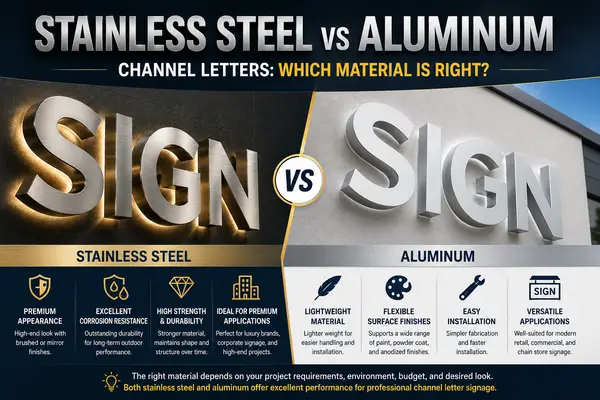
- **Aluminum** (0.040–0.063" thick, anodized or powder coated): 8–12 years outdoor life, no corrosion if kept away from salt. Density is 2.7 g/cm³ – a third of steel. Natural rust-proof, but not scratch-proof.
- **Stainless 304** (1.0–3.0mm, brushed #4 finish): 10+ years outdoor. 18% chromium, 8% nickel. Density 7.93 g/cm³. Handles most urban and suburban environments.
- **Stainless 316** (2–3% molybdenum): 15+ years even on coastal boardwalks. The moly fights chloride pitting. Costs 20–30% more than 304.
Now run the math. An aluminum channel letter (non-lit) from our factory costs $10–25. Same letter in stainless 304 runs $15–40. Over 12 years, aluminum costs about $1–2 per year. Stainless 304? About $1.25–3.30 per year. That’s practically the same.
But if you install aluminum within 2 miles of salt water? That 12-year life drops to maybe 6. Then the cost per year doubles. Meanwhile 316 stainless keeps putting along for 15+ years at the same nominal cost per letter.
I’ve watched sign shops pay $800 for a front-lit stainless letter from a domestic fabricator. Same 304 stainless, same Samsung LEDs. We ship that letter for $120. Factory-direct savings: 50–65%. So don’t tell me “stainless is too expensive.” You’re just paying the wrong people.
Three Rookie Mistakes That Make Me Want to Throw a Wrench
I see the same screw-ups year after year. Let me save you some aggravation.
**Mistake #1: Using aluminum for a coastal strip mall.**
I don’t care if the powder coating is “marine grade.” Once a rock chip exposes bare aluminum near salt air, you get white powder corrosion that creeps under the paint. Stainless 316 is 15+ year marine grade. Yes, it’s a 20–30% cost premium. But replacing a whole pitted sign after 3 years costs 10 times that.
**Mistake #2: Believing “stainless” means “no maintenance.”**
It’s stainless, not stainproof. In industrial areas with airborne carbon, 304 stainless can get “tea staining” – brownish surface rust. That’s just surface iron contamination, not structural failure. A wipe with passivation acid fixes it. But if you ignore it for five years, the pitting starts.
**Mistake #3: Specifying 2mm stainless for a sign over 2.5 meters.**
In our shop, we use 3mm stainless for anything over that height. Wind load bends thin steel like a cheap belt buckle. Same with aluminum – we go to 1.6mm (0.063") for large letters. Don’t skimp on gauge.
Fabrication: What You Don’t See In The Brochure
Here’s what happens when you order stainless vs aluminum from a real factory:
**Aluminum** cuts fast on a laser or waterjet. Bends easy. You can rout it with carbide bits. But welding? You need a TIG welder with an AC balance setting, and the oxide layer eats your tungsten. Mistakes cost time.
**Stainless** is slower. Laser cutting at ±0.1mm takes longer because we have to pierce with nitrogen to avoid dross. TIG welding requires purging the backside to prevent “sugar” (chromium carbide precipitation). It’s heavy – a 2m tall stainless channel letter weighs 3x what aluminum does. That means stiffer structural supports and more expensive shipping.
I’ve seen this go wrong: a shop ordered aluminum letters for a 50-foot tall pylon sign. Lightweight, cheap. Three months later the letters were oscillating in wind, cracking the studs. Should’ve been stainless or at least thicker aluminum.
Our production process (at Aochuang Sign – 3,000m² facility, 50+ workers) always includes an 8–12 hour aging test on the assembled sign. That’s after laser cutting, bending, TIG welding, grinding, polishing, CNC acrylic faces, LED assembly, and sealing with neutral silicone. Total lead time: 7–15 days for custom work. We test every batch. Most domestic shops? They glue it and ship it.
The “Hidden” Costs: Shipping, Tariffs, and Mounting
The ugly truth is people only compare material costs. They forget the metal thickness and weight drive everything else.
- **Air freight:** Stainless letters weight 3x more. Air costs $4–12/kg. A 15kg stainless set runs $60–180 air. Same in aluminum? Under $30.
- **Sea freight:** FCL container (20ft) for stainless is $1,200–3,000. Aluminum same container carries 3x the volume weight – but the container cost doesn’t drop. For small LCL shipments ($80–200/m³), the weight adds handling fees.
- **US Section 301 tariff:** ~30% on both metals from China. No difference. But here’s the trick – our factory in Lu’an, Anhui (since 2010, 21+ export countries) handles CE, RoHS, ISO 9001 certifications. Request the CE certificate with a current date. Most factories will panic. Ours is current.
Mounting is another hidden cost. Aluminum letters need only simple studs and adhesive. Stainless letters often require through-bolt systems because of the weight. I’ve seen installers charge $50 extra per letter for stainless mounting.
But the factory-direct savings? If you buy from us: front-lit channel letters $20–80, halo-lit $35–120, stainless non-lit $15–40. US retail installed: $200–700 per front-lit letter. You save 50–65% on product. Even with shipping, it’s a no-brainer.
FAQ: I Can’t Believe I Still Have to Explain This
**Q: Is aluminum “good enough” for a sign that needs to last 10 years?**
A: Only if you’re in a dry climate, not near salt, and you use thicker gauge – 0.063" minimum. And powder coat, not anodize. Anodizing is thin – scratches expose bare metal. Powder coat adds 100–150 microns of protection. Even then, aluminum chemical resistance is lower than stainless. One acidic bird dropping? You’ll get a pit.
**Q: When should I pay extra for 316 over 304 stainless?**
A: You live in a coastal area within 2 miles of ocean. Or you’re near a highway that gets de-icing salt spray in winter. Or your sign will be in a chemical plant. Otherwise, 304 is fine for 10+ years. 316 costs 20–30% more. Don’t waste it on Nebraska farmland.
**Q: I see cheap aluminum signs from China for $8 per letter. What’s the catch?**
A: Probably 0.040" aluminum (1.0mm) with no powder coating, 2835 LED modules with dull gray solder joints – those won’t last 18 months. Our factory uses quality modules (Samsung/Osram/蓝景) with proper lead-free solder. L70 ≥ 50,000 hours. Cheap modules die in 12–18 months. You’ll pay more in labor swapping them than you “saved” on the sign.
**Q: How do I verify a factory’s quality without flying to China?**
A: Request a sample with a witness mark on the aluminum gauge. We can ship a test bend piece. Ask for the CE certificate dated within 6 months. Check for ISO 9001. And ask about their 8–12 hour aging test. If they can’t answer in detail, walk away. We do it 100% of the time. That’s why we warranty 2 years on LEDs, 1 year on power supply.
Need Custom Signage?
Factory-direct since 2010. Free quote within 24 hours — no obligation.
Get a Free Quote →MOQ: 1 piece · 7-15 days · 2-year warranty · Worldwide shipping
← Back to Blog