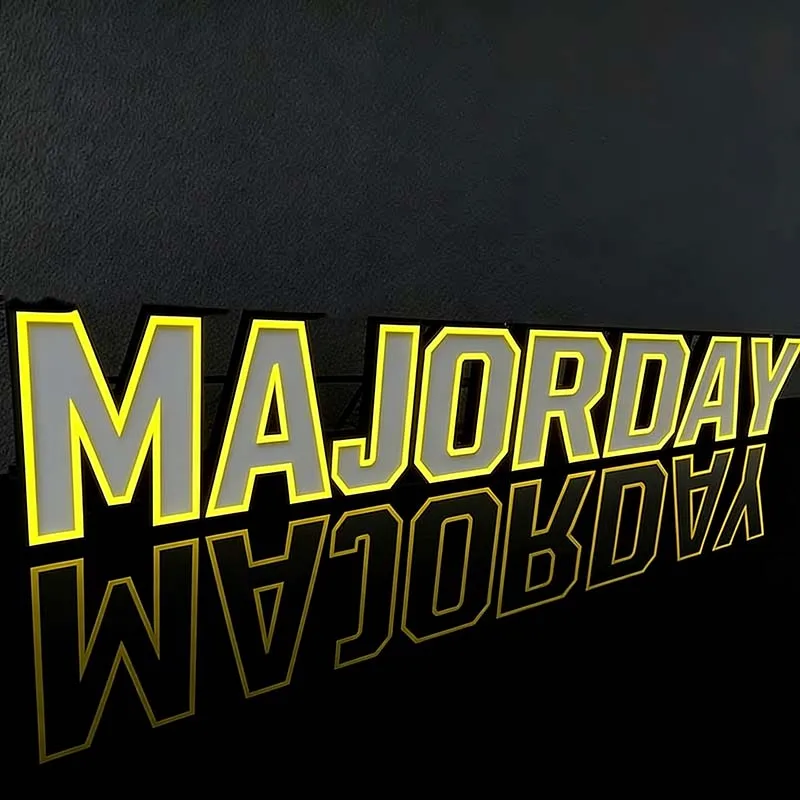
Fifteen years on the shop floor and I still watch people pick the wrong material because they fell in love with a showroom sample, not a sign after three winters in Cleveland. Here's what nobody tells you: stainless steel, aluminum, and acrylic don't compete with each other. One's a structural tank, one's a lightweight skin, one's a light-transmitting face. Mix them up and you're paying for a crane and a replacement at the same time.
Stainless steel letters start as 304 or 316 sheet, 1.0mm to 3.0mm thick. We laser-cut at ±0.1mm, bend it, TIG weld the returns, then grind and polish. Brushed #4, mirror #8, PVD, powder coat — all on the table. 304 is 18% chromium, 8% nickel, and 7.93g/cm³. That's a heavy sign. Your substrate had better be masonry or a steel plate, not drywall.
Aluminum is a different animal. It weighs one-third of steel and runs 1.0mm to 1.6mm thick. We cut, bend, weld or use stud mounts, then anodize, powder coat, or brush it. Naturally rust-proof because there's no iron. You'll get 8-12 years outdoors. Less than 304, but you pay half as much.
Acrylic LED letters use 2mm, 3mm, or 5mm sheet. 90-92% light transmittance. We CNC-route, flame-polish, and either use it as a channel letter face or stand-alone dimensional letters. Over 2.5m in any dimension, use 5mm minimum or it'll bow under its own weight. That's not an option.
I've burned my hands on hot acrylic more times than I can count.
Our line runs 10 steps: design confirmation, laser cutting, bending and TIG welding, grinding and polishing, CNC the acrylic face, LED assembly, silicone sealing, aging test for 8-12 hours, QC, export packaging. about 5-15 days total.
Warranty covers parts. It won't cover the lift rental or the labor to re-hang letters. So let's talk about what actually lasts. 304 stainless delivers 10+ years outdoors. 316 adds 2-3% molybdenum, gets you 15+ years in marine or industrial air, and costs 20-30% more.
Aluminum lasts 8-12 years outdoors. It won't rust, but it will oxidize if the powder coat gets scratched. In coastal salt, aluminum pits. Not immediately, but year three you'll see it.
And 316 stainless is the only thing I'd hang within 500 meters of the ocean.
Acrylic's real enemy is UV. UV-resistant sheet from Mitsubishi or Degussa goes 5-8 years without yellowing. Domestic sheet in full sun? I've seen it go brittle and yellow in 18 months. That's the industry lie every budget shop tells: "it's UV-stable." Ask for the mill cert.
Cheap LEDs kill a sign faster than weather. SMD 2835 from Samsung, Osram, or Blueview runs L70 ≥50,000 hours and lasts 5+ years. Cheap modules? 12-18 months. Look at the solder joints. Dull gray means lead-free wasn't used. Shiny silver is proper lead-free solder.
Look, I've seen this go wrong: a client ordered 3mm acrylic letters for a 4-meter wide facade because they saved $400. First heat wave, the letters expanded, cracked at the stud holes, and one fell. Acrylic thermal expansion is real. Over 2.5m, use 5mm and slotted mounting points or you're doing it twice.
Stainless steel letters at 1.0-3.0mm thick weigh enough to need structural anchoring. Count on 7.93g/cm³. A 600mm letter in 2mm 304 can weigh 6-8 kg with returns. That's not a silicone job.
Aluminum at 1.0-1.6mm is the sensible compromise for facades where the engineer says no heavy steel. One-third the weight of steel. Use stud mounts with 3M VHB tape and mechanical fasteners.
Tape-only outdoor mounting is a warranty claim waiting to happen.
For back-lit or halo signs, the mounting pattern matters more than the material. We add a steel backer plate inside the return. If the wall flexes, the letter doesn't.
Look, factory price per letter isn't your installed cost. Front-lit channel letters from our floor run $20-80 per letter. Back-lit halo letters run $35-120. Stainless non-lit runs $15-40, 3D fabricated $40-120, aluminum $10-25. That's product, not installed.
US retail installed runs $200-700 per front-lit letter and $400-1,000 per halo-lit letter. You'll save 50-65% buying factory-direct before shipping and tariffs. Shipping: express about 5-15 days at $30-100 for small orders, air about 10 days at $4-12/kg, sea about 65 days at $80-200/m³ LCL or $1,200-3,000 FCL. Add US Section 301 tariff of roughly 30% on top.
Sea freight LCL means your crate changes hands 6-8 times between our dock and yours.
I've watched sign shops pay $800 for a front-lit letter from a domestic fabricator. Same 304 stainless, same Samsung LEDs. We ship that letter for $120. You do the math.
But the real cost is lifecycle. A cheap acrylic or domestic stainless replacement in year two eats your margin. I'd rather pay $40 for aluminum than $30 for cheap steel that rusts through the paint in a strip mall in Ohio.
Stainless gives you four real finishes: brushed #4, mirror #8, PVD color, and powder coat. Mirror #8 looks like a jewelry store sign, but every fingerprint shows. Brushed #4 hides scratches better on a storefront that gets touched.
Aluminum finishes: anodized, powder coated, brushed. Anodized gives a clean matte look. Powder coat gives any RAL color. Brushed looks like steel without the weight. If your client wants a matte black 600mm letter, aluminum powder coat is the cheapest path that won't rust.
Acrylic is the light shaper. Polished edges glow on back-lit halo letters. 3mm acrylic with a 3000-3500K warm LED looks like a lounge. 6000-6500K cool white looks like a distribution center. Don't mix color temperatures on the same facade unless you want to look like a liquidation store.
For dimensional non-lit branding, I push aluminum for most retail, stainless for law firms and medical, acrylic for interior or back-lit. That's not a rule. It's a track record.
Interior dimensional letters are easy. Acrylic with stud mounts, 3mm, no UV issue. But don't put 304 stainless in a hallway where nobody touches it — overkill and the weight is a hassle. Use aluminum or acrylic.
Exterior storefronts? If you're ordering front-lit channel letters, the face is acrylic, the returns are aluminum or stainless, and the LEDs are SMD 2835. Use IP65 minimum for outdoor. IP65 means dust-tight and water jets. It does not mean hurricane-proof. I've seen IP65 signs ripped off the wall in 140 mph wind. The rating is about electrical enclosure, not mounting.
For back-lit halo letters, stainless returns give the crispest halo because steel holds a tight edge. Aluminum works too, but the halo can get fuzzy if the return flexes during installation.
Wayfinding and directional systems need tactile ADA signs at 48-60" mounting, non-glare, Grade 2 Braille. That's not a material choice, it's code. NEC Article 600 covers electrical signs. UL 48 or ETL listing for the US. UL 48 costs $4,000-15,000 and 4-9 months. ETL is 10-30% cheaper. CE marking in Europe costs 20,000-50,000 RMB. Ask to see the cert with today's date. Most factories claim they have it.
If the install is coastal or industrial, use 316 stainless. 20-30% premium buys 5+ extra years. Miami Beach or a paper mill. Not Ohio.
If the building facade can't take weight, use aluminum letters. Powder coat them. Accept 8-12 year life.
If it's back-lit or channel, use an acrylic face with aluminum or stainless returns. For letters over 2.5m, 5mm acrylic minimum. For outdoor, IP65 minimum. For coastal, IP66.
Budget under $30 per letter product? Aluminum non-lit or acrylic non-lit. Budget $80-120 per letter? You're in halo territory. Budget $400-700 per letter installed? You're paying US labor, not material.
That's the matrix. Material, environment, weight, budget. Not a spreadsheet. Common sense.
Does IP65 mean my sign survives a hurricane? No. IP65 means dust-tight and water jets. It's an electrical enclosure rating. It does not mean your mounting hardware survives 140 mph wind. Bolt it to structure.
Can I use 2mm acrylic for outdoor letters? If the letter is under 2.5m and no thermal stress, maybe. Over that, use 5mm. And use UV-resistant acrylic, not domestic sheet, or you'll replace yellowed plastic in two years.
Is 304 stainless good enough for a coastal sign? For 10+ years, yes if you're 500 meters from salt spray. For beachfront, use 316. 316 has 2-3% molybdenum. It costs 20-30% more. Cheaper than re-installing in year three.
Why is your factory price so much lower than local shops? We don't run a showroom, a sales team with company trucks, or charge $120 an hour for installation. We're a 3,000m² factory in Lu'an, Anhui with 50+ workers. MOQ 1 piece. You handle freight and install, you save 50-65%.

Real photo from our production floor — every sign we ship is made here.
Products mentioned or relevant to this topic — factory-direct, custom built.
From $24/letter · MOQ 1 piece · Flexible lead time · Project-specific compliance documents · ships to 20+ countries
Custom sizes, colors, and finishes. Get a factory price in 24 hours.
Get a Free Quote Copy EmailWhatsApp +86 13865703472 · business@aochuangsign.cn