You want to know what a storefront sign costs. Fine. I'll give you the numbers from 15 years on a factory floor in Lu'an, Anhui, not from some marketing PDF.
Our facility has 3,000 square meters and 50+ workers. We've shipped storefront signs to every continent. Here's what I tell my own customers when they ask price.
Look, the price gap between factory-direct and installed retail is stupid wide. Here's the range I quote every week.
Those installed numbers come from real US sign shops. They have rent, labor, insurance, and a truck that breaks down every Tuesday. I don't blame them. But I've watched sign shops pay $800 for a front-lit letter from a domestic fabricator. Same 304 stainless, same Samsung LEDs. We ship that letter for $120.
Our MOQ is one piece. One piece. Lead time is 7–15 days. You don't need to order 50 letters to get factory pricing.
Here's what nobody tells you: the material spec matters more than the design. I've seen beautiful signs fail because someone saved $3 on acrylic.
Acrylic faces with UV-resistant resin from Mitsubishi or Degussa last 5–8 years before yellowing. Domestic acrylic starts to yellow in 1–2 years. Light transmittance is 90–92%. If your sign is over 2.5 meters, you need 5mm acrylic or it'll bow like a cheap bookshelf.
Then there's stainless. 304 is fine for most of Ohio. 316 has 2–3% molybdenum and costs 20–30% more. For Miami Beach or a marina, pay the premium or you're replacing letters in 3 years. Finishes range from brushed #4 to mirror #8 to PVD and powder coat.
Aluminum is lighter and cheaper: 0.040–0.063 inches thick, 8–12 year outdoor life, and you can anodize, powder coat, or brush it. Great for second-story signage where weight matters.
The ugly truth is most factories stuff garbage LEDs into a beautiful letter. You won't know until 18 months later when half the face is dead. I've pulled too many of those apart. Quality modules from Samsung, Osram, or Blueview run 5+ years real lifespan. Cheap modules run 12–18 months. SMD 2835 is the standard at 100–150 lumens per watt. SMD 5050 handles RGB. SMD 5730 is highest brightness at 40–60 lumens per chip.
Look, here's a quick way to spot bad LED modules before you buy: look at the solder joints. Dull gray means they used cheap solder and it won't last 18 months. Shiny silver is proper lead-free solder.
Also check color temperature. 3000–3500K is warm for hospitality. 4000–5000K is neutral for corporate and retail. 6000–6500K is cool for industrial or highway. A steakhouse with 6000K looks like a morgue.
And for the love of all that's holy, don't overpay for thickness. A 3mm acrylic face cuts 92% light output. A 2mm face cuts 90%. Your customer won't notice the 2% difference, but they will notice the 40% cost bump.
Look, permits are where your cheap sign becomes an expensive headache. I can't give you one universal number because every municipality is different. But I can tell you what inspectors care about.
ADA tactile signs have to mount between 48 and 60 inches to center, with non-glare finish and Grade 2 Braille. NEC Article 600 covers electrical for lit signs in the US. If your sign shop doesn't know those two codes, find a new shop.
UL 48 certification costs $4,000–15,000 and takes 4–9 months, plus quarterly audits. ETL is a legitimate alternative and costs 10–30% less. CE marking is different. It costs 20,000–50,000 RMB. Most factories will say they have it. Ask to see the certificate with today's date. Watch them sweat.
IP ratings matter for outdoor. IP65 is the minimum: dust-tight and protected against water jets. IP66 handles powerful jets, which is better for coastal areas. IP68 is submersible, which is overkill unless your sign is in a fountain.
I've seen this go wrong: a client ordered a 12-foot illuminated sign for a stucco facade. Then we found out the wall couldn't support the weight without steel backing. That added a structural retrofit that cost more than the sign itself. Site prep isn't free. Check your wall before you order.
Here's what nobody tells you: most "design fees" are just someone tracing your logo in CorelDRAW. If you already have vector art, you shouldn't pay $500 for that.
At our factory, design confirmation takes one day. Then we move to laser cutting with ±0.1mm accuracy. Bending and TIG welding take another 1–2 days. Grinding and polishing 1–2 days. We CNC the acrylic face. We assemble the LEDs, seal with neutral silicone, and run an 8–12 hour aging test before shipping. Total: 7–15 days.
Branding costs are a different animal. If you're paying an agency $5,000 for a new logo, that's a marketing decision, not a sign cost. But a good fabricator can make a $200 letter look better than a badly kerned $800 letter. Don't blame us if your logo has four fonts.
Look, if you're comparing quotes, don't just look at the bottom line. Ask for the spec sheet.
First, ask what stainless they're using. 304 vs 316. If they can't tell you, walk away. Second, ask what acrylic brand. Mitsubishi or Degussa is 5–8 years. Domestic is 1–2 years before yellowing. Third, ask for the LED module brand. Samsung, Osram, or Blueview are 5+ years. No-name modules die in 12–18 months.
Then ask about warranty. We give 2 years on LEDs and 1 year on the power supply. If a shop won't stand behind their work for at least that long, what are you paying for?
Check the IP rating. IP65 is minimum outdoor. If you're on the coast, ask for IP66. And if they claim CE, ask to see the certificate with today's date. I've caught suppliers lying about that more times than I can count.
Finally, compare total installed cost, not just product price. Factor in the Section 301 tariff, which is around 30% on Chinese imports. Add freight: Express 7–15 days runs $30–100 for small signs, Air 10–20 days runs $4–12 per kg, Sea 50–70 days runs $80–200 per cubic meter LCL or $1,200–3,000 for a full container. A cheap letter that takes 70 days to arrive can kill a grand opening.
The biggest factory-direct advantage is the price. I've watched sign shops pay $800 for a front-lit letter from a domestic fabricator. Same 304 stainless, same Samsung LEDs. We ship that letter for $120. That's a 50–65% savings on product, depending on the spec.
Our MOQ is 1 piece. One. Not 50. Lead time is 7–15 days. You can order a single back-lit halo letter and we'll build it.
Shipping is where rookies get burned. LCL sea freight means they handle your crate 6–8 times between our dock and yours. Every touch is a chance for damage. That's not in the brochure. Pack it properly: foam, carton, plywood crate. We do that on every shipment.
Here's the brutal honesty: factory-direct isn't for everyone. If you need UL 48 certification for a national chain, that process costs $4,000–15,000 and takes 4–9 months. You need a partner who already has it or a product that doesn't require it. But for a local storefront? Direct from a factory with ISO 9001, CE, and RoHS certifications, you're paying for materials and labor, not someone's showroom lease.
And don't forget total cost of ownership. A quality LED sign with L70 ≥50,000 hours will run for years. A cheap sign that dies in 18 months costs you another install, another permit, and a lot of angry customers staring at a half-dead sign.
Q: Why is there such a huge range between $20 and $700 per letter?
A: Because one is a factory-direct product and the other is an installed retail sign with rent, labor, permits, and margin baked in. Also because some shops use 316 stainless with Samsung LEDs and others use recycled steel with no-name LEDs. You're not comparing the same letter.
Q: Do I need a UL listed sign?
A: That depends on your local inspector. Some cities require UL 48 or ETL for illuminated signs. UL 48 costs $4,000–15,000 and takes 4–9 months with quarterly audits. ETL is 10–30% cheaper. If your sign shop can't explain the difference, you're talking to the wrong person.
Q: How long does it take to get a sign from a factory in China?
A: Express is 7–15 days for small signs, $30–100. Air freight is 10–20 days at $4–12 per kg. Sea freight is 50–70 days at $80–200 per cubic meter LCL. If you need it tomorrow, I can't help you. If you planned ahead, you're saving 50–65%.
Q: Can I install a sign myself?
A: Sure, if you like ladders, electrical code, and angry inspectors. ADA mounting requires 48–60 inches to center and Grade 2 Braille. NEC Article 600 applies to lit signs. If you don't know those rules, hire a licensed installer. It's cheaper than a failed inspection and an emergency room copay.

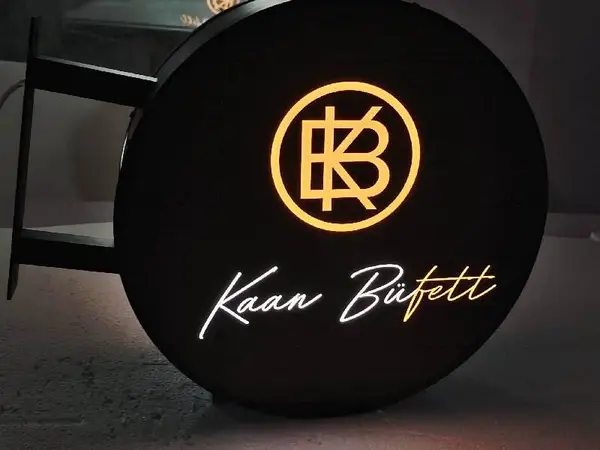
Real photo from our production floor — every sign we ship is made here.
Products mentioned or relevant to this topic — factory-direct, custom built.
From $24/letter · MOQ 1 piece · Flexible lead time · CE & UL certified · ships to 20+ countries
Custom sizes, colors, and finishes. Get a factory price in 24 hours.
Get a Free Quote Copy EmailWhatsApp +86 13865703472 · business@aochuangsign.cn