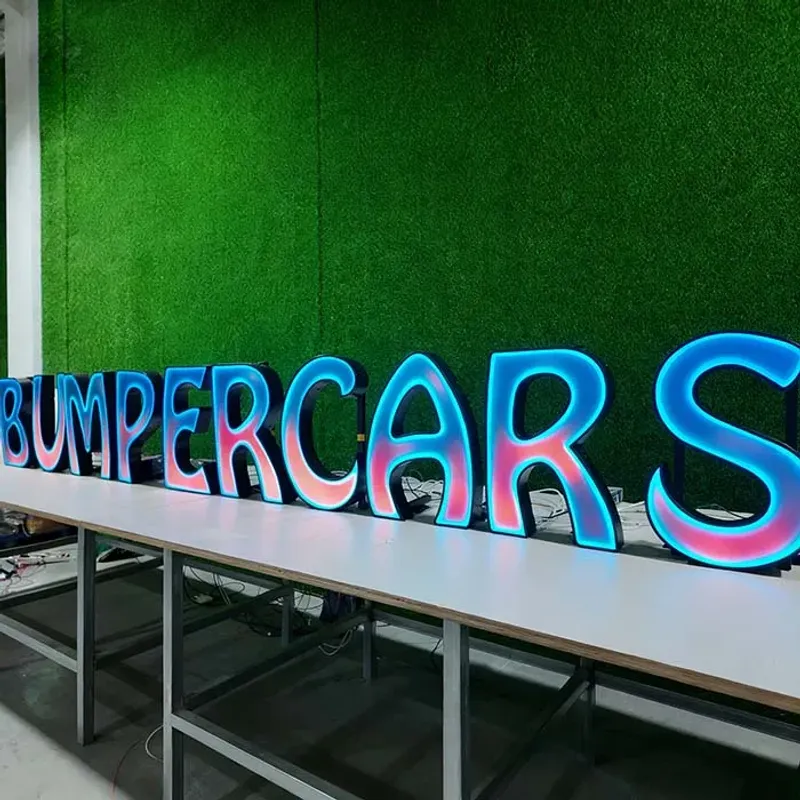
Three years ago I watched a guy hand a city inspector $12,000 worth of fabricated
channel letters because he never pulled a permit. The letters were beautiful. The violation was ugly.
I've been on the factory floor since 2010. I've burned my hands on hot acrylic, argued with LED suppliers, and shipped signs to six continents. This isn't a brochure. I'd tell you this over a beer after a 14-hour shift.
Look, the math is embarrassingly simple. A front-lit channel letter from a U.S. fabricator runs $200 to $700 per letter, installed. From our factory floor in Lu'an, that same letter is $20 to $80. Even after shipping and the Section 301 tariff—roughly 30%—you're saving 50 to 65% on product.
And the letters aren't worse. They're often the same damn thing.
I've watched sign shops pay $800 for a
front-lit letter from a domestic fabricator. Same 304 stainless, same Samsung LEDs. We ship that letter for $120. If you're ordering
front-lit channel letters for a storefront, the factory-direct spread is the single biggest lever you have.
The ugly truth? Most business owners treat signage as a one-time cost. That's wrong. Cheap LEDs die in 12 to 18 months. A quality module from Samsung, Osram, or Blueview lasts 5+ years real-world. That's the difference between replacing letters twice and forgetting about them for half a decade.
Storefront Sign Types and Material Selection
Front-lit channel letters are the bread-and-butter. Acrylic face, aluminum or stainless returns, LEDs inside. Don't cheap out on the acrylic. UV-resistant Mitsubishi or Degussa sheet lasts 5 to 8 years before yellowing. Domestic acrylic? 1 to 2 years if you're lucky. That's a joke.
Here's what nobody tells you: a 3mm acrylic face cuts 92% of light output. A 2mm face cuts 90%. Your customer won't notice the 2% difference, but they'll notice the 40% cost bump on a 3mm face for a sign under 2.5 meters. For anything over 2.5m, go 5mm+ so it doesn't sag and warp in the sun.
Back-lit halo letters are the premium architectural look. You're looking at $35 to $120 per letter from the factory, versus $400 to $1,000 installed retail. Those are
back-lit halo letters—the ones that glow against the wall. They cost more because you're building a hidden mounting system and the LED placement is fiddly. But damn, they look expensive.
Stainless steel letters give you 10+ years outdoors if you spec 304. That's 18% chromium, 8% nickel, density 7.93 g/cm³. For coastal or industrial air, go 316 with 2-3% molybdenum. It costs 20-30% more than 304. For a strip mall in Ohio, 304 is fine. For Miami Beach, pay for 316 or you're replacing letters in 3 years. I keep saying this and people keep ignoring it.
304/316 stainless steel letters are rust-proof if you pick the right grade for the zip code.
Acrylic LED letters are versatile for indoor and mid-range outdoor. A 2mm acrylic face with SMD 2835 LEDs at 100-150 lumens per watt is the industry standard. If someone quotes you SMD 5730 at 40-60 lumens per chip, that's the highest brightness you can get without going RGB.
Acrylic LED letters are the sweet spot between price and punch.
Storefront Sign Design Requirements That Drive Conversion
The ugly truth is most sign designers care about how a sign looks in a portfolio, not how it reads from a moving car at 40 mph. Wrong metric.
Color temperature matters. 3000-3500K warm white says hospitality, restaurant, boutique. 4000-5000K neutral white is corporate and retail. 6000-6500K cool white is industrial and highway. If you put a warm white sign on a cold white storefront next door, it looks dingy. Pick one and hold the line.
Letter height isn't a suggestion. For every 10 feet of viewing distance, you need roughly 1 inch of letter height. A storefront 30 feet from the curb needs 3-inch letters minimum. And that's for legibility, not impact. Think bigger.
Don't overdo the typeface. A sign with six fonts looks like a ransom note. One font, two weights max. And for god's sake, check the kerning. I've seen channel letters spaced so tight they read "PIZZ A" instead of "PIZZA." That's a $3,000 mistake you can't unsee.
Permits, Codes, and Compliance for Commercial Signs
Permits are where rookies bleed money. You sequence the permit before you sign the lease. Not after. Not during. Before. If the landlord says no
illuminated signs, or the city says no projecting signs, you need to know that before you spend $10,000 on fabrication.
I've seen this go wrong. A tenant signs a five-year lease, orders a custom storefront sign, and finds out the historic district only allows 18-inch flat-cut letters. The sign sat in a crate for eight months while they fought the variance. They lost.
UL 48 certification costs $4,000 to $15,000 and takes 4 to 9 months with quarterly audits. ETL is a UL alternative that's 10-30% cheaper. CE marking costs 20,000 to 50,000 RMB. Most factories will say they have it. Ask to see the certificate with today's date. Watch them sweat.
IP65 means dust-tight and protected against water jets from any direction. It doesn't mean your sign survives a Florida hurricane. IP66 is for coastal exposure with powerful jets. IP68 is submersible—extreme weather only. For most US storefronts, IP65 is the minimum outdoor rating. And NEC Article 600 covers electrical signs in the US. If your installer doesn't know what that is, find a new installer.
Factory-Direct Manufacturing: Quality Control and Cost Levers
Our production floor in Lu'an runs 3,000 square meters with 50+ skilled workers. We hold CE, RoHS, and ISO 9001. MOQ is 1 piece. Lead time is 7 to 15 days. Not months. Seven to fifteen days.
The process is ten steps: design confirmation in one day, laser cutting to ±0.1mm in one to two days, TIG welding and bending, grinding and polishing, CNC acrylic face, LED assembly, sealing with neutral silicone, an 8-12 hour aging test, 100% QC inspection, then export packaging—foam, carton, plywood crate.
Here's the thing: the quickest way to spot bad LED modules is to look at the solder joints. Dull gray solder means the joints will crack and fail within 18 months. Shiny silver is proper lead-free solder. I've rejected entire batches over dull solder. You should too.
Warranty should be 2 years on LEDs and 1 year on the power supply. If a factory won't give you that, walk. If they give you 5 years on cheap modules, they're lying and they know you won't ship a dead sign back to China.
Installation, Electrical, and Structural Considerations
A sign that falls off the wall is a lawsuit, not a design problem. Structural engineering for storefront signs isn't optional. Don't skimp.
Stainless 304 letters are 1.0 to 3.0mm thick. For a large storefront sign with big letters, you need the thicker gauge or the letters flex in wind and crack the acrylic face. Aluminum is one-third the weight of steel and naturally rust-proof, with an 8-12 year outdoor life. If weight is a concern on an older facade,
cast aluminum letters are the right call.
Electrical is where most installers cut corners. They daisy-chain too many modules on one power supply, or they don't seal the wire connections. Water gets in. The sign fails in 14 months. Use a licensed electrician for any sign over 120 volts. And if you're within 10 miles of salt water, every metal component—screws, brackets, raceways—needs to be 316 stainless or you'll have rust streaks down the facade in two years.
Maintenance, Repair, and Lifecycle Planning
A storefront sign isn't a set-it-and-forget-it asset. Treat it like a machine with moving electrical parts.
LED modules are rated L70 ≥50,000 hours. That means after 50,000 hours, they still put out 70% of their original light. Quality modules last 5+ years. Cheap ones last 12-18 months. You do the math on labor to rent a lift and replace a dead module versus buying the good stuff up front.
Acrylic faces yellow. UV-resistant Mitsubishi or Degussa lasts 5-8 years. Domestic acrylic yellows in 1-2 years. If your sign is in full sun all day, that's the replacement timeline. For
stainless steel letters, the metal lasts 10+ years for 304, 15+ for 316. The failure point is almost always the LED or the power supply, not the metal.
Plan for maintenance every 3 to 5 years on illuminated signs. That's a pro tip most sign shops won't tell you because they want to sell you a new sign in year 4.
Quick FAQ — because I can't believe I still have to explain this.
What's the MOQ for factory-direct signs?
One piece. That's it. You don't need to order 50 letters to get factory pricing. We'll build one letter and ship it to your door. That's how we've operated since 2010.
How fast can I get a storefront sign?
7 to 15 days for production. Express shipping is another about 5-15 days. Air freight about 10 days. Sea freight about 65 days. If you need it next week, you're already too late.
Is IP65 enough for my storefront sign?
Probably. IP65 means dust-tight and water jets. It doesn't mean hurricane-proof. If you're on the coast, step up to IP66. If you're in a flood zone, you've got bigger problems than your sign.
304 or 316 stainless?
In Ohio, 304. In Miami, 316. That's not a debate. 316 costs 20-30% more and contains 2-3% molybdenum. Pay it or replace rusted letters in 3 years. Your call.