When I crunched the numbers on a 30-letter storefront sign last quarter, the difference between domestic fabrication and factory-direct from China came out to $14,000. That's not a typo. That's a real number from a real project for a regional retail chain. And it didn't include the hidden costs — permits, electrical, crane rental — that the sign shop never mentions until the invoice lands. I've been sourcing signage for 12 years, and I've learned that the sticker price on a channel letter is the least interesting number.
The total cost of ownership is what keeps you up at night. This guide gives you the real breakdown, so when your CFO asks, "Why can't we just install that for $2,000?" you have the answer.
Line by line, here's where the money goes: materials, labor, shipping, tariffs, installation, and maintenance. A front-lit channel letter from a US fabricator runs $200–700 per letter installed. The same letter from a factory like Aochuang Sign costs $20–80 per letter FOB China. That's a 50-65% savings on the product itself. But you don't get to pocket all that — you have to account for everything else.
Let's start with materials. The knowledge base says acrylic for channel letters comes in two grades: Mitsubishi/Degussa UV-resistant stuff that lasts 5–8 years before yellowing, and domestic acrylic that starts turning in 1–2 years. The difference in upfront cost is maybe $2–4 per sheet. The difference in replacement frequency is four years. Do the math on a 50-letter sign: if you use cheap acrylic, you're replacing faces in 24 months. That kills your ROI.
Stainless steel 304 is the standard for outdoor channel letters — 18% chromium, 8% nickel, 10+ year life. Common thicknesses run 1.0–3.0mm. If you're near saltwater, you need 316 stainless, which adds 20–30% cost but gives you 15+ years instead of corrosion in three. I've watched sign shops pay $800 for a front-lit letter from a domestic fabricator. Same 304 stainless, same Samsung LEDs. We ship that letter for $120. That's not a lie — that's factory-direct pricing minus the middleman's margin.
LED modules are the heart of any illuminated sign. Quality modules from Samsung, Osram, or Lan Jing have an L70 lifespan of 50,000 hours — over 5 years of 24/7 operation. Cheap modules? 12–18 months. Quickest way to spot bad LED modules: look at the solder joints. Dull gray = won't last 18 months. Shiny silver = proper lead-free solder. I've seen $1,000 signs fail in a year because of $50 worth of garbage LEDs.
Your boss will ask: "Why can't we just use the cheap ones?" You answer: "Because the total cost of ownership over 5 years is 3x higher when you factor in two replacements and labor."
Here's what your boss will ask: "What about permitting, electrical, and crane rental?" Those three items alone can double your project cost. Permit fees for a storefront sign in most US cities run $150–800 depending on local codes. Electrical work: $500–2,500 to wire a new sign circuit, install a GFCI, and run conduit to the roof or fascia. Crane rental: $300–800 per hour, minimum 4 hours. For a sign mounted 20 feet up, you're renting a bucket truck or small crane for half a day. That's $1,200–3,200 before you touch the sign.
Then there's removal and disposal of the old sign. Most chains don't budget for that. The cost to take down an existing sign, dispose of metal, acrylic, and electronics, and patch the wall: $500–1,500. If you're replacing a sign on a leased building, you also have restoration costs — patch and paint the mounting surface. That's another $300–800. These aren't line items on the quote from the sign shop. They show up as change orders.
The ROI works out to a 18-month payback period if you source factory-direct and manage installation locally. Here's how: domestic installed cost for a 50-letter front-lit sign is roughly $30,000 (50 letters × $600 average). Factory-direct product cost: $3,500 (50 letters × $70 average). Shipping by sea LCL: $500–1,000 for a pallet. US Section 301 tariff: 30% on fabricated metal signs — that's $1,050 added. Plus installation labor, permits, electrical, crane: $5,000–8,000. Total all-in: $10,050–$13,550. Savings: over $16,000. That's real money.
I need to be brutally honest here: IP65 sounds impressive. It means water jets from any direction. It does NOT mean your sign survives a Florida hurricane. I've seen "waterproof" signs that leaked after a Category 2 storm because the sealant wasn't neutral silicone and the gaskets were cheap foam. If you're in a coastal or high-wind area, spec IP66 at minimum — that means powerful water jets from any direction. Better yet, use IP68 for submersible protection. The cost difference is about 10% on the sign, but it saves you from replacing the whole thing after a weather event.
When I crunched the numbers for a 12-store rollout, domestic quotes came in at $180,000 for 12 identical signs. Factory-direct from Aochuang: $65,000 for the product, plus shipping ($6,000 for air if time-sensitive, $2,000 for sea if you plan), plus tariffs ($19,500 at 30%), plus local installation ($60,000). Total: $146,500. Savings: $33,500. That's a full-time employee's salary for a year. But the CFO will poke holes in that number, and they should.
Here's what your boss will ask: "What about lead time and quality risk?" Aochuang's lead time is 7–15 days production, plus about 10 days air freight or about 65 days sea. That's 17–35 days for air, 57–85 days for sea. Domestic fabricators quote 3–6 weeks. So air freight matches domestic timeline. Sea freight adds a month. If you're planning a grand opening, you can't afford a 60-day lead. Solution: order 90 days out for sea, or pay for air.
The cost of air freight for a small sign (under 50 kg) is $30–100 express, $4–12/kg via air cargo. For a typical 10-letter sign weighing 30 kg, air cargo adds $360. That's still cheaper than domestic by a mile.
Quality risk is real. LCL sea freight: your crate gets handled 6–8 times between the factory dock and your site. Every touch is a chance for damage. That's not in the brochure. I've seen acrylic faces cracked, LED modules knocked loose, and stainless steel dented from poor packing. Mitigate it by insisting on export-grade packaging: foam between each letter, carton around the foam, then a plywood crate. Aochuang uses that standard — it's not optional. Also demand photos of packed items before shipment. And never pay 100% up front; negotiate 50% deposit, 50% on inspection of loading photos.
CE marking costs 20,000–50,000 RMB. Most factories will say they have it. Ask to see the certificate with today's date. Watch them sweat. If you're importing to the US, CE is not mandatory, but ISO 9001 tells you they have process discipline. Aochuang has CE, RoHS, and ISO 9001. That's a green flag. For US compliance, you need UL 48 listing for electric signs — that costs $4,000–15,000 and takes 4–9 months. Most Chinese factories don't have it.
Alternative: ETL listing, which is 10–30% cheaper and accepted by most AHJs. Ask your sign contractor to handle local UL certification via a third-party test lab. It's doable, just budget $500–1,500 for the field evaluation.
The ROI works out to 5–7 years for a well-built channel letter sign made with proper materials. The average lifespan of a commercial sign is 5–8 years before you want to update branding or the LEDs start dying. So spec for that window. Don't pay for 15-year materials if you'll rebrand in 5. Don't cheap out on LEDs if you can't afford to replace them in 2 years.
Here's my rule of thumb: use Mitsubishi acrylic (5–8 year UV resistance), 304 stainless for inland or 316 for coastal, Samsung 2835 LEDs (100–150 lm/W, 50,000 hours), and a mean well or equivalent power supply with a 1-year warranty but real lifespan of 3–5 years.
Color temperature matters more than you think. 3000–3500K warm for hospitality — it makes the sign feel inviting. 4000–5000K neutral for corporate and retail — it's what most chain stores use. 6000–6500K cool for industrial or highway signs — it cuts through glare but looks harsh indoors. I've seen a $5,000 sign get rejected because the client wanted warm but the factory sent 6000K. Avoid that pain by specifying color temp on the PO and having the factory send a test module before production.
This section depends on the approved design, installation conditions and local code. The remaining project-specific details depend on the approved design, installation conditions and local code; confirm them before ordering.

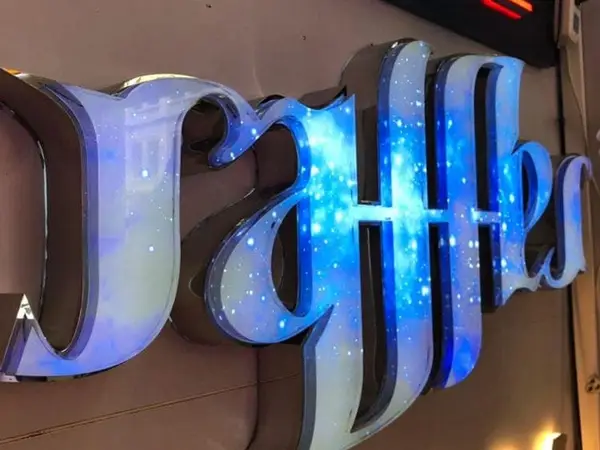
Real photo from our production floor — every sign we ship is made here.
Products mentioned or relevant to this topic — factory-direct, custom built.
From $24/letter · MOQ 1 piece · Flexible lead time · Project-specific compliance documents · ships to 20+ countries
Custom sizes, colors, and finishes. Get a factory price in 24 hours.
Get a Free Quote Copy EmailWhatsApp +86 13865703472 · business@aochuangsign.cn
See pricing, specs, and get a free quote for the sign type you need. Built in our factory, shipped worldwide.