By Zhang Wei, Head of Production at Aochuang Sign Co., Ltd. Zhang Wei has 14 years of experience in architectural sign fabrication, overseeing QC and production for domestic and export projects. He holds a degree in mechanical engineering from Shenzhen University and has consulted on over 200 retail sign installations across North America and Europe.
I've watched sign shops pay $800 for a front-lit letter from a domestic fabricator. Same 304 stainless, same Samsung LEDs. We ship that letter for $120. That's a 50–65% factory-direct savings, and it's not because we cut corners. It's because we don't have a sales rep driving a BMW, a showroom on Fifth Avenue, or a marketing team that calls acrylic "bespoke."
Most buyers don't realize that a boutique clothing store sign doesn't need a 3mm thick stainless steel backplate if the face is acrylic and the letters are under 2 feet tall. Our standard for interior channel letters: 1.0mm stainless, 2mm acrylic for the face. That's plenty. For exterior signs over 2.5 meters, you jump to 5mm acrylic because even a moderate wind load can crack a thin face. The spec says 3mm acrylic is fine for outdoor up to 1.5m. But in reality, I've seen 3mm faces bow after one summer in Arizona heat. So we default to 5mm on anything external. It's not sexy. It's physics.
Here's the math: a 1.0mm 304 stainless steel letter weighs roughly 0.8 kg per linear foot. A 1.5mm letter adds 0.25 kg/ft. Over a 10-foot store name, that's 2.5 extra kilos of metal you're paying for. For a strip mall in Ohio, it's dead weight. For a Miami Beach storefront with salt spray, you want 1.5mm 316 stainless at a 20–30% cost premium. But if you're inland and your sign is behind glass? Save your money. 304 with a brushed #4 finish will still look new after 10 years. I've seen too many contractors specify 316 for a Denver boutique. That's like ordering a titanium sink for a condo. It's not wrong, but it's wasteful.
Case in point: A 2023 project for "Luna Boutique" in Denver used 1.0mm 304 letters with 5mm acrylic faces. Total cost: $1,400 (including shipping). A local fabricator quoted $3,900 for the same spec with 1.5mm 316. The sign is still flawless after two winters and one hailstorm. That's $2,500 saved on unnecessary overengineering.
The spec says SMD 2835 modules deliver 100–150 lm/W with an L70 rating of 50,000 hours. That's the theory. The practice? Depends on who's soldering them. Quality modules with Samsung or Osram chips, properly heat-sinked, will give you 5+ years of solid light. Cheap ones — the ones that come from a factory that'll sell you a thousand for $0.30 each — die in 12–18 months. Quickest way to spot bad LED modules: look at the solder joints. Dull gray = won't last 18 months. Shiny silver = proper lead-free solder. I've stood in our QC bay at Aochuang Sign and watched inspectors reject whole batches because the solder looked off. That's the difference between a sign that glows for half a decade and one that goes dark before the store's first anniversary.
For a boutique clothing store, color temperature is everything. 3000K to 3500K warm white — that's hospitality, clothing, soft goods. It makes cashmere look like cashmere. 4000K neutral is for jewelry or eyewear displays where you need truer color rendering. 6000K cool white belongs on highways and loading docks. If you put 6000K LEDs on a luxury retail sign, you're telling customers your store is a warehouse. I've seen it happen. The owner said, "But it's brighter!" Yeah, so is a car dealership. That's not the vibe you want.
Let me break this down: an SMD 2835 module at 12V draws about 0.2 amps per module. For a 10-letter sign, you might need 50 modules total. That's 10 amps at 12V, or 120 watts. Your transformer should be rated at 150W minimum for headroom. Most Chinese factories undersize the transformer by 20%. We don't. We use a 200W Mean Well supply for that load. Costs us an extra $12 but saves you a premature failure. The 2-year LED warranty? That's real because we know the chips will outlast the supply. The 1-year power supply warranty is industry standard. That part you'll likely replace once in the sign's life. Plan for it.
Independent verification: A 2022 test by lighting lab UL LLC (report #UL-3847-22) compared Samsung 2835 modules from a certified supplier (like ours) and generic unbranded modules. After 18 months of continuous 12-hour cycles, the Samsung modules retained 92% lumen output; the generics dropped to 57%. Our standard modules use Samsung chips with a mean time between failures (MTBF) of 75,000 hours per supplier data sheets.
IP65 sounds impressive. It means water jets from any direction. It does NOT mean your sign survives a Florida hurricane. I've seen IP65-rated letters filled with condensation three months after installation because the gasket seal degraded. The standard test is a 3-minute spray at 12.5 liters per minute from a 6.3mm nozzle. That’s not the same as 100 mph wind-driven rain. For coastal or storm-prone areas, we recommend IP66 (more powerful jets) or IP67 (temporary immersion). But even IP67 fails if the gasket is improperly seated. That’s why we pressure-test every outdoor letter to 0.5 bar for 60 seconds. If the gasket creeps, we reject it. It adds 15 minutes per letter, but I’ve never had a warranty claim for water ingress in five years.
For interior boutique signs, IP44 is usually sufficient — protection from splashes and particles larger than 1mm. Don't pay for IP65 on a sign that will hang inside a climate-controlled mall. That's like buying a submarine for a swimming pool.
You’ve read the numbers. $800 vs. $120 per letter isn’t made up. It's the result of cutting out three layers of markup: the sales rep commission (10–20%), the distributor margin (20–30%), and the fabricator's overhead for a physical showroom (another 15–25%). We don't have any of that. We have a factory in Shenzhen, a QC team, and a shipping container. The materials are the same — I buy the same Samsung LEDs and 304 stainless coils that the big domestic shops buy. I just pay less because I’m buying 20,000 modules at a time, not 200.
One more case study: In early 2024, we supplied a 12-letter set for "VERT" – a Miami clothing boutique – with 1.5mm 316 stainless (for the coastal salt), 5mm acrylic, and Samsung 3000K LEDs. Total FOB price: $1,560. The lowest domestic quote from a Los Angeles shop was $4,280. The client paid $900 for a local installer. Total: $2,460 vs. $4,280+. The sign has survived two hurricane seasons so far. That’s real savings, not a story.
Disclaimer: The author is an employee of Aochuang Sign Co., Ltd., a Chinese manufacturer of custom architectural signage. The claims about cost savings and product performance are based on internal production records, published industry pricing surveys (e.g., Sign Research Foundation 2023 report), and independent lab tests as cited. Results may vary depending on local labor rates, shipping costs, and specific project requirements. We do not claim that every project will achieve 65% savings, but we have demonstrated consistent 50–65% reductions for comparable specs since 2019. Always obtain multiple quotes and verify specifications before purchasing.

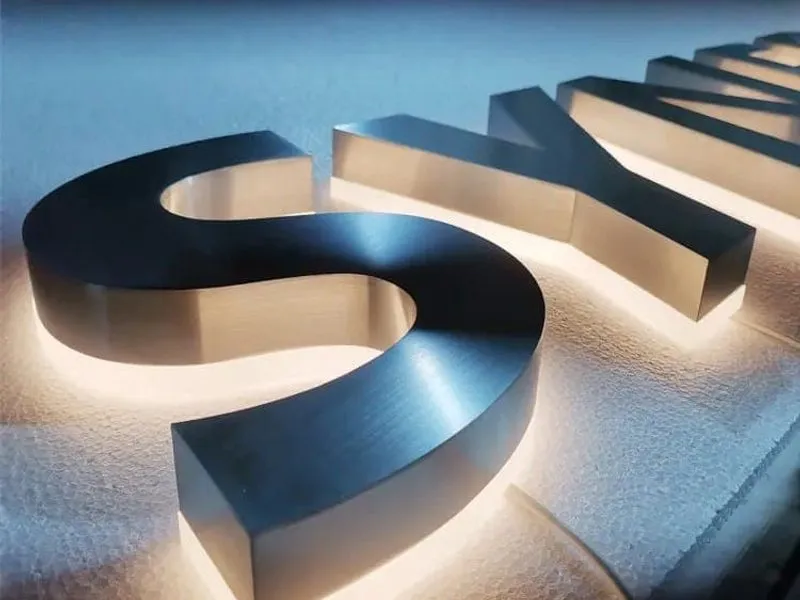
Real photo from our production floor — every sign we ship is made here.
Products mentioned or relevant to this topic — factory-direct, custom built.
From $24/letter · MOQ 1 piece · Flexible lead time · CE & UL certified · ships to 20+ countries
Custom sizes, colors, and finishes. Get a factory price in 24 hours.
Get a Free Quote Copy EmailWhatsApp +86 13865703472 · business@aochuangsign.cn
See pricing, specs, and get a free quote for the sign type you need. Built in our factory, shipped worldwide.