After 14 years of cutting, routing, and swearing at acrylic, I can tell you the thickness question isn't about what the sheet can survive; it's about what your sign can't.
Look, I've watched sign shops order 5mm faces for an 18-inch letter because some engineer's spec said "heavy duty." That letter ends up looking like a glowing brick.
Nobody tells you this: translucent acrylic sign face thickness is a lens decision, not just a durability decision.
The face diffuses LED light, protects the modules, and keeps the sign from looking like a string of bright dots. Get it too thick and you're paying for material that blocks light and adds weight. Get it too thin and it bows under wind load, cracks at the mounting holes, and looks cheap from the street. The three thicknesses you'll actually use are 2mm, 3mm, and 5mm.
That's it. Don't let a supplier sell you 4mm or 4.5mm unless they're clearing warehouse stock.
For most storefront front-lit channel letters, 3mm is the default. That sheet holds its shape across a typical 18-36 inch letter face without flexing. You get 92% light transmission. A sharp bit and the right CNC speed will cut it clean, no chipping.
2mm works for small letters under maybe 18 inches.
90% light transmission. Fine. The material costs less. But I've seen 2mm faces bow on a 24-inch letter the first time a delivery truck drives past and kicks up wind. That gets you a callback three months later.
If a letter or sign face runs over 2.5 meters in any dimension, use 5mm. That's not a suggestion. At that size, wind load, thermal expansion, and self-weight all start working against you. A 5mm face on a 3-meter lightbox will still flex, but it won't crack under normal weather.
I've seen this go wrong. A shop in Tampa ordered a 2.4-meter lightbox face in 3mm to save $40. The face cracked right down the middle during the first summer thunderstorm. The replacement cost them $400 in air freight because the client needed it open in three days. That $40 savings turned into a very expensive lesson.
The ugly truth? Most sign shops over-think thickness and under-think span. Short unsupported span? 3mm is plenty. Long span? 5mm plus a mid-span brace beats 8mm acrylic without a brace. And no, 8mm isn't a standard sign face sheet. Don't be that guy.
A 3mm acrylic face transmits 92% of the light. A 2mm face transmits 90%. Your customer won't notice the 2% difference. They will notice the 40% cost bump if you spec 5mm when 3mm was fine.
Nobody tells you this: hotspotting isn't caused by face thickness. LED placement, module spacing, and how close the LEDs sit to the face cause it. If your LEDs are 75mm apart behind a 2mm face, you'll see dots. Move them to 100mm apart behind a 5mm face and you'll still see dots, just dimmer ones.
SMD 2835 modules at 100-150 lumens per watt are the industry standard for backlit faces. The good ones from Samsung, Osram, or Blueview last 5+ years. Cheap modules last 12-18 months, then half the sign goes dark. The face thickness won't save you from bad LEDs.
I've watched a shop blame 3mm acrylic for uneven lighting. They swapped to 5mm, spent more money, and the sign still looked patchy. The problem? Cheap LED modules spaced too far apart. The acrylic was never the issue.
If you're building an embedded lightbox with a large face, the plastic's job is to diffuse, not to hide bad LED layout. Thicker faces can soften hot spots a little, but the real fix is more LEDs or a better diffuser layer. Don't expect 5mm acrylic to work magic.
Quality LED modules have an L70 rating of at least 50,000 hours. That means after 50,000 hours, they're still putting out 70% of their original brightness. Cheap modules don't hit that. The acrylic face will outlast the LEDs if you buy good sheet.
If you're mixing a 6000-6500K cool white LED with a warm-tinted acrylic face, you'll see a color temperature shift. But that's a tint issue, not a thickness issue. Don't blame the gauge of the sheet for a bad color match.
I've seen 3mm acrylic faces on a 4-foot channel letter survive a Minnesota winter. I've also seen 5mm faces crack on a 2-foot letter because someone over-tightened the mounting screws and didn't drill oversized holes for thermal expansion.
Over 2.5 meters, use 5mm. That's the hard rule I give every importer. Under that, 3mm is fine for almost everything except extremely exposed installations or signs that get hit by pressure washers. Because someone always hits the sign with a pressure washer.
For back-lit halo letters, the acrylic isn't the face—it's the backer or diffuser behind the letter. The thickness still matters because it holds the LED modules and keeps light glowing evenly off the wall. But you're not fighting wind load the same way. 2mm or 3mm is usually fine there.
IP65 sounds impressive. That rating means the sign is protected against water jets from any direction. It doesn't mean your sign survives a Florida hurricane. That's a structural engineering problem, not an ingress protection rating.
Here's what nobody tells you: wind load kills more acrylic faces than impact. A 3mm face on a big sign will deflect in wind, and repeated flexing causes stress cracks at the corners and mounting holes. If you're in a coastal or high-wind area, bump to 5mm and add mechanical fasteners with rubber washers. The washers let the acrylic expand and contract without cracking.
LCL sea freight: your crate gets handled 6-8 times between our dock and yours. Every touch is a chance for damage. That's not in the brochure. A 3mm face packed without foam corners arrives cracked. Thicker acrylic doesn't help if the packaging is garbage.
The ugly truth? Most importers ask "cast or extruded?" when they should ask "whose resin and whose UV package?" Cheap domestic acrylic sheet yellows in 1-2 years. UV-resistant sheet from Mitsubishi or Degussa lasts 5-8 years before yellowing. Thickness doesn't fix that.
I've seen signs come back from the coast after three years. The 3mm face was fine, but the 5mm no-name face was so yellow it looked like nicotine stains. The customer thought the LEDs went bad. They didn't. The cheap acrylic yellowed.
If you're ordering acrylic LED letters for an exterior install, spend the money on the imported UV-stable sheet. That sheet isn't a luxury. It separates a sign that looks new for five years from one that looks tired in eighteen months.
Here's what nobody tells you: some factories will quote you 3mm acrylic and ship 2.7mm or 2.5mm to shave cost. When the crate lands, measure it. A cheap caliper costs $15. Finding out your 3mm face is actually 2.4mm after it's installed costs a lot more.
CE marking costs 20,000-50,000 RMB. Most factories will say they have it. Ask to see the certificate with today's date. Watch them sweat. Same goes for UV claims on acrylic. If they can't show the resin brand, treat it as domestic sheet.
I've watched sign shops pay $800 for a front-lit letter from a domestic fabricator. Same 304 stainless, same Samsung LEDs. We ship that letter for $120. The acrylic face is a small part of that cost, but it's the part your customer sees every day.
The ugly truth? A 3mm face versus a 2mm face is maybe a 40% material cost bump. On a $120 channel letter, that's a few dollars. On a 500-letter project, it adds up. But the bigger cost is the replacement if you choose wrong.
Factory-direct pricing for front-lit channel letters runs $20-80 per letter. Back-lit halo runs $35-120. If you're paying retail installed prices of $200-700 per letter, you're paying for labor, markup, and overhead. The acrylic thickness decision is maybe 2% of that bill. Don't let it become 100% of your headache.
Can I use 2mm acrylic for a 36-inch letter face?
No. Use 3mm. A 36-inch face is too big for 2mm unless you're adding internal supports, and at that point the labor costs more than the material difference. Stop trying to save $8.
Does thicker acrylic reduce LED hotspots?
A little, but not enough to fix bad LED spacing or cheap modules. If you can see bright dots, the problem is your LED layout, not your face thickness. Fix the modules first.
What thickness do I need for a lightbox face over 2.5 meters?
5mm minimum. And use a mid-span brace. I don't care what your local supplier says. 3mm on a 3-meter face is a warranty claim waiting to happen.
Is cast acrylic better than extruded for sign faces?
The honest answer is that the brand and UV package matter more than whether it's cast or extruded. Imported UV-resistant sheet from Mitsubishi or Degussa lasts 5-8 years. Cheap domestic sheet yellows in 1-2 years. Buy the good stuff and stop asking about the manufacturing process.

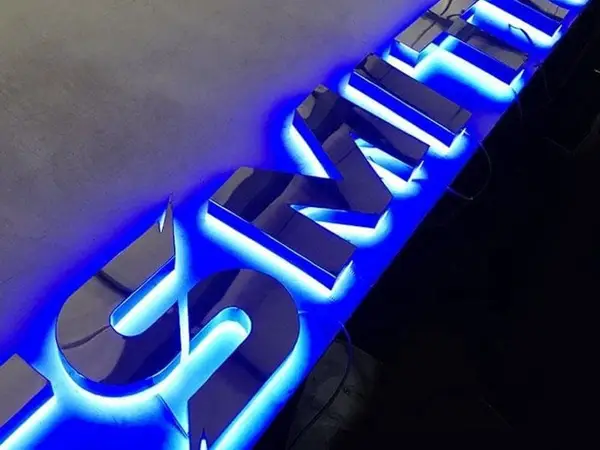
Real photo from our production floor — every sign we ship is made here.
Products mentioned or relevant to this topic — factory-direct, custom built.
From $24/letter · MOQ 1 piece · Flexible lead time · CE & UL certified · ships to 20+ countries
Custom sizes, colors, and finishes. Get a factory price in 24 hours.
Get a Free Quote Copy EmailWhatsApp +86 13865703472 · business@aochuangsign.cn