I've been building signs since 1997, and I can tell you within five minutes whether your sign will get approved. But I can't get it approved for you. That's the first thing you need to understand.
We're Aochuang Sign, a factory in Lu'an, Anhui. We've shipped worldwide, and most of our American customers are sign shops, contractors, and importers who know exactly what they're doing. They order front-lit channel letters from us because we save them 50-65% off what they'd pay a US fabricator. But then a third of their headaches start at city hall, not at the loading dock.
So here's my promise: I'll tell you the truth about permitting, including the parts that embarrass this industry. And I'll tell you exactly what we can help with and what you're on your own for.
Here's what nobody tells you: the permit is 10% of the work and 100% of the delay. Your sign can be perfect. Welds clean, LEDs bright, acrylic faces cut to a millimeter. And then it sits in a warehouse for six weeks because someone at the building department doesn't like your letter height.
The ugly truth is that most permitting rejections aren't about wiring or wind load. They're about zoning. Square footage. Setback distances. Illumination limits. A city planner with a ruler and a grudge can kill a $10,000 sign project.
I've seen this go wrong: a restaurant owner in Texas ordered a full set of halo-lit letters, paid for expedited fabrication, then discovered his sign exceeded the city's square footage allowance by four square feet. Four. He had to redesign, refabricate, and re-apply. The permit took longer than the manufacturing.
So let's walk through how this actually works.
Every city has its own rules, but the skeleton is the same everywhere. Here's the standard dance:
That's the process. Simple to write, painful to live through.
Let's talk numbers, because you're planning a budget and a grand opening.
A simple permit for a stainless steel letters install — non-illuminated, conforming to code — typically takes 2 to 4 weeks from application to approval. Some small towns will approve in 3 days. Chicago can take 8-12 weeks.
An illuminated sign with electrical components adds time. Expect 4 to 8 weeks in most cities. If you need a variance or a zoning amendment, add 60 to 120 days, plus a public hearing. Yes, a public hearing for a sign. I'm not joking.
Here's a real-world breakdown I see from customers:
Now add shipping. Our lead time is about 5-15 days. Air freight gets to the US in about 10 days. Sea freight takes about 65 days. So the smart move is to start the permit application while your sign is still on the water, not after it lands.
And here's a trick: if you're ordering custom back-lit halo letters, ask your city upfront about their "copy change" rules. Some cities allow you to change letters on an existing permit without a new application. That saves you weeks next time you rebrand.
I've collected rejection letters from customers for a decade. Patterns are consistent:
The ugliest rejections happen when someone installs first and asks for forgiveness later. Don't. Municipalities don't forgive; they fine. Daily fines of $100-500 until the sign comes down or gets permitted retroactively.
One customer in Ohio bragged that he'd installed a lightbox without a permit and "nobody noticed." He noticed when the city sent him a removal order with a $1,800 fine. A compliant acrylic light box with a proper permit would have cost him a fraction of that.
You'd think a sign is a sign. You'd be wrong.
New York City requires a permit for virtually every sign and has strict rules about projecting signs over public property. Los Angeles has a sign district system and bans most off-site advertising. Chicago requires an electrical permit in addition to the sign permit. Miami-Dade County has hurricane wind-load requirements — that's why we push 316 stainless for coastal installs. Regular 304 stainless is fine for a strip mall in Ohio, but for Miami Beach, pay the 20-30% premium for 316. Salt air eats 304 in a few years, and your permit inspection might flag it anyway.
Some cities regulate sign color. Some regulate light color temperature. A hotel group in Arizona was told their warm 3000K neon flex signs were too similar to a traffic signal's amber. I couldn't make that up.
Also, ADA. If your sign is tactile (like dimensional letters identifying a permanent room), it must meet ADA requirements: mounted 48-60 inches from the floor, non-glare finish, Grade 2 Braille. That's federal, not local, and it's non-negotiable for certain building elements.
And don't forget the National Electrical Code — Article 600 covers signs specifically. Your LED power supplies need proper disconnects and grounding. That's on you and your electrician, not us.
Here's where I earn your trust. A lot of factories will tell you they "handle" US permits. They don't. They can't. Let me be clear about what Aochuang Sign does and doesn't do.
What we CAN do:
What we CANNOT do:
If a factory promises you a turnkey permit, run. Either they're lying, or they're charging you enough to hire a local lawyer anyway.
CE marking? We have it — it costs 20,000-50,000 RMB and takes 2-8 weeks. But CE is a European standard. It means nothing to a US inspector. What matters in the US is compliance with NEC Article 600 and local building codes, plus UL-listed components.
Look, I'm in the business of selling signs. If you order today, I'll be happy to build it. But I've also got 16 years of watching things go wrong, and the single dumbest mistake I see is ordering a custom sign before checking local regulations.
A restaurant in Pennsylvania ordered beautiful dual-lit channel letters from us — premium build, perfect LED illumination. They never checked their township's sign ordinance. Turned out the township limited sign height to 6 feet, but the building's fascia was 14 feet up. The letters physically could not be installed within code. They had to mount them on a new monument base. That's an extra $2,000 in site work nobody budgeted for.
You wouldn't buy a car that doesn't fit in your garage. Don't buy a sign that doesn't fit your zoning.
The steps are simple: check the municipal code (it's online, free), measure your mounting surface, check setback and height limits, then call us with exact dimensions. We'll build precisely to your spec. Our laser cutting is accurate to ±0.1mm, so the drawing you submit to the city will match the sign that shows up.
Before you spend a dollar on fabrication, do this:
Do all that, and the permitting process is a formality, not a crisis.
Here's how to think about this: Aochuang Sign builds the physical sign. You, or your local contractor, handle the legal sign. Neither of us can do the other's job. Anyone who tells you different is selling something.
We make it easy on our side. We give you transparent pricing — $20-80

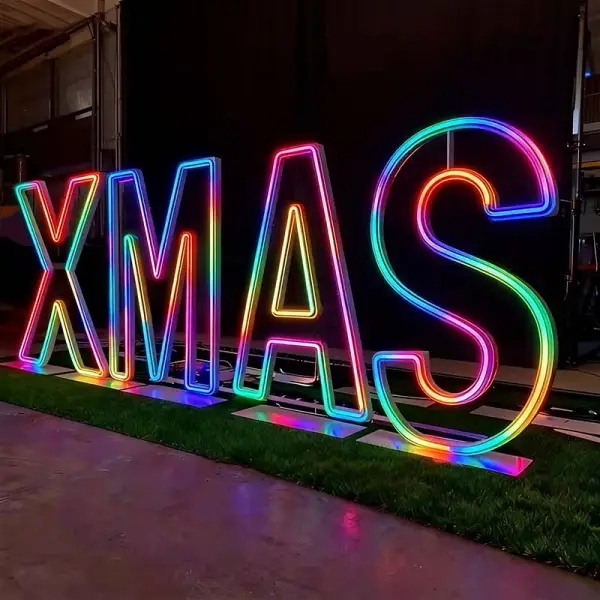
Real photo from our production floor — every sign we ship is made here.
From $24/letter · MOQ 1 piece · Flexible lead time · CE & UL certified · ships to 20+ countries
Custom sizes, colors, and finishes. Get a factory price in 24 hours.
Get a Free Quote Copy EmailWhatsApp +86 13865703472 · business@aochuangsign.cn
See pricing, specs, and get a free quote for the sign type you need. Built in our factory, shipped worldwide.