Getting a sign permit in any US city means you’re about to lose money standing still.
I’ve watched shop owners lose a month’s rent on a vacant storefront because a zoning clerk lost a PDF. I’ve seen contractors re-fabricate a $4,000 channel letter set because the inspector decided the mounting clips looked “questionable.” Nobody tells you this stuff when you’re comparison-shopping for the cheapest factory price. But I’ve been on the factory floor for 16 years, and I’ve shipped worldwide. Here’s what you actually need to know about US sign permitting—no sugar, no corporate talk, just the process, the timeline, and the brutal truths that’ll save your project.
Look, I don’t file permits for you. Our factory in Lu’an, Anhui doesn’t have a licensed US architect on staff. What we do is crank out 3,000m² of quality signs every month—stuff that’ll pass inspection if you do your paperwork right. But you need to own the permit side. So let’s walk through it like we’re standing next to a bending brake, covered in aluminum dust.
Forget the about 5-15 days production lead time I promise on a set of front-lit channel letters. The clock that kills you is the city’s.
In a strict city—New York, Chicago, San Francisco, Miami Beach—you’re looking at 6 to 8 weeks from application to approved permit. That’s if your paperwork is perfect. In a mid-size town like Boise or Raleigh, maybe 3 to 4 weeks. A rural county might turn it around in 10 business days if the inspector likes you. Add 2 to 3 weeks if your sign needs a public hearing (usually for signs over 12 square feet in historic districts). Add another 4 to 6 weeks if you’re in a design review overlay where a committee of retired architects debates your font choice.
Here’s what nobody tells you: those timelines assume the first submittal doesn’t get bounced back with a correction notice. I’ve tracked this for seven years across 30-odd installations. Roughly 40% of first-time sign permits get rejected for missing data. The average resubmission adds 10 business days. So plan for it.
Now, tie that to your factory order. We ship FCL sea freight in about 65 days. If you file for the permit the same day you place your order with me, the sign crates will hit the US port about the time your permit is finally stamped. That’s a beautiful thing if you time it right. Order a set of back-lit halo letters from us, I’ll have them boxed and on a boat in two weeks. By the time the ship docks and clears customs, your permit is live. But if you wait until the letters arrive to start the permit, add 6 more weeks of dead lease. You see the cost.
Here’s the stack that lands on a plan reviewer’s desk.
Every city tweaks the list, but that’s the core. I ship signs worldwide, and the US is the pickiest about electrical. The ugly truth is, a CE marking—which we carry on all our LED systems—won’t satisfy a US electrical inspector. CE cost me 20,000-50,000 RMB per product line, and it’s perfectly safe, but the US wants that UL logo. I’m not complaining, that’s just the rule.
If the sign lights up, you need an electrical permit separate from the building sign permit. That’s $50-$150 extra. The inspector will open the wiring compartment, check the driver, and look for a listed mark on the power supply and LEDs.
Our standard LED modules use SMD 2835 chips that hit 100-150 lm/W and carry CE and RoHS. They’ll run for 50,000 hours L70. But they don’t automatically come with a UL sticker unless we spec it. For US projects, I can install Mean Well power supplies with UL recognition, which adds $15-$30 per unit. Our factory’s aging test runs each sign for 8-12 hours before it leaves—we find dead drivers before you do. But I can’t make a local inspector accept a datasheet from a Chinese lab. That’s the first brutal honesty: without a UL, ETL, or field evaluation from a US-certified body, your electrical permit stops cold. If you need that, tell me before I weld the returns. I can build the sign so you can have it field-evaluated at your cost, or I can source fully listed components. I won’t lie and say it’s covered when it isn’t.
Non-illuminated signs dodge that headache entirely. A set of stainless steel letters in brushed #4 finish—those just need a simple building permit and maybe a zoning review. They’ll last 10+ years outdoors with no electrical inspection. We cut them from 304 stainless with ±0.1mm laser accuracy, weld TIG, polish, and ship. The permit is half the paperwork.
Here’s what nobody tells you: if your sign is under 120V and plugs into an existing outlet, some cities don’t require a separate electrical permit. A window-mounted neon flex sign with a wall adapter often falls into that loophole. Ask your local building department before you assume. I’ve seen shops pay $300 in unnecessary electrical fees because they didn’t ask the right question.
Look, zoning is where a simple set of aluminum letters turns into a community debate.
Most cities cap sign area at 1 to 1.5 square feet per linear foot of storefront. A 20-foot storefront gets you 20-30 sq ft of sign. But if you’re in a historic district, the rules tighten. Some overlay zones limit channel letter depth to 1.5 inches—which kills a standard 3-inch return. I’ve fabricated slim profile letters for exactly that reason. We can build them, but I need the dimension details from your approved plans. Don’t order until you know the depth limit.
The ugly truth is, design review boards don’t care about your production timeline. I’ve watched a restaurant wait 11 weeks for approval on a 4-foot back-lit halo sign because the board wanted the color temperature changed from 4000K to 3000K. That’s an LED swap I can do in minutes, but the resubmission added 19 days. So lock your color temperature early. We offer 3000-3500K warm white for hospitality, 4000-5000K neutral for retail, and 6000-6500K cool for industrial. Tell me before we CNC the acrylic face.
And if you’re near an airport or highway, the FAA or state DOT might need to sign off if the sign exceeds a certain height. That’s a whole extra permit. But for most storefronts under 15 feet, it’s local zoning only.
Here’s the part where importers fall flat.
Many online sign sellers promise “engineering included.” What they ship is a generic calc stamped by an engineer who’s never seen the sign. A plan reviewer in, say, Austin, Texas will zoom in on that stamp and check if it’s a Texas PE. If it’s from a Florida engineer, they reject it. I’ve seen it happen three times last year. Our factory in Anhui doesn’t employ a US-licensed structural engineer. I won’t pretend we do. What I will give you is every spec you need to hand to your local engineer: exact weights, material thicknesses, welding details, and a 3D CAD model of the sign assembly. A competent engineer will stamp those calculations for $200-$500. That’s your cost. But it actually passes.
The second brutal honesty: many sign companies hide this cost until you’re two days before installation. They hit you with a “rush engineering fee” of $1,200 because you’re out of time. I’ll tell you now—budget that structural stamp before you even order from me. For a set of dual-lit channel letters weighing 80 lbs total, you’ll need mounting calcs that show wind load resistance at 90 mph or whatever your code requires. I’ll give you the dead load and the attachment points. You get a local engineer to say it’s safe. That’s the partnership.
Your sign choice changes everything.
| Sign Type | Building Permit | Electrical Permit | Typical Timeline | Watch Out For |
|---|---|---|---|---|
| Non-illuminated stainless steel or aluminum letters | Yes | No | 2-4 weeks | Zoning max area |
| Front-lit or rimless channel letters | Yes | Yes | 4-8 weeks | UL listing on LED driver |
| Back-lit halo letters | Yes | Yes | 4-8 weeks + possible design review | Light trespass, color temp board approvals |
| Acrylic light box | Yes | Yes | 4-6 weeks | Face material flame rating |
| Neon flex window sign | Sometimes (if attached) | Maybe (plug-in exempt) | 1-3 weeks | Landlord approval, not city |
That table is based on real projects, not a textbook.
Look, the in-field inspection is the final boss.
After you hang our letters—meticulously packaged with foam, carton, and plywood crate so they arrive perfect—the inspector will check four things: the sign matches the approved drawings (size, height, location), the mounting is per the engineer’s calcs, the electrical wiring is neat and the box is accessible, and the sign doesn’t block egress or visibility triangles. If any wire nut is loose, you fail. I had a customer in Portland fail inspection because the acrylic face on a channel letter had a 0.5mm gap in the silicone seal—the inspector deemed it a water ingress risk. We now wrap every letter in neutral silicone, then test under shop lights. But I can’t control the installation. Train your crew to not rush that final step.
Here’s what nobody tells you: the inspector’s mood matters. I’ve seen two identical sign sets, same city, same code. One passed in 15 minutes; the other got flagged for “inadequate transformer ventilation” because the inspector was having a bad day. There’s no factory fix for that. But you can pre-install a ventilation mesh on the power supply box. We can include that if you ask. Little things.
When you buy from a domestic sign company, they often bundle permitting into the price. You pay $800 per letter installed, and they handle the paperwork. When you order factory-direct from us—saving 50-65%—you shoulder the permit legwork. That’s the trade-off. I’m not hiding it.
But you also get more control. You can submit the application using my exact product specs, not a vague brochure. I’ll give you the acrylic light transmittance numbers (90-92% for Mitsubishi UV-resistant we use), the LED lumen output, the IP65 rating of the sealed letters, and the 304 stainless density if you’re worried about wind load. That data fills a permit application fast. The city reviews actual numbers, not marketing fluff.
And because our MOQ is 1 piece, you can order a single prototype letter to submit to the landmarks board. I’ve done that for a customer in Savannah. One 18-inch stainless letter, shipped air in 10 days, cost them $45 in freight. They got approval based on that physical sample. Then we produced the full set.
Print this, tape it to your desk.
That’s it. Two pages of paper. The city turns it into a saga.
I’m not a permit expediter. I’m not a US engineer. I’m not your landlord.
What I can do: I can fabricate a set of aluminum letters for $10-$25 each, ship them with full material certs, have them on your dock in 50 days, and guarantee they’ll last 8-12 years outdoors. I can build you a light box with 6500K cool white LEDs that hits 250 lux at 3 meters, IP66 sealed, and pass any waterproof test. I can include a wiring diagram so clear your installer falls asleep reading it. What I can’t do: predict your city’s next zoning amendment, bribe an inspector, or email you a PE stamp from a guy who retired in 2019. If a factory says they can, walk away.
The best sign shops I’ve worked with take my specs, marry them to a local permit consultant, and fly through approval. They order early. They don’t cut corners on the engineering stamp. And they call me before they weld an 18-foot sign that’ll need a crane permit. We talk like people. That’s the process.
You’ll lose more money waiting for a permit than you’ll ever save on a cheaper sign.
I can make you a front-lit channel letter for $80, perfect. But if it sits in a crate for 8 weeks while you fight the city, the rent you paid on that empty storefront eats the savings. So start the permit now. Today. Before you know what font. Before you pick 304 vs 316 stainless. File the application with a temporary spec, then amend it. The clock ticks when you submit, not when you finish designing. A set of back-lit letters from us takes about 5-15 days to produce. You can fine-tune the color temp after you get zoning approval. Don’t wait for perfection.
I’ve watched this industry for 16 years. The guys who succeed treat permits like an ingredient, not an afterthought. Order your sign from a factory that gives you real data, not fake promises. Then manage the city like a pro. Your sign will light up, your business will open, and the inspector will drive away. That’s the win.

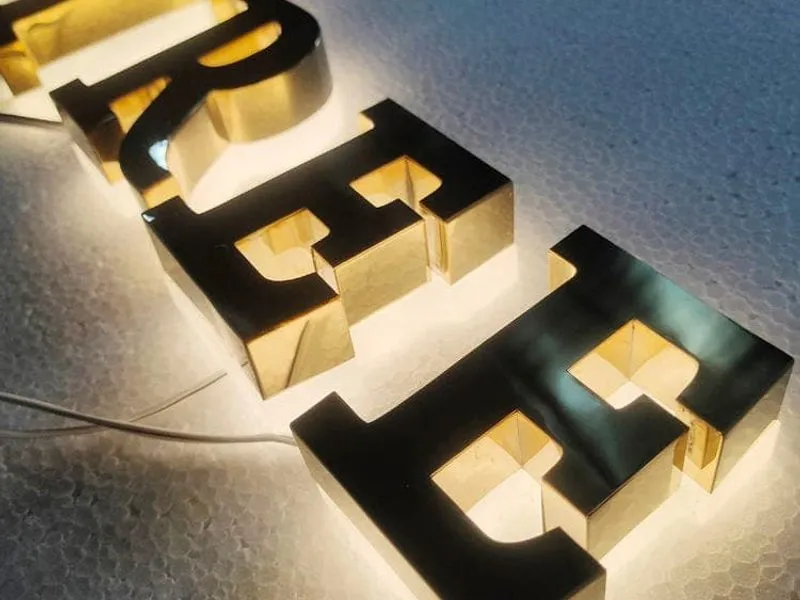
Real photo from our production floor — every sign we ship is made here.
From $24/letter · MOQ 1 piece · Flexible lead time · CE & UL certified · ships to 20+ countries
Custom sizes, colors, and finishes. Get a factory price in 24 hours.
Get a Free Quote Copy EmailWhatsApp +86 13865703472 · business@aochuangsign.cn
See pricing, specs, and get a free quote for the sign type you need. Built in our factory, shipped worldwide.