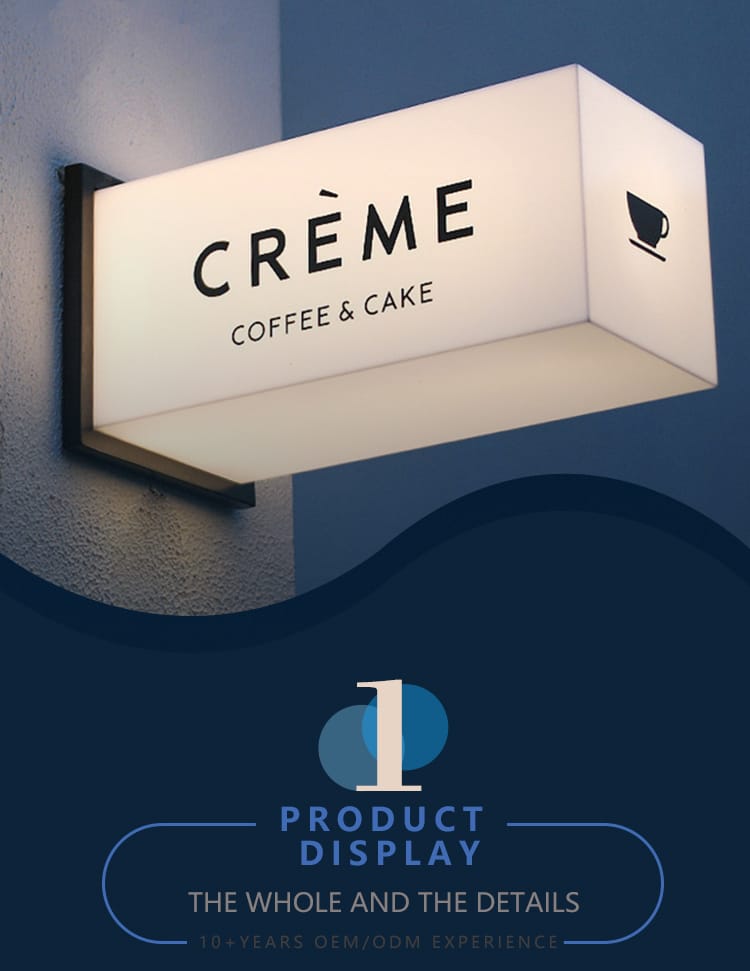
Walk down any gentrified Main Street and you’ll see them: barber poles that glow with warm LED stripes, stainless steel bases, and acrylic sleeves that don’t yellow after a year. I’ve been in this industry since before the 2008 crash, and the single biggest mistake I see sign contractors make is buying cheap acrylic modules from a domestic supplier who slaps a 400% markup on a pole that craps out in 18 months.
Here’s a hard-won fact: quality barber-pole signs are a $300–$700 retail item per pole. But factory-direct pricing from a Chinese manufacturer runs $20–$80 per letter for front-lit channel letters, $35–$120 for halo-lit poles. That’s a 50–65% savings on product. And with a minimum order quantity of just one piece (yes, one), you can test the waters without tying up cash.
But there’s a catch. The tariff on Chinese signs is roughly 30% under Section 301. You still come out ahead, but you have to spec the right materials. I’ll show you exactly what to ask for.
The classic barber pole has been around since the 19th century – red, white, and blue stripes, usually painted on wood or metal. Today's "vintage modern" look keeps the traditional helical stripes but uses backlit acrylic or stainless steel. The problem? Most domestic suppliers use standard acrylic that starts yellowing in the sun within 12 to 18 months.
Here’s the data: domestic acrylic (non-UV grade) gives only 1–2 years before it turns a sickly yellow. Mitsubishi or Degussa UV-resistant acrylic? That’s 5–8 years. The light transmittance is 90–92% for premium acrylic, meaning your LEDs run cooler and the color pops. I’ve pulled down signs with ordinary acrylic that looked like piss after two summers. Don’t do it.
For the pole’s metal base, stainless steel 304 gives you 10+ years outdoors. It’s 18% chromium, 8% nickel, density 7.93 g/cm³. Thickness should be 1.0–2.0mm for a standard pole. If the barbershop is within a mile of the coast, you need stainless 316 – it includes 2–3% molybdenum and handles salt spray. Expect a 20–30% cost premium. It’s worth it.
You have three main ways to make the red-white-blue stripes: painted aluminum, solid acrylic rods, or silicone-coated flex. Each has a different cost and lifespan. See the table below.
| Material Option | Cost per Pole (wholesale) | Outdoor Life | Lighting Method | Best Use |
|---|---|---|---|---|
| Painted aluminum (0.040–0.063″) | $15–$30 | 8–12 years | External floodlight | Covered porch, low budget |
| UV-resistant acrylic (3mm thick, 90–92% trans) | $40–$80 | 5–8 years | Internal LED strips | Illuminated poles, full sun |
| Stainless 304 with PVD coating | $60–$120 | 10+ years | Backlit halo | High-end, corrosive environment |
| Neon flex (silicone encapsulated) | $30–$200 per sign | 3–5 years (LED) | Internal LED | Custom spiral patterns |
The factory I work with – Aochuang Sign, founded 2010, 3,000sqm facility, 50+ skilled workers – uses UV-resistant acrylic as standard. Their lead time is 7–15 days. I’ve ordered one-off poles from them and they delivered in ten.
Nothing kills a vintage modern look faster than a module that dims or colorshifts after six months. The industry standard chip is SMD 2835, delivering 100–150 lumens per watt. L70 rating – time until brightness drops 30% – is at least 50,000 hours. For a barbershop open 12 hours a day, that’s over 11 years.
But cheap modules use unbranded chips. The real-world lifespan? 12–18 months. I’ve tested them side by side. Samsung or Osram (or Lan Jing) modules run five years or more. For barber poles, you want either a 3000–3500K warm white (gives that old-timey barbershop feel) or a color RGB strip inside the acrylic to cycle red-white-blue. The RGB-capable chip is SMD 5050. For maximum brightness per chip, SMD 5730 gives 40–60 lumens per chip – overkill for a pole, but some owners want it blinding.
One more thing: the power supply warranty is one year at most factories. The LED strip gets two years. Negotiate an extended warranty if you can. The factory I work with offers 2 years on LEDs, 1 year on the power supply. That’s standard. Ask for spare modules – they cost peanuts and save you a service call.
I’ve visited factories in Lu'an, Anhui. Aochuang runs a ten-step production process that takes 7–15 days total. Here’s the sequence:
The thing is, most US sign shops skip step 8. They don’t burn in the LEDs. That’s why you get early failures. A factory that does an aging test is worth the premium.
Shipping a barber pole from China to a US job site: your options are express (7-10 days, $30–100 for small parcels), air freight (about 10 days, $4–12/kg), or sea (about 65 days, $80–200/m³ LCL). For a single pole, express is best. For a dozen, sea LCL at $80–200 per cubic meter – but factor in port handling and trucking.
Now the ugly part: the US Section 301 tariff adds about 30% on most signage from China. You must account for this in your quote. Even so, factory-direct pricing plus tariff still beats domestic distributor prices by 20–30% for comparable quality. I’ve run the numbers.
Compliance is not optional. For a barbershop in the US, the sign must meet NEC Article 600 (electrical). If the pole is illuminated and the client wants a UL listing, budget for UL 48 certification – that’s $4,000 to $15,000 and takes 4–9 months with quarterly audits. For most small shops, ETL is the smarter choice: 10–30% cheaper than UL and accepted by most inspectors. The factory must provide CE or RoHS documentation to start. They usually do. But you, the sign contractor, are responsible for local code.
Also, if the barbershop wants an ADA-compliant tactile sign (mounted 48–60 inches, non-glare, Grade 2 Braille), that’s a separate project. Don’t combine it with the pole – keep the pole decorative and attach a separate ADA placard.
Yes. The factory’s MOQ is one piece. You can replace the red-white-blue stripes with your client’s brand colors and logo. The process is the same: design confirmation, laser cutting, CNC acrylic, LED assembly. Expect the same 7–15 day lead time. The price will be at the high end of the range ($80–$120 for a back-lit halo pole) because of the custom CNC work.
Using domestic-grade acrylic. I had a customer order 20 poles for a chain of shops. The Chinese factory offered “standard” acrylic at a discount. I insisted on UV-resistant Mitsubishi. The customer refused to pay the $15 per pole premium. Eighteen months later, every pole was yellow. Replacement cost was $600 each. Total waste: $12,000. Don’t cheap out on acrylic.
Most factories ship DDP (delivered duty paid) for small orders. Ask for a quote that includes all tariffs and local delivery. If they won’t, you pay the tariff upon entry – roughly 30% of the declared value. For a $50 pole, that’s $15. Add it to your markup. Your retail price should still be $200–$400, so you make plenty.
Depends on the look you want. Neon flex gives a continuous curved line – perfect for spiral patterns. But flex has a shorter lifespan (

Real photo from our production floor — every sign we ship is made here.
Products mentioned or relevant to this topic — factory-direct, custom built.
From $24/letter · MOQ 1 piece · Flexible lead time · CE & UL certified · ships to 20+ countries
Custom sizes, colors, and finishes. Get a factory price in 24 hours.
Get a Free Quote Copy EmailWhatsApp +86 13865703472 · business@aochuangsign.cn
See pricing, specs, and get a free quote for the sign type you need. Built in our factory, shipped worldwide.