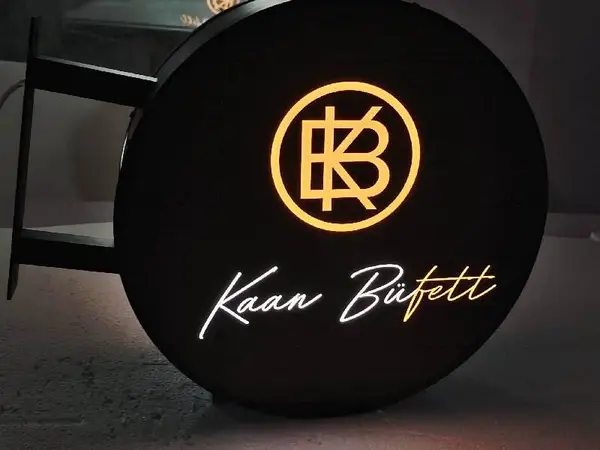
Look, if you’re still paying retail for wall signs, you’re bleeding 50–65% on the product alone.
I’ve watched sign shops pay $800 for a front-lit letter from a domestic fabricator. Same 304 stainless, same Samsung LEDs. We ship that letter for $120. That’s not magic. That’s factory-direct economics. After 15 years on the floor, I’ve seen every corner cut and every supplier lie. Trust me.
Wall signs aren’t just decoration. They’re code compliance, safety, and brand identity bolted to a wall. Get one piece wrong and you’re doing rework.
OSHA requires safety signage following ANSI color standards—red for danger, orange for warning, yellow for caution. But that’s not the whole story.
Most plant managers forget ADA applies outside the production line. Break rooms, restrooms, front offices—those are public spaces. Tactile wall signs there need 48–60 inches mounting height, non-glare surfaces, and Grade 2 Braille. I’ve seen plants pass a floor inspection and fail an accessibility audit the same week.
If any wall sign is illuminated, NEC Article 600 kicks in for the electrical. Importing from overseas? Ask for UL 48 certification. Not a copy-paste PDF—a real cert with your supplier’s name on it.
We seal our back-lit halo letters with neutral silicone and run an 8–12 hour aging test before they leave the floor. That’s not optional in my shop.
Fact: 304 stainless isn’t enough for every wall.
For a strip mall in Ohio, 304 is fine—18% chromium, 8% nickel, 10+ years outdoors. For Miami Beach or any coastal industrial park, you need 316 stainless with 2–3% molybdenum. It costs 20–30% more, but it buys you 15+ years instead of rust streaks in three. I’ve watched someone cheap out on 304 near salt air. They were back in 36 months. If you’re speccing 304 or 316 stainless steel letters for an exterior wall, know your environment first. No exceptions.
If weight is the enemy—say drywall or ACM panels—aluminum is the answer. It weighs one-third of steel. Anodized or powder-coated 1.0–1.6mm aluminum gives you 8–12 years outdoors and it’s naturally rust-proof. Thinner than 1.0mm? Don’t.
The ugly truth about acrylic faces: 3mm cuts 92% light output. 2mm cuts 90%. Your customer won’t notice the 2%, but they will notice the 40% cost bump if you upsell 5mm without reason. UV-resistant acrylic from Mitsubishi or Degussa lasts 5–8 years before yellowing. Domestic cheap stuff? 1–2 years, then it looks like a smoker’s teeth.
I’ve seen this go wrong: a customer specced polished #8 stainless for an exterior wall sign facing a dusty foundry. Six months later, it looked sandblasted.
For a hallway, 4000–5000K neutral white keeps things readable. For exterior highway-facing walls, 6000–6500K cool white cuts through glare. Warm 3000–3500K belongs in hospitality, not a factory’s main entrance.
If your sign is meant to be seen from 100 feet, don’t cheap out on modules. SMD 2835 chips run 100–150 lumens per watt—that’s industry standard. SMD 5730 gives you 40–60 lumens per chip, brightest for big exterior letters. Quality Samsung, Osram, or Blueview modules run 5+ years. Cheap no-name LEDs die in 12–18 months. You do the math.
For high-traffic facilities, wayfinding and directional systems need the same contrast and color temp logic. A visitor who can’t find the loading dock is a liability. Use non-glare faces and high contrast ratios. If your sign washes out under plant lights, you wasted the money. Money gone.
The ugly truth: most sign shops don’t stock wall signs because they can’t justify warehouse space. So they quote you a custom price and a three-week lead time, then outsource the work anyway.
Factory-direct flips that. Our MOQ is 1 piece. Lead time is 7–15 days. That’s faster than some local shops rescheduling. Front-lit channel letters run $20–80 per letter from the factory. Back-lit halo letters run $35–120. Stainless steel non-lit letters run $15–40. A US shop installing the same work charges $200–700 per letter for front-lit, $400–1,000 for halo. You’re paying for their markup, their shop rent, and their middleman.
We laser cut each piece to ±0.1mm after your design confirmation. Custom doesn’t mean slower or more expensive. It means you get exactly what you need, not a standard size that half-works.
I’ve seen this go wrong: a crew mounted a 3mm stainless sign on drywall with plastic anchors.
Drywall can’t hold a 50-pound stainless wall sign. Toggle bolts or, better, hit studs. Brick and concrete need wedge anchors or sleeves. ACM panels need rivet nuts. Stucco is the worst—you have to get through the scratch coat to something solid. If you don’t, you’ll be back with a tube of caulk and an apology. Aluminum signs at 1.6mm thickness are lighter, but they still need proper anchors, not drywall plugs.
Outdoor wall signs need IP65 minimum. That means water jets from any direction. It doesn’t mean your sign survives a Florida hurricane. IP66 for coastal. IP68 for extreme weather. For shipping, your LCL sea freight changes hands 6–8 times between our dock and yours. Every touch is a chance for damage. We pack wall signs in foam + carton + plywood crate for a reason.
Factory floors are getting smarter. Your wall signs should too.
SMD 5050 LEDs are RGB capable, so you’re not stuck with one color. IoT smart signs let you push production counts, shift schedules, or safety alerts to a wall sign from an app. DMX programmable signs can run custom light sequences. That’s not a gimmick—it’s operational visibility.
But don’t put indoor-rated electronics outside without IP65 sealing. We’ve seen “smart” signs die in six months because someone skipped the gasket.
A static wall sign says “we’re here.” A digital wall sign says “we know what we’re doing.”
I’ve been doing this since 2010. Aochuang Sign runs a 3,000m² facility in Lu’an, Anhui, China with 50+ skilled workers. We export worldwide with CE, RoHS, and ISO 9001. That’s not a sales brochure—it’s what’s on the wall.
Our factory prices are 50–65% below US retail installed. A front-lit channel letter that costs $200–700 per letter installed from a domestic shop leaves our floor for $20–80. Back-lit halo letters run $35–120. That’s not cheap Chinese junk—that’s the same 304 stainless and Samsung LEDs.
Shipping: sea freight takes 50–70 days at $80–200/m³ LCL, or $1,200–3,000 for a full container. Air is 10–20 days at $4–12/kg. Express 7–15 days for small orders at $30–100. Section 301 tariffs add about 30% on top. Do the math. You’re still ahead.
Ask to see the CE certificate with today’s date. Most factories will say they have it. Watch them sweat. We offer 2-year LED warranty and 1-year power supply warranty because we know what fails.
Quick answers to the questions I get every week:
Do I need UL certification for wall signs?
If it’s going into a US commercial building and it’s lit, yes—or at least ETL. UL 48 costs $4,000–15,000 and takes 4–9 months. If a supplier says they have UL but can’t show a cert with their factory name, they’re lying. ETL is a cheaper alternative, 10–30% less, and most inspectors accept it.
What’s the real lifespan of an outdoor wall sign?
Cheap LEDs die in 12–18 months. Quality Samsung, Osram, or Blueview modules run 5+ years. L70 ≥50,000 hours means the light is still at 70% brightness at that point. Stainless 304 lasts 10+ years; 316 lasts 15+ in marine. UV-resistant acrylic lasts 5–8 years. Anything else is marketing.
Can I really order just one custom wall sign?
MOQ is 1 piece. Yes, one. That’s not a typo. Lead time 7–15 days because we laser cut and assemble in-house. We don’t need to retool.
Why is sea freight so slow?
50–70 days. Your crate changes hands 6–8 times between China and your dock. Each touch is a chance for damage. Pack it right or don’t complain.

Real photo from our production floor — every sign we ship is made here.
Products mentioned or relevant to this topic — factory-direct, custom built.
From $24/letter · MOQ 1 piece · Flexible lead time · CE & UL certified · ships to 20+ countries
Custom sizes, colors, and finishes. Get a factory price in 24 hours.
Get a Free Quote Copy EmailWhatsApp +86 13865703472 · business@aochuangsign.cn