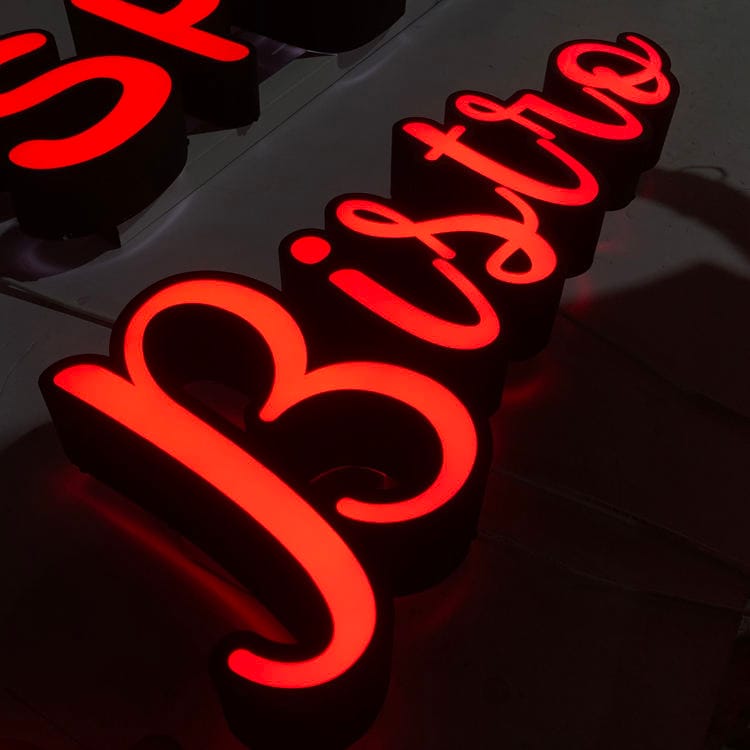
An awning sign is a fabric or rigid face stretched over an aluminum or steel frame that projects from the building. First hard fact: aluminum weighs a third of steel. That's why it's the default frame material on 90% of the awnings I quote.
I've built, imported, and repaired enough of them to know exactly where they fail.
Look, most failures aren't the fabric tearing or the LEDs dying. They're the bracket pulling out of the brick or the weld cracking at the arm. A broker will sell you a pretty render and skip the wind-load math. Then the first storm turns your sign into a missile.
Here's what nobody tells you: the face material usually fails before the frame. Cheap acrylic or fabric without UV stabilizer turns yellow in 12–24 months. Pay for UV-resistant acrylic and you get 5–8 years.
Strip it down and an awning sign has four parts: the frame, the face, the cover or valance, and the mounting hardware. That's it. If it's illuminated, you add a power supply and LED modules.
Frame specs matter more than graphics. 1.0–1.6mm aluminum sheet is standard. It won't rust and gives you 8–12 years outdoors. Steel is heavier and stronger, but if you skip powder coat or galvanizing, you'll see rust in 24 months.
The ugly truth is most buyers spend two hours debating the logo and zero hours checking the anchor spacing. That's backwards.
Fixed awnings are welded aluminum frames bolted to the facade. No moving parts, nothing to fail except the coating and the LEDs. I recommend them for 80% of storefronts.
Retractable awnings have arms, a motor or hand crank, and a fabric drum. More moving parts, more failure points. I've seen this go wrong: a restaurant saved $900 on a cheap retractable. The motor mount snapped at the corner because nobody boxed the frame. It dropped halfway during lunch service.
Backlit awnings run LED modules behind a translucent face. The same SMD 2835 modules we use in back-lit halo letters put out 100–150 lumens per watt. Do a corner storefront? A double-sided backlit awning is basically an oversized double-sided lightbox on a steel arm.
Hybrid means a fixed frame with a backlit front panel or illuminated valance. You get the architectural look without the moving parts.
Aluminum frame: 1.0–1.6mm thick, powder coated or anodized, 8–12 years outdoors. Cheap factories cut corners on weld quality. TIG welds hold. MIG welds on thin aluminum look lumpy and crack.
Stainless steel hardware: 304 is 18% chromium, 8% nickel, and gives you 10+ years. If you're matching an awning to stainless steel letters, don't assume the finish matches. Brushed #4 and powder coat don't reflect the same.
316 stainless costs 20–30% more than 304 because of the 2–3% molybdenum. Strip mall in Ohio? 304 works. Miami Beach or any saltwater exposure? Pay for 316 or you'll replace brackets in three years.
Acrylic faces: standard 5mm, 90–92% light transmittance. Buy UV-resistant grade from Mitsubishi or Degussa and it holds up 5–8 years. Domestic sheet starts yellowing in 1–2 years. That's the same grade sheet that goes into quality acrylic LED letters. Not the place to save $40.
LED modules: SMD 2835 is the industry standard at 100–150 lm/W. Buy Bluesky or Rishang and you get 5+ years real lifespan. Cheap no-name modules last 12–18 months, then you're re-skinning a blacked-out face. Check the solder joints: dull gray means fail, shiny silver means proper lead-free solder.
An awning sign is the cheapest advertising square footage you'll buy. It works 24/7—rain, snow, direct sun.
Weather protection is the second value. When it's raining, customers linger at a storefront door under an awning. That's real foot traffic.
Third benefit: brand consistency. Match the awning face color to your logo. Backlight it at 4000–5000K neutral white for corporate retail, or 3000–3500K warm white for hospitality. Color temperature isn't just a preference—it changes how your food or product looks from the street.
A 60cm double-sided lightbox costs $70 from the factory. Scale that up to a full awning and you're still paying less than a monthly billboard rental in most cities.
Permitting is where I see grown sign buyers cry.
Most cities want 8 feet of clearance from sidewalk to awning bottom. Any illuminated sign must comply with NEC Article 600 for electrical. If you're within reach of a walkway, ADA says protrusions between 27 and 80 inches above floor can't stick out more than 4 inches. That kills a lot of deep projection designs.
Nobody tells you this: UL 48 certification for an illuminated awning can run $4,000–15,000 and take 4–9 months with quarterly audits. ETL is an accepted alternative and 10–30% cheaper. CE marking costs 20,000–50,000 RMB and takes 2–8 weeks. Most factories say they have it. Ask to see the certificate with today's date. Watch them sweat.
IP ratings matter. IP65 means dust-tight and protected from water jets—minimum for outdoor. IP66 is for coastal or powerful hose-down. IP68 is submersible and overkill unless your awning is in a car wash. If the city requires tactile signage alongside the awning, mount it at 48–60", non-glare, Grade 2 Braille.
Stop asking for a square-foot price. Ever. Until you get the spec sheet, any number you hear is a guess.
Real cost drivers: projection depth, frame material, face material, illumination, and shipping. Projection depth drives wind load and bracket engineering. A 3-foot projection isn't just twice the cost of 18 inches—you're paying for more steel, larger anchors, and maybe a structural engineer's stamp.
Ugly truth: cheap LED modules are false economy. No-name modules last 12–18 months. I've seen this go wrong: a shop owner bought a backlit awning with unbranded LEDs to save $260. Six months later half the face was dark. Re-skinning and relighting cost $2,100 because the original seller was gone.
Shipping from a China factory: express 7–10 days, air around 10 days, fast sea 40–50 days, standard sea around 65 days. Production runs about 5 days for a sample and 15 days for bulk, depending on quantity, size, and complexity. Freight always depends on destination and volume—never trust anyone who gives a freight price without a shipping address.
ROI: if an awning brings 5 extra customers a day at an average ticket of $20, that's $36,500 a year. Payback on a $3,000 awning: about a month. You do the math.
I'm going to be blunt.
Brokers add 30–50% and can't tell the aluminum grade from the packaging tape. Local sign shops can be great for repairs, but for new fabrication you're often paying $800 for a product the factory ships for $120. I've watched it happen with front-lit letters; same math applies to awning hardware.
Factory-direct means you buy from the people who laser cut the frame and TIG weld the brackets. Our shop is Aochuang Sign in Lu'an, Anhui, China. 3,000 square meters, 50+ workers, and a minimum order of one piece. We export worldwide. Two-year warranty on LEDs, one year on power supplies.
Look, the factory-direct risk is you don't inspect before you pay. So ask for weld photos, material mill certificates, IP test reports, and a video of the 8–12 hour aging test. If they won't send it, walk.
And remember the CE scam. Most factories say they have CE. The certificate costs 20,000–50,000 RMB and takes 2–8 weeks. Ask for the cert with today's date. If they can't show it, they don't have it.
Three questions I still get every week:
How much does an awning sign cost? Stop asking for a square-foot price. That's like asking how much a car costs. A fixed aluminum awning with a fabric face isn't the same as a backlit acrylic hybrid with a 4-foot projection.
Do I need a permit? If it projects over a public sidewalk or is illuminated, yes. Don't be the guy who installs first and begs forgiveness later. The city will make you take it down.
Can I install it myself? If you have to ask, no. The bracket anchor load on a projecting sign isn't a homeowner job. I've seen brick facades spalled from badly placed wedge anchors.
Why does your factory price change by destination? US and EU developed markets have higher compliance costs, so we quote accordingly. That's not a scam; it's the cost of doing business where the spec sheet is the law.
Products mentioned or relevant to this topic — factory-direct, custom built.
From $16/letter · MOQ 1 piece · 7–15 day production · CE & UL certified · ships to 20+ countries
Custom sizes, colors, and finishes. Get a factory price in 24 hours.
Get a Free QuoteWhatsApp +86 13865703472 · cairuisheng@aochuangsign.cn