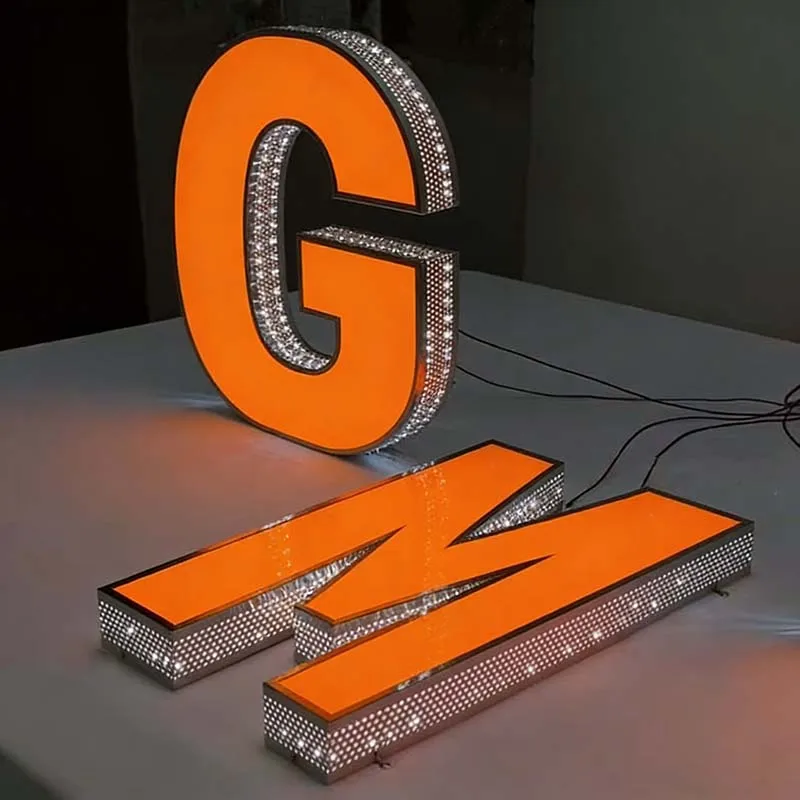
A 40-inch double-sided lightbox costs 50 bucks factory-direct. But the best sign for an ice cream shop? Not one sign. Never one sign. You want lit channel letters over the storefront plus a cheap A-frame on the sidewalk. I've watched owners blow $15,000 on a pylon sign nobody reads, then stand there wondering why the minivan full of kids drove past. The sign that moves ice cream sits at eye level, lit at 9 p.m., within 50 feet of the door. Eye level.
Look, I've built signs since 2010. Aochuang Sign, Lu'an, Anhui. 3,000 square meters, 50-plus workers. I've shipped everything from 30-centimeter acrylic letters to 120-centimeter RGB floor-standing monsters. For ice cream shops, the number that matters is front-lit channel letters at $0.7–$0.9 per centimeter of letter height. A 40-centimeter letter lands around $28–$36. You can't buy a month of social ads for that. The sign keeps working for 5-plus years.
Here's what nobody tells you: an ice cream shop's busiest hours land after dinner. No lights? You're invisible. Cheap LED modules? They die in 12–18 months. Good modules—Bluesky or Rishang—use SMD 2835s at 100–150 lumens per watt and hold a real 5-plus-year lifespan. That's the gap between a sign that looks dead in two summers and one that's still yanking cars into the lot five years later.
I've seen this go sideways: a shop owner in Ohio paid $800 per letter to a domestic fabricator for a front-lit face. Same 304 stainless. Same Samsung LEDs. We ship that letter for $120. That's not a sales pitch—that's factory-direct math. The markup comes from layers of distributors, not from better quality.
An ice cream cone is an impulse buy. Nobody drives 20 minutes because a billboard told them to. You stop because a warm, glowing sign popped waffle cones and your kid's face into your head. So don't measure ROI in impressions. Measure it in one extra car swinging into the lot per hour. Do the math. If that car drops $15 and comes back twice a summer, the sign pays for itself in weeks.
The ugly truth: most sign shops hand ice cream clients the wrong product. They push a giant illuminated cabinet because the margin's fatter. Cabinets have their place, but they don't build the same brand trust as dimensional channel letters. A cabinet is a box with a face. A channel letter is architecture. That matters when you're charging $9 for a milkshake.
If your ice cream shop sits on a 45 mph stroad behind a parking lot, a pylon sign might earn its keep. But here's the problem: pylon signs mean permits, concrete footings, engineering stamps, and wind-load calcs. You can burn $20,000 before a single LED fires. Most ice cream shops don't need that.
The ugly truth? A monument sign—low, wide, aluminum or 304 stainless—usually does the job better at eye level from a turning lane. Aluminum weighs a third of steel and gives you 8–12 years outdoors. 304 stainless gives you 10-plus, and its 18% chromium, 8% nickel mix means it won't rust in normal weather. Strip mall in Ohio? 304 is fine. Miami Beach? Pay for 316 stainless—20–30% more—or plan on replacing letters in three years.
Look, I've argued with contractors over this. A 60-centimeter pylon sign hanging 6 meters up doesn't stop a mom scanning for a parking spot. The sign that stops cars is the one she can read through the windshield while her kid yells about sprinkles. Save the pylon money. Put it into the storefront and the sidewalk.
For an ice cream shop, front-lit channel letters are the bread and butter. You want an even glow on the face, returns that match your brand color, and LEDs you can service from the front. Ordering from a factory? Specify 5mm acrylic faces as the default. A 3mm face saves about 40% on material, but the light output difference is marginal—around 2 percentage points. Your customer won't notice 2% less light. They will notice the cheap look when the face waves in the wind.
Back-lit halo letters are the premium architectural look. They splash light against the wall and make a shop feel like a boutique, not a fast-food window. For ice cream, I like halo letters on a dark facade or above a window. The price premium is real: $1.0–$1.2 per centimeter for electroplated stainless backlit versus $0.7–$0.9 for front-lit. If your brand is "artisanal small-batch," the halo effect sells that without a single word.
Here's the part people skip with acrylic: UV-resistant Mitsubishi or Degussa sheet lasts 5–8 years before it yellows. Domestic acrylic can start turning yellow in 1–2 years. If your ice cream shop faces west, that's the difference between a sign that looks creamy and one that looks like it's been smoking for a decade. Ask the factory what acrylic they're using. If they blink, walk.
A digital menu board isn't just a screen. Think of it as a salesperson that never calls in sick. You can swap flavors, push the new lavender honeycomb, and flash the "waffle cone upgrade" at 7 p.m. when the after-dinner crowd rolls in. But don't buy garbage. The LED modules in those boards matter just as much as the ones in channel letters.
Nobody mentions this one: color temperature changes how food looks. 3000–3500K warm white makes a strawberry cone look rich and indulgent. 4000–5000K neutral works for a corporate or retail feel, but it can make dairy look sterile. 6000–6500K cool white is for highway signs. Not ice cream. If your digital board defaults to 6500K, dial it down or your product photos will look like hospital equipment.
Cheap reader boards with no IP rating fail fast. IP65 means dust-tight and protected against water jets from any direction. That's the outdoor minimum. For a board under an awning that gets hit by power washers, IP65 is mandatory. IP66 handles powerful jets for coastal or stormy areas. IP68 is submersible—unnecessary unless you're mounting the sign in the walk-in freezer.
Look, a reader board doesn't have to be digital. A simple backlit cabinet with changeable letters still works for daily specials. But if you go digital, budget for the software and the replacement power supply. The power supply on a cheap board dies first. We warranty the LEDs for 2 years, the power supply for 1. That's not generosity. That's knowing what fails.
Nobody gets out of a car at 25 mph and reads a pylon sign. They park. They walk. They look down. That's where an A-frame wins. An A-frame is cheap, movable, and the only sign your customer reads after they've already decided to stop. Use it to list today's flavors or point to the door.
Skip the flimsy plastic A-frames that blow over in a 15 mph wind. Get an aluminum frame with a weighted base and an acrylic face. Aluminum gives you 8–12 years outdoors and weighs a third of steel. Edge-glow side-lit acrylic letters on the A-frame can look sharp, but honestly, a laminated print in a well-built frame does the job. The message matters more than the material.
I've seen this go wrong: a shop bought a gorgeous hand-painted A-frame, then left it chained to a bike rack all winter. The paint peeled, the hinges rusted, and by spring it looked like a picked-over garage-sale sign. If you're using an A-frame seasonally, store it dry. Or buy stainless hardware. 304 stainless runs 18% Cr, 8% Ni and can sit outside for 10-plus years without rusting.
Walk-up shops need channel letters over the window, a clear menu board at eye level, and an A-frame on the sidewalk. That's the holy trinity. Drive-thru shops add two more: a pre-order menu board at the speaker and a direction sign at the merge point. For the drive-thru board, a double-sided lightbox earns its place if you want visibility from both the driver and the walk-up side.
Factory pricing on double-sided lightboxes runs by diameter: 40 cm costs $50, 50 cm costs $60, 60 cm costs $70, 70 cm jumps to $120, 80–90 cm costs $150, and 100–120 cm costs $200. I don't know why the 70 cm jumps, but it does—probably because the frame extrusion changes. On a budget, two 60 cm units often beat one 80 cm unit.
Seasonal shops in tourist towns face a different headache. They need signs that come down in October and go back up in May without failing. For that, spec 304 stainless or aluminum—not painted mild steel. Painted steel rusts at the cut edges within one season if you're near salt air. 316 stainless is marine grade, packs 2–3% molybdenum, and costs 20–30% more. For a Cape Cod or Gulf Coast ice cream shack, that's the only choice if you don't want to repaint every April.
Look, the sequence matters. You don't need one giant sign. You need three or four signs that move the customer from the road to the cone. Road sign says "Ice Cream." Storefront says "This is the place with the good stuff." Menu says "Order this now." A-frame says "Yes, the lavender honeycomb is back." That's a conversion funnel made of aluminum and acrylic.
Here's what nobody tells you: CE marking costs 20,000–50,000 RMB. Most factories claim they have it. Ask to see the certificate with today's date. Watch them sweat. Same with UL 48 for the US market—that certification runs $4,000–$15,000 and takes 4–9 months with quarterly audits. If a factory quotes UL-listed signs at bargain prices, they're either eating the cost or lying.
For an ice cream shop, your material sweet spot is 304 stainless returns with a 5mm acrylic face. Stainless business pricing starts at $0.6–$0.7 per centimeter for baked paint, $0.7–$0.8 for electroplated, and $1.0–$1.2 for backlit electroplated. Aluminum is cheaper and lighter, but it dents easier. If the sign sits above 3 meters or in a hail zone, stainless earns its keep.
I've seen this go wrong: a client specified 316 stainless for a shop in Kansas. Three years later, he sold the business and the sign looked brand new. He spent 30% more than he needed to. Not a tragedy, but it's waste. Match the material to the environment. 304 for most of the US. 316 if you're within 10 miles of the coast or in an industrial corridor with acid rain. That's the rule.
Budget somewhere around $500–$1,500 for a simple storefront set if you're buying factory-direct, depending on size, finish, and quantity. Our MOQ is one piece. Sample lead time runs about 5 days, bulk production roughly 15 days, confirmed case by case. Freight depends on destination and volume—don't let anyone quote a fixed freight price without a shipping address. Express takes 7–10 days, air about 10 days, fast sea 40–50 days, standard sea about 65 days. Plan ahead. Ice cream season doesn't wait for slow boats.
If you're still wondering: no, a $50 lightbox isn't the best sign. Think of it as a component. The best sign is lit, clean, and placed where a kid can see it from the back seat. Everything else is just fabrication.
Can I use an LED neon sign outdoors for my ice cream shop? Sure. Buy LED neon flex with an IP65 rating or better, and it'll survive weather. But LED neon is an accent, not a primary sign. Most cities won't give you a permit for a storefront ID. Use it inside the window or as a decorative wall piece.
What's the minimum IP rating I need for an outdoor ice cream sign? IP65. That's dust-tight and protected against water jets from any direction. Go IP66 if you're coastal or pressure-wash your facade. IP68 is overkill unless you're mounting your sign inside the soft-serve machine. Don't do that.
How long should a good channel letter sign last? The LED modules should run L70 at 50,000 hours minimum. With Bluesky or Rishang modules in a properly sealed sign, that's 5-plus years of real-world evening use. Cheap modules die in 12–18 months. If a shop quotes you a 10-year warranty, ask what exactly it covers. Usually, nothing that fails.
Can I really order one sign from a factory in China? Yes. Our MOQ is one piece. You'll pay more per unit than a container order, but it's still cheaper than domestic markup for most shop owners. Just don't expect one-piece pricing to match 20-piece pricing. That won't happen. And don't forget freight and customs.
Products mentioned or relevant to this topic — factory-direct, custom built.
From $16/letter · MOQ 1 piece · 7–15 day production · CE & UL certified · ships to 20+ countries
Custom sizes, colors, and finishes. Get a factory price in 24 hours.
Get a Free QuoteWhatsApp +86 13865703472 · cairuisheng@aochuangsign.cn