Here's the difference in one sentence: acrylic faces pass 90–92% of light, and 304 stainless weighs 7.93 g/cm³ and blocks every photon. One's a lens, the other's armor. If you're lighting a sign, you need acrylic. If you're building a sign that survives a decade of weather, you need metal.
Here's what nobody tells you: most "metal letters" still use acrylic somewhere—the face, the returns, or the light diffuser. A stainless channel letter is a metal can with an acrylic face. So you're not comparing acrylic versus metal in a vacuum. You're comparing what job each material actually does.
Acrylic sheet comes in 2mm, 3mm, and 5mm thicknesses. For any letter over 2.5 meters wide, you spec 5mm or the face sags under its own weight. We CNC route the faces to ±0.1mm, flame-polish the edges, and bond them into aluminum or stainless returns.
Sheet metal—304 stainless, 316 stainless, or 5052 aluminum—starts as 1.0–3.0mm coil. We laser cut it, TIG weld the corners, grind the seams, then finish it brushed #4, mirror #8, powder coated, or PVD. No plastic shrink wrap. No UV stabilizer praying to the sun.
I've seen this go wrong: a shop orders 1.5mm 304 for a 6-foot monolith, welds it with cheap filler, and the first cold snap pulls the corner apart. Metal is forgiving until it isn't.
Look, acrylic fabrication is cleaner and faster. Metal fabrication is slower and dirtier. If your deadline is 7 days, a simple set of acrylic LED letters with aluminum returns ships on time. If you want a 316 stainless logo with mirror polish and welded studs, budget the full 15 days.
Acrylic gives you color. Domestic sheet yellows in 1–2 years, but Mitsubishi or Degussa UV-resistant acrylic holds 5–8. Metal gives you depth. A brushed #4 finish reads differently at 10 a.m. than under sodium lights. And you can powder coat metal any RAL color a client pulls from a fan deck.
The ugly truth is that most clients say they want a "metal look" but then ask for a white logo that glows at night. That's acrylic. Front-lit channel letters are exactly this: an aluminum or stainless body, an acrylic face, and internal LEDs doing the heavy lifting.
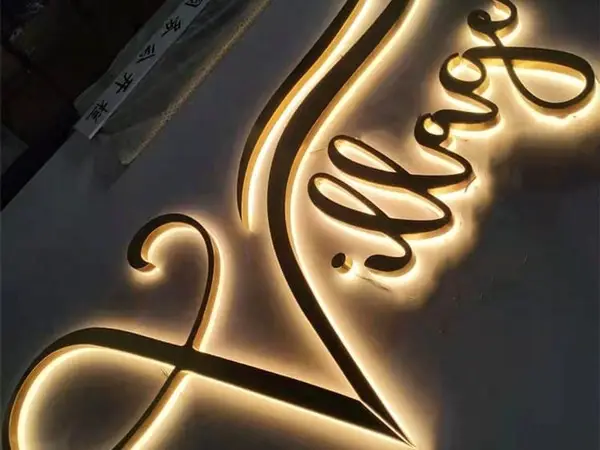
If you want the architectural look with light spilling onto the wall behind the letter, that's a back-lit halo letter. You're buying a metal letter with a clear acrylic back and LEDs aimed backwards. The metal returns block the face glow. That's why halo letters cost more—they're metal fabrication plus light engineering.
You can tint acrylic, frost it, paint the second surface, or thermoform it into a domed face. You can mirror-polish metal to look like chrome without plating. One material bends light, the other throws it back at you.
Here's what nobody tells you: acrylic doesn't rust, but it does fade, yellow, and craze. UV-resistant sheet from Mitsubishi or Degussa buys you 5–8 years. Cheap domestic acrylic? 12–18 months before it looks like a smoker's teeth. Metal has the opposite problem—it doesn't yellow, but cheap 304 in a coastal salt environment pits at the welds.
Look, 316 stainless contains 2–3% molybdenum. That's the only reason it survives Miami Beach or a refinery fence. That costs 20–30% more than 304. For a strip mall in Ohio, 304 is more than enough. For a Miami Beach hotel, pay for 316 or you're replacing letters in three years.
Aluminum is naturally rust-proof, but it's soft. A 1.0mm aluminum face dents if a kid throws a rock. Powder coating helps, but once the coating chips, the raw aluminum underneath starts to oxidize—white powder, not red rust. Structurally, it'll last 8–12 years.
Maintenance on acrylic is mostly cleaning. On metal, it's inspection—check the welds, the mounting studs, the silicone seals. Skip the silicone on an outdoor acrylic face and water gets behind the LED, turning the letter into a fish tank. IP65 means water jets from any direction. That doesn't mean your sign survives a Florida hurricane.
Aluminum weighs one-third of steel. A 3-foot stainless letter might weigh 18 kg; the same size aluminum letter might weigh 6 kg. That's the difference between a simple stud-mount and structural backing.
Here's what nobody tells you: installers charge by the hour, and a heavy metal sign takes two guys, a lift, and a lot more wall anchoring. Acrylic letters with aluminum returns go up with VHB tape and silicone for small interiors, or studs for exterior. Stainless letters over a certain size need a pattern, a drill, and a prayer if the wall is hollow block.
Look, I've watched an installer try to hang a 50 kg stainless logo on drywall with toggle bolts. The ugly truth is that the mounting hardware matters more than the letter itself. NEC Article 600 compliant installations aren't optional for US electrical work, and UL 48 listing is what inspectors ask for. If your factory won't show you the UL certificate when you ask, walk.
And when a factory says they're CE certified, ask for the certificate with today's date. CE marking costs 20,000–50,000 RMB. If they can't produce it, they don't have it.
Factory direct, a non-lit stainless letter runs $15–$40. An aluminum letter runs $10–$25. A front-lit acrylic channel letter runs $20–$80. A back-lit halo letter runs $35–$120. Those aren't retail. US retail installed front-lit letters go $200–$700 per letter.
The ugly truth is that the sticker price is the smallest number. Over 10 years, a cheap acrylic face on a coastal building gets replaced twice. A 316 stainless body with a UV-stable acrylic face gets cleaned once a year. That's the total cost of ownership nobody puts in a quote.
Lead time is 7–15 days from a Chinese factory, plus shipping. Express gets small signs to the US in 7–15 days for $30–$100. Air freight runs 10–20 days at $4–$12 per kg. Sea freight takes 50–70 days at $80–$200 per cubic meter LCL. Section 301 tariffs add about 30%. If a US fabricator quotes you 6 weeks for the same thing, you're paying for their rent.
I've seen this go wrong: an order of 50 stainless steel letters shows up with scratches because the factory shipped them in one thin foam layer. LCL freight means your crate passes through six to eight sets of hands between our dock and yours. Every touch is a chance for damage. Spec export packaging—foam, carton, plywood crate—or don't complain when it arrives looking like it went through a car wash.
Interior, use acrylic every time. The light control, the color options, the weight. An acrylic LED letter with a 3000–3500K warm LED looks like a million bucks in a hotel lobby. Exterior, if you're on a coastal highway or an industrial site, use 316 stainless or aluminum with a powder coat and an IP65-rated seal.
Here's what nobody tells you: outdoor acrylic letters don't fail because of the acrylic. They fail because the silicone seal fails, water gets in, and the cheap LEDs inside corrode. Quality LED modules—Samsung, Osram, Blueview—run 5+ years. Cheap modules die in 12–18 months. Solder joints that look dull gray? Those are failed joints waiting to happen.
For a corporate headquarters, a brushed 304 stainless logo with a clear acrylic halo looks expensive and stays that way for a decade. For a retail strip mall, a front-lit channel letter with a 4000–5000K neutral white face is the workhorse. For a Miami restaurant, 316 stainless and warm white 3000K halo is the only thing that won't look like hell in 24 months.
If you're debating between acrylic and metal for an exterior brand sign, stop thinking material first. Think failure method. Do you want the face to yellow or the body to rust? Pick the material you can maintain. Your call.
Yes, with UV-resistant sheet from Mitsubishi or Degussa. Expect 5–8 years. Use cheap domestic acrylic and you're replacing it in 18 months. And don't skip the silicone seal.
Stainless is the heaviest—7.93 g/cm³. Aluminum weighs one-third of steel. Small interior letters go up with tape. Big exterior stainless needs studs, a lift, and a higher install bill.
Acrylic faces are usually cheaper upfront. A front-lit acrylic channel letter runs $20–$80 factory direct. A non-lit stainless letter runs $15–$40. But the material cost is nothing compared to replacement and maintenance over 10 years.
Not always. 304 stainless lasts 10+ years in most climates. For coastal or industrial sites, spend the extra 20–30% on 316. Or use aluminum and powder coat it. Just don't put cheap acrylic faces on an oceanfront building and then complain to me when they yellow.

Real photo from our production floor — every sign we ship is made here.
Products mentioned or relevant to this topic — factory-direct, custom built.
From $24/letter · MOQ 1 piece · Flexible lead time · Project-specific compliance documents · ships to 20+ countries
Custom sizes, colors, and finishes. Get a factory price in 24 hours.
Get a Free Quote Copy EmailWhatsApp +86 13865703472 · business@aochuangsign.cn