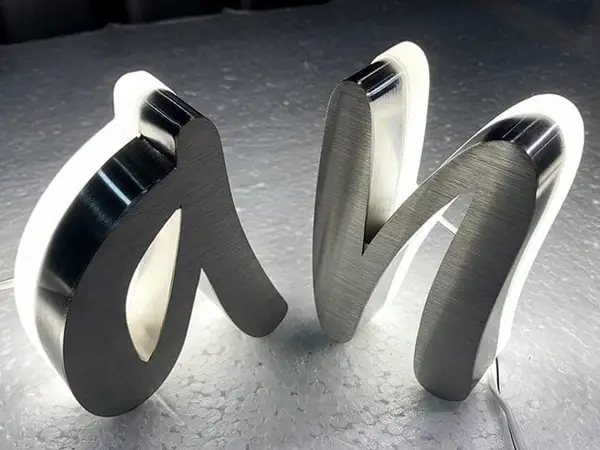
You want the truth about wholesale channel letters? Most shops bleed cash on their first three orders. They look at the invoice price and forget freight, duties, and the rework you get when a factory doesn't ask the right questions. I've been at Aochuang Sign since 2010—3,000 square meters, 50-plus workers, CE, RoHS, ISO 9001—and I've seen every shortcut there is.
I've burned my hands on hot acrylic, argued with suppliers about LED solder joints, and opened crates that arrived looking like they'd been drop-kicked across the Pacific. The numbers below aren't from a sales pitch.
I get a call at least once a month from a shop owner who says, "I can build these in-house cheaper."
No, you can't. Once you factor in the aluminum coil, the acrylic sheet, the LED modules, the labor, the rework from a rookie welder, and the shelf space for half-used materials, that $45 wholesale letter starts looking like a bargain. A domestic fabricator quoted a client $800 for a front-lit letter in 304 stainless with Samsung LEDs. We shipped that same letter for $120. That's not a typo.
That's factory-direct savings of 50–65% on product, before you add your own margin. US retail installed pricing runs $200–700 per front-lit channel letter and $400–1,000 per halo-lit letter, so you've got a lot of meat on the bone if you source properly.
Here's what nobody tells you: most domestic "fabricators" are just middlemen. They take your order, mark it up 200%, and send it to a factory like ours. You can do the same thing without paying their overhead.
Look, material spec sheets mean nothing if you don't know what happens to them after 18 months under UV.
Front-lit letters are the workhorse. A good acrylic face—Mitsubishi or Degussa—transmits 90–92% of light and holds up 5–8 years before yellowing. Cheap domestic acrylic? 1–2 years, and your client calls you with fading, brittle faces. If the letter span goes over 2.5 meters, don't even think about 2mm acrylic. Use 5mm or thicker.
If your project leans indoor or corporate, acrylic LED letters are lighter and cheaper to ship. They're not for coastal outdoor. For lobby signs and tenant corridors, they're perfect.
For back-lit halo letters, the face doesn't light up—the halo behind does. That's an architectural look. That costs more: $35–120 factory per letter versus $20–80 for front-lit. But your margin is higher if you position it as premium.
304 stainless letters will survive 10+ years outdoors. 316 is marine grade with 2–3% molybdenum and 15+ years, but it's a 20–30% cost premium. For a strip mall in Ohio, 304 is fine. For Miami Beach, pay for 316 or you're replacing letters in 3 years.
The ugly truth is LED quality separates a five-year sign from an 18-month warranty claim. SMD 2835 modules from Samsung, Osram, or Blueview run 100–150 lumens per watt and carry an L70 rating of 50,000 hours. Cheap modules? 12–18 months. I can spot them by the solder joints—dull gray means cheap lead-free solder that'll fail. Shiny silver means proper solder.
Color temperature matters. 3000–3500K warm for hospitality, 4000–5000K neutral for corporate and retail, 6000–6500K cool for industrial and highway work. Ask your client before you specify. If the sign feels too blue, you can't fix it after it's built.
Start with certifications, but don't be naive. CE marking costs 20,000–50,000 RMB and takes 2–8 weeks. Most factories will tell you they have it. Ask to see the certificate with today's date. Watch them sweat.
For the US market, UL 48 runs $4,000–15,000 and 4–9 months with quarterly audits. ETL is a legitimate alternative and costs 10–30% less. If a factory quotes you $120 per letter and says "UL included," they're either lying or eating the cost to win your order. Neither is sustainable.
Then look at the production floor. A real factory has a 10-step process: design confirmation in 1 day, laser cutting at ±0.1mm, TIG welding, grinding, acrylic CNC, LED assembly, sealing with neutral silicone, an 8–12 hour aging test, 100% QC inspection, and export packaging with foam, carton, and plywood crates. If they can't explain their aging test, walk away.
Plenty of factories skip the aging test. They assemble the letter, seal it, and box it. Six weeks later, condensation forms inside and your client's sign looks like a fish tank. Demand proof of the 8–12 hour burn-in.
Let's put real numbers on the table. Factory prices per letter: front-lit $20–80, back-lit halo $35–120, stainless non-lit $15–40, 3D fabricated $40–120, aluminum $10–25. Light boxes run $80–250 per square meter. LED neon flex $30–200 per sign. MOQ is one piece. Yes, one.
Now add your landed costs. Express shipping gets a sign to you in 7–15 days for $30–100 on small orders. Air freight is $4–12/kg and takes 10–20 days. Sea freight is $80–200 per cubic meter LCL or $1,200–3,000 for a full container, and it takes 50–70 days. Don't forget the US Section 301 tariff on signs, which adds roughly 30%.
Here's what nobody tells you: your customs broker will charge you whether the shipment is perfect or destroyed. And with LCL sea freight, dockworkers handle your crate 6–8 times between our dock and yours. Every touch is a chance for damage. That's not in the brochure.
Your margin playbook: quote the client $500 per front-lit letter installed. Buy the letter for $50, spend $80 on freight, duties, and broker, pay your installer $150, and you're still clearing $220 per letter before overhead. If you're buying domestic at $250 per letter, that margin shrinks to $100. Do the math.
I've watched shops leave money on the table because they don't mark up design files, mounting patterns, or site surveys. Charge for all of it. You're not selling letters. You're selling the fact that they'll light up for five years and the inspector won't reject the install.
I've seen this go wrong: a shop sent us a JPEG logo from a business card and expected a 4-foot channel letter set. We had to rebuild the art from scratch, the client changed colors twice, and the order shipped two weeks late. Send vector files—AI, EPS, PDF, or DXF—with exact dimensions, color temperatures, and face thickness on day one.
Our process runs 7–15 days from design confirmation to export packaging. Design confirmation takes 1 day, laser cutting at ±0.1mm takes 1–2 days, bending and TIG welding 1–2 days, grinding and polishing 1–2 days, acrylic face CNC 1 day, LED assembly 1–2 days, sealing with neutral silicone 1 day, then an 8–12 hour aging test, 100% QC inspection, and export packaging with foam, carton, and plywood crates. If you don't confirm the drawings, the clock doesn't start. Read that again.
Rework happens because someone didn't ask about installation environment. Is it coastal? Then 316 stainless, not 304. Is it near a road with heavy vibration? Reinforce the returns. Does the client want warm white or cool white? 3000–3500K for hospitality, 4000–5000K for retail, 6000–6500K for industrial. I can't read minds, and neither can the factory.
For the US, NEC Article 600 governs electric signs. If your client's contractor doesn't know that, you're the one who looks bad when the inspector fails the job. IP65 is the minimum for outdoor—dust-tight and protected against water jets. IP66 handles powerful jets, and IP68 is for submersion. IP65 does not mean your sign survives a Florida hurricane.
ADA signs are different. Tactile signs need mounting between 48–60 inches, non-glare finish, and Grade 2 Braille. Don't confuse your channel letter order with ADA compliance. Two different worlds.
Long-term service comes down to two things: LED quality and power supply quality. We warranty LEDs for 2 years and power supplies for 1 year, but quality modules from Samsung/Osram/Blueview should run 5+ years. If a client signs off on cheap LEDs to save $20 per letter, they'll call you in 18 months with half the sign dark. You'll eat the labor for the service call. That's the real cost of "value engineering."
What's the MOQ? One piece. I can't believe I still have to explain this. We'll ship a single letter if you want, but don't expect sea freight to make sense on one letter. Express is $30–100, so order a sample or combine with a real project.
Can I get a free sample? No. You can buy a sample at normal single-unit price. If you place a production order, I'll credit it back. I'm not sending free signs to every tire-kicker with a logo.
Do I need UL certification? If your local inspector requires it, yes. UL 48 costs $4,000–15,000 and takes 4–9 months. A factory that says "UL included" on a $120 letter is lying or losing money. Check the certificate with today's date.
Why is sea freight so slow? A boat. That's 50–70 days LCL. Plan ahead. And dockworkers handle your crate 6–8 times, so make sure it's packaged like it'll be dropped. Because it will be.

Real photo from our production floor — every sign we ship is made here.
Products mentioned or relevant to this topic — factory-direct, custom built.
From $24/letter · MOQ 1 piece · Flexible lead time · CE & UL certified · ships to 20+ countries
Custom sizes, colors, and finishes. Get a factory price in 24 hours.
Get a Free Quote Copy EmailWhatsApp +86 13865703472 · business@aochuangsign.cn