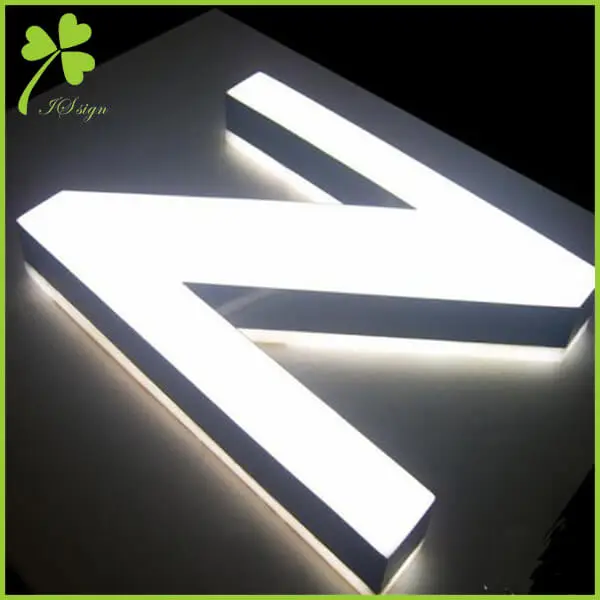
Let me break this down: you've been paying $400 to $700 per letter for front-lit channel letters from a domestic shop. I've watched sign shops buy the same 304 stainless steel letter with Samsung LEDs for $120 — from the factory. The difference isn't quality. It's middlemen, markup, and the false comfort of "local support." I'm going to show you exactly how wholesale works, where the savings come from, and where you need to be careful.
Here's the math: factory-direct prices for front-lit channel letters run $20 to $80 per letter. Back-lit halo letters: $35 to $120. Stainless non-lit: $15 to $40. Aluminum letters: $10 to $25. That's not a typo. Compare that to US retail installed prices of $200 to $700 per letter for front-lit, and $400 to $1,000 for halo-lit. The factory saves you 50 to 65 percent on the product itself.
Most buyers don't realize that the retail shop is often buying from the same overseas factory and marking it up 300%. Or they fabricate in-house but use the same imported components — same Samsung LEDs, same Mitsubishi acrylic — and charge you for the "American labor." There's nothing wrong with paying for local service if you need it. But if you're a contractor who can manage your own install, you're leaving thousands on the table.
The spec says… but in reality, some factories cut corners. Cheap LED modules with dull gray solder joints — that's a dead giveaway. Shiny silver solder means proper lead-free process. Those cheap modules? They die in 12 to 18 months. Quality modules from Samsung or Osram, or reputable brands like 蓝景, last 5 years plus. I've seen it in the field. You get what you pay for — but you don't have to overpay.
Stainless 304 is the workhorse. 18% chromium, 8% nickel. Density 7.93 grams per cubic centimeter. Ten-plus years outdoor life if you spec 1.0 to 3.0 millimeter thickness. For a strip mall in Ohio, 304 is fine. But here's the brutal honesty: if your job is within a mile of saltwater — Miami Beach, Gulf Coast, even near road salt in the Northeast — 304 will pit in 3 to 5 years. You need 316 stainless. It contains 2 to 3 percent molybdenum. Cost premium is 20 to 30 percent. Worth every penny. I've seen 304 letters rust in 3 years by the ocean. Don't learn that lesson the expensive way.
Acrylic is another place to watch. Mitsubishi and Degussa UV-resistant acrylic lasts 5 to 8 years before yellowing. Domestic acrylic? 1 to 2 years. For a sign over 2.5 meters tall, you need 5 millimeter thickness minimum. Standard thicknesses are 2mm, 3mm, and 5mm. I've seen a 3mm face crack in a windstorm three years out. Save the headache.
LEDs: SMD 2835 is the industry standard. 100 to 150 lumens per watt. SMD 5050 for RGB. SMD 5730 for highest brightness at 40 to 60 lumens per chip. Color temperature matters: 3000 to 3500 Kelvin for warm hospitality, 4000 to 5000K for corporate or retail, 6000 to 6500K for industrial or highway. Don't let anyone sell you 6500K for a luxury boutique. It looks like a hospital.
CE marking sounds official. It costs 20,000 to 50,000 RMB to get certified — that's about $3,000 to $7,000. Most factories say they have it. Quickest way to check: ask to see the certificate with today's date. Watch them sweat. Many factories buy a fake cert for a few hundred dollars. If they can't show it, assume they don't have it.
IP65 is the minimum for outdoor signage. Dust-tight and water jets from any direction. Sounds impressive. It does NOT mean your sign survives a Florida hurricane. The housing seal is only as good as the silicone. Standard sealing uses neutral silicone. But I've seen signs with gaps around the knockouts. That's a rookie mistake. Water gets in, LEDs short, and you're replacing the whole letter.
If you're shipping to the US, UL is the gold standard. UL 48 certification costs $4,000 to $15,000 and takes 4 to 9 months with quarterly audits. ETL is an alternative — it's UL's rival, approved by OSHA, and 10 to 30 percent cheaper. For most commercial installations, UL or ETL is required by code. NEC Article 600 governs signs. If your spec calls for UL and you don't have it, your project won't pass inspection. I've seen it happen. The contractor had to rip out 40 letters and pay expedited labeling fees. That's a nightmare you don't want.
ADA compliance is its own universe. Tactile signs must be mounted 48 to 60 inches above the floor, have non-glare finish, and Grade 2 Braille. If you're doing interior wayfinding, don't forget that.
Most buyers don't realize that LCL sea freight — less than container load — is the most common way to import channel letters. Your crate gets handled 6 to 8 times between our dock in Lu'an, China, and your job site. Every touch is a chance for damage. That's not in the brochure. Air freight is faster but costs $4 to $12 per kilogram. For a 50-kilogram crate of letters, that's $200 to $600. Sea freight LCL runs $80 to $200 per cubic meter. Full container load (FCL) is $1,200 to $3,000 for a 20-foot container. Express shipping like DHL or FedEx works for small samples under $100.
US Section 301 tariffs add about 30 percent on Chinese imports. Factor that in. But even with tariffs, the factory-direct price beats domestic by 30 to 40 percent. I've done the math for a 20-letter job: $120 per letter factory, $30 tariff, $20 shipping = $170 per letter landed. Domestic retail: $400 per letter. Still a no-brainer.
Let me break this down: lead time from a good factory like Aochuang — 7 to 15 days from design confirmation to shipment. That includes laser cutting (±0.1mm accuracy), TIG welding, grinding, CNC acrylic, LED assembly, sealing, an 8 to 12 hour aging test, 100% QC inspection, and export packaging with foam, carton, and plywood crate. That's the real process. If a factory promises 3 days, they're skipping steps.
Ten steps, minimum. Design confirmation takes a day. Laser cutting: 1 to 2 days. Bending and TIG welding: 1 to 2 days. Grinding and polishing: 1 to 2 days. CNC acrylic face: 1 day. LED assembly: 1 to 2 days. Sealing with neutral silicone: 1 day. Aging test: 8 to 12 hours. QC inspection: 100% of letters. Then export packaging. Total: 7 to 15 days.
Here's the thing about quality: a good factory will let you video-call during the aging test. You want to see all LEDs lit for 8 hours straight. If one flickers, they replace the module. That's standard. If they won't show you the test, they're hiding something.
Q: What's the minimum order quantity? Can I order just one letter?
Yes. MOQ is one piece. I've shipped a single "D" for a Dentist's office. The price per letter goes down with volume, but one piece is fine. No minimum, no hassle.
Q: How long do the LEDs really last? I hear 50,000 hours but I've seen signs dead in two years.
L70 rating means 50,000 hours until the light output drops to 70%. That's about 5.7 years if the sign runs 24/7. But that's only true for quality modules. Cheap modules with dull solder joints? You'll be lucky to get 18 months. We use Samsung or 蓝景 modules. Our warranty is 2 years on LEDs, 1 year on power supply. But we've had customers with 5+ years real lifespan. It's the solder joint quality that separates good from bad. Look for shiny silver joints.
Q: Do I need IP65 or IP68 for a sign on a storefront?
IP65 is fine for a normal storefront under an awning. If the sign is fully exposed to rain and wind, go IP66. IP68 is for signs that can be submerged — think poolside or flood-prone areas. Don't pay for IP68 if you don't need it. And don't assume IP65 means hurricane-proof. Seal the knockouts with silicone. That's the most common failure point.
Q: I'm worried about tariffs and customs hassle. Is it worth it?
If you can't handle a customs broker, you shouldn't be importing. But here's the reality: we handle FOB shipping, you hire a broker. Even with 30% tariff, you save 50% compared to domestic. That's $5,000 on a $10,000 order. If that's not worth your afternoon of paperwork, I don't know what is.
Factory-direct since 2010. Free quote within 24 hours — no obligation.
Get a Free Quote →MOQ: 1 piece · 7-15 days · 2-year warranty · Worldwide shipping