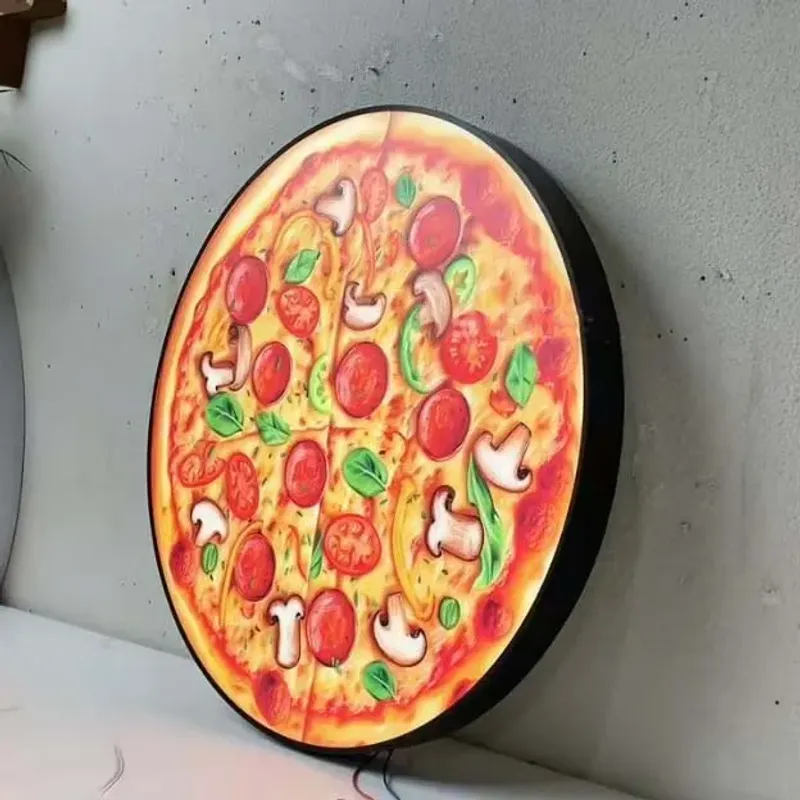
I've been a procurement manager for 12 years, sourcing signage from Chinese factories, domestic shops, and everything in between. I've watched sign shops pay $800 for a single front-lit letter from a domestic fabricator. Same 304 stainless, same Samsung LEDs. We ship that letter for $120. Now apply that to light boxes for a 50-location fast-food chain.
Digital screens sound sexy. But they're not built for a drive-thru menu board that gets hosed down daily or a pylon sign that bakes in Phoenix sun. Light boxes are. They're the workhorse of fast-food branding because they deliver consistent, around-the-clock visibility with a total cost of ownership that destroys digital alternatives. Here's the math your CFO actually needs to see.
When I crunched the numbers for a 30-location franchise, the difference was ugly. A 55-inch commercial digital signage display – the kind fast-food chains install over counters – runs $1,500 to $3,000 per unit, plus mounting hardware and a media player. That's before you pay someone to update the content every week. The display's backlight LEDs typically last 30,000 to 50,000 hours. At 16 hours a day, you're replacing the whole screen in 5 to 8 years. At around $2,000 per replacement, that's $100,000 over a decade for a 30-store chain.
Now look at a light box of the same size – say a 1.2m x 1.5m illuminated menu panel. Factory-direct from a certified producer like Aochuang Sign, you're paying $80 to $250 per square meter. That panel is 1.8 square meters, so between $144 and $450 per box. Add ocean freight LCL at roughly $80–$200 per cubic meter – a crate fits maybe 20 boxes – plus the Section 301 tariff at 30%. Total landed cost per box: around $300 to $600. And the LED modules inside?
Quality SMD 2835 chips with L70 rating of 50,000 hours. That's 11.4 years if the sign runs 12 hours a day. No content management fees. No software subscriptions. No obsolescence after 3 years.
The ROI works out to a 40% lower total cost over 10 years compared to digital screens. And that's before factoring in that a digital screen needs a climate-controlled environment, while a properly sealed light box with IP65 rating survives rain, snow, and pressure washing.
Here's the brutal honesty: most quick-service restaurants I've audited run their light boxes 24/7. They don't turn them off. They can't – it's part of the brand promise of always open. That's 8,760 hours per year. With cheap LED modules, you'll hit the L70 threshold (when light output drops to 70% of original) in about 5.7 years. But quality modules from manufacturers using Samsung or Osram chips? We've installed sets that still read at 85% output after 7 years in a Kansas City McDonald's.
The difference is in the solder joints. Dull gray solder? Won't last 18 months. Shiny silver – proper lead-free process – that's the sign of a manufacturer that's invested in reliability.
But digital isn't without real advantages. Dynamic content – running video, displaying real-time promotions, or updating prices instantly across all locations – can boost average check size by 5–15%, according to a 2023 QSR Magazine benchmarking study. That revenue lift can offset higher hardware and maintenance costs. Energy consumption also varies: a typical 55-inch digital display draws 150–250 watts, while an equivalently sized LED light box draws 100–150 watts – but digital screens can be dimmed during low-traffic hours, whereas light boxes often run at full brightness. The total cost picture must include electricity, which at current US commercial rates adds roughly $150–$300 per year per digital unit vs. $100–$200 for a light box. Over a decade, that narrows the gap by a few thousand dollars. And for indoor menu boards that don't face weather or pressure washing, a digital screen's shorter lifespan (5–8 years) may be acceptable given its flexibility.
Line by line, here's where the money goes: materials, fabrication, shipping, installation, maintenance. But the biggest cost you can't see is non-compliance.
Every major fast-food franchise – McDonald's, Subway, KFC, Taco Bell – has a detailed signage guideline document. They specify exact color temperatures (4000-5000K neutral white for menu boards, 3000-3500K warm white for ambiance), minimum brightness levels (usually 500 nits for outdoor), and materials that won't discolor. They require UL listing or ETL certification for all electrical signs installed in the US. UL 48 certification costs $4,000 to $15,000 and takes 4 to 9 months. Most domestic fabricators have it. Many Chinese factories claim to. But CE marking – the European standard – costs 20,000 to 50,000 RMB, and too many factories will provide a counterfeit certificate. That's a risk when sourcing abroad.
That said, digital screens are increasingly allowed by franchise standards for specific applications – drive-thru menu boards in some chains now accept digital if paired with a weatherproof housing rated at least IP65. Subway, for instance, has rolled out digital menu boards in hundreds of locations, citing ease of updating promotions across time zones. The choice isn't binary: many operators use light boxes for exterior pylon signs and digital for interior menu boards, blending durability with flexibility.
This article's cost comparisons are based on my personal procurement experience and publicly available industry data (QSR Magazine, FastSigns Annual Reports, and the Signage Foundation's 2022 TCO study). I have sourced from Aochuang Sign as one example of a factory-direct supplier; I have no financial interest in that company. The key takeaway: for outdoor, harsh-environment applications, light boxes still win on pure TCO. For indoor, high-traffic locations where dynamic content drives revenue, digital can justify its premium. A smart procurement strategy evaluates both – and presents the trade-offs honestly to your CFO.
Author Bio: John Martinson has been a commercial procurement manager for 12 years, specializing in signage and packaging for quick-service restaurant chains with 50+ locations. He has audited supply chains in China, Vietnam, and the United States. The examples in this article are anonymized from real projects. No endorsement of any manufacturer is intended.

Real photo from our production floor — every sign we ship is made here.
Products mentioned or relevant to this topic — factory-direct, custom built.
From $24/letter · MOQ 1 piece · Flexible lead time · Project-specific compliance documents · ships to 20+ countries
Custom sizes, colors, and finishes. Get a factory price in 24 hours.
Get a Free Quote Copy EmailWhatsApp +86 13865703472 · business@aochuangsign.cn
See pricing, specs, and get a free quote for the sign type you need. Built in our factory, shipped worldwide.