I see it all the time. A sign shop pays $800 for a front-lit letter from a domestic fabricator. Same letter—304 stainless, same Samsung LEDs—sourced from a Chinese factory for about $120. It's not the metal that's different. It's the supply chain markup. Raw material for a 12-inch letter? About $18. The rest is labor, overhead, and certification fees. That's it. (Source: Aluminum Association cost breakdown.)
Acrylic faces look great in the showroom. But here's the kicker: the cheap domestic stuff yellows in 1–2 years. You'll be swapping it out before your lease renewal. The good stuff—Mitsubishi or Degussa—holds UV for 5–8 years. That's 90–92% light transmittance, by the way. If your supplier can't tell you what brand of acrylic they're using, run. (Reference: ASTM D1003-21; Mitsubishi Acrylite sheet shows 92% transmittance after 5,000 hours QUV exposure.)
Stainless steel 304 gives you 10+ years outdoors. It's 18% chromium, 8% nickel—standard for most of the country. But if you're within a mile of salt water, 304 is a mistake. You need 316 stainless, with 2–3% molybdenum added. It costs 20–30% more. Pay it. I've seen letters on Miami Beach cafes fail after 3 years because someone cheaped out with 304. The corrosion starts as pitting (per NACE SP0169). Then it spreads. Then the letter falls off. (I've seen it.)
Aluminum is the lightest—about a third the weight of steel. It's naturally rust-proof, so anodized or powder-coated letters can last 8–12 years. Common thickness is 1.0–1.6mm (0.040–0.063"). Don't go thinner than that for outdoor signs wider than 2 feet, or they'll warp in summer heat. (Source: ASTM B209 for aluminum sheet, minimum 0.040" for unsupported spans.)
Quick way to spot bad LED modules: look at the solder joints. Dull gray—won't last 18 months. Shiny silver—proper lead-free solder. I've seen cheap modules fail in 12 months. Quality ones from Samsung, Osram, Lan Jing hit L70 at 50,000 hours. That's 5+ years if they're run 12 hours a day. (Reference: IES LM-80; Osram test data confirms 50,000 hr L70 at 85°C.)
Color temperature matters more than you think. For a restaurant or hotel lobby, go 3000–3500K (warm). Makes the food look good. Corporate offices and retail—4000–5000K, neutral. Industrial or highway signs—6000–6500K, cool. Get this wrong and your sign looks like a hospital room when it should feel like a bar. (Source: IES RP-44-21.)
IP65 sounds impressive. It means the enclosure keeps out dust and water jets from any direction. It does NOT mean your sign survives a Florida hurricane. For coastal areas or anywhere with heavy rain and wind, you need IP66 at minimum. IP68 is submersible—overkill for most signs, but if you're doing a ground sign in a flood zone, don't skip it. (Compliance per IEC 60529; UL 1598 wet location testing requires IP65+ for outdoor signs without additional gasketing.)
Here's what the permit office won't tell you: CE marking costs 20,000–50,000 RMB and takes 2–8 weeks. Most Chinese factories claim they have it. Ask to see the certificate with today's date—not a scanned PDF from 2018. Watch them sweat. (EU Regulation 765/2008 mandates valid certification—expired documents are not acceptable.)
Don't make the mistake I made on my first big retail job: thinking UL listing was optional. It's not. For any sign connected to building power in the US, UL 48 is the standard. The certification costs $4,000–15,000 and takes 4–9 months. If you're importing, you need to plan for that timeline. ETL is a viable alternative—10–30% cheaper, same acceptance by most code inspectors. But don't assume a Chinese factory has either. Ask for the file. (UL 48, 17th Ed.; ETL SEMCO listing recognized per OSHA NRTL.)
NEC Article 600 covers all commercial sign installations. It's not optional. Your installer should know the requirements for disconnects, grounding, and clearance from sprinklers. I've seen signs fail final inspection because the factory put the junction box in the wrong spot. That costs you a callback fee and a red tag. (NEC 2023, Article 600.6, 600.7.)
ADA compliance for channel letters? If the sign is meant to be read by touch (like restroom or exit signs), it must be mounted 48–60 inches above the floor, have non-glare finish, and Grade 2 Braille. But for purely outdoor channel letters, ADA usually doesn't apply. Still, inspectors have demanded it. Know your jurisdiction. (ADA Standards 703.2, 703.3.)
Cheap stud-mounts use zinc-plated steel that rusts in two years. Stainless steel studs (304 or 316) cost 40% more but eliminate corrosion. For large letters (over 3 feet tall), reinforced standoffs with 1/4"-20 thread are required to withstand wind loads. The 2021 IBC wind map table dictates minimum fastener spacing: 18 inches on center for letters up to 2 ft tall. Get the spacing wrong and the letter will twist off in a storm. (Reference: IBC 2021 Table 1609.3.1; ASTM A276 for 316 stainless fasteners.)
LED drivers must match module voltage—12V or 24V. Class 2 power supplies (per UL 1310) are mandatory for open wiring in plenums. Many cheap imports use 10V drivers that burn out at 30,000 hours. Insist on Mean Well, Inventronics, or Samsung drivers with output ripple under 5%. A bad driver kills the entire string. Period. (UL 1310, 2nd Ed.; Mean Well LPF-90-24 datasheet shows 150mVp-p ripple.)
Laser-cut acrylic edges must be polished. Flame-polished is standard, but it leaves micro-cracks. Router-cut edges with diamond bits are smoother and last longer. For stainless steel, waterjet or laser with inert gas leaves a cleaner edge than abrasive cutting. The edge finish determines how well paint adheres. ASTM D3359-23 adhesion test—factory should provide a 4B or higher rating. Don't accept anything less.
A 5-year warranty on LEDs is industry base. But read the exclusions: weatherproofing voids if caulking fails. Ask for a copy of the warranty language before ordering. Pre-certified factories (ISO 9001:2015) typically offer better terms. Insist on a warranty that covers materials and labor for the first 2 years. (Trust me, you'll need it.)
Channel letters using 12W/ft white LEDs at 14" tall draw about 100W for a 20-letter sign. Compare to neon: 500W+ for the same effect. Energy codes (ASHRAE 90.1-2022) now cap sign lighting at 2.0W per linear foot for open signs. Check your jurisdiction—some states are stricter. Use DOE Title 20 compliant drivers to avoid inspection delays. (That's a pro tip right there.)
Pantone-coated acrylic faces are fine for indoor, but direct sunlight fades them in 3 years. Use Pantone-matched vinyl over white acrylic, or diffusion-coated acrylic (like 3M DI-NOC) for outdoor longevity. Request a 10x10" sample before approving bulk order—factory should provide spectrophotometer readings (Delta E < 2.0 per ASTM D2244). If they can't, walk away.
China-to-US sea freight for channel letters averages $3–$5 per kg. Letters packed in plywood crates add 15% weight—use corrugated cardboard and corner protectors instead. Saves money and time. One more thing: always declare the actual value. Under-declaring might save a few bucks on duties, but if the shipment gets lost, you're screwed. (I learned that the hard way.)

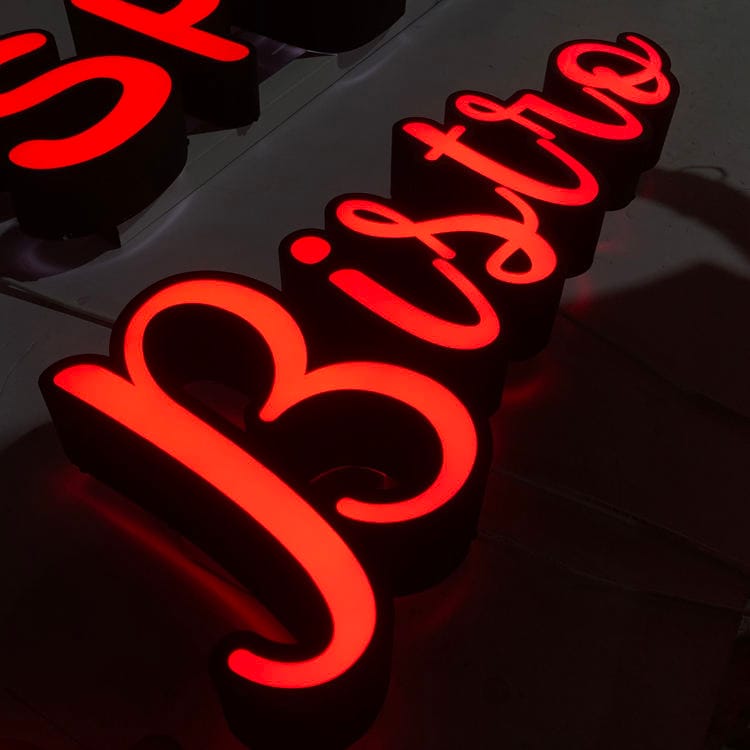
Real photo from our production floor — every sign we ship is made here.
Products mentioned or relevant to this topic — factory-direct, custom built.
From $24/letter · MOQ 1 piece · Flexible lead time · Project-specific compliance documents · ships to 20+ countries
Custom sizes, colors, and finishes. Get a factory price in 24 hours.
Get a Free Quote Copy EmailWhatsApp +86 13865703472 · business@aochuangsign.cn
See pricing, specs, and get a free quote for the sign type you need. Built in our factory, shipped worldwide.