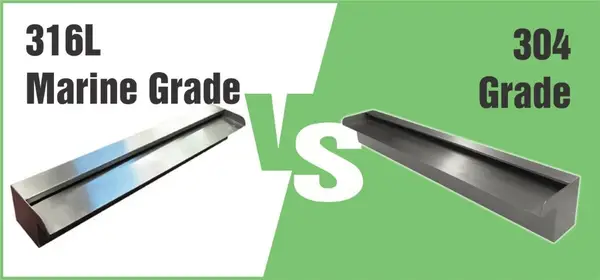
I've seen this go wrong: a contractor in St. Petersburg, Florida installed 304 stainless letters on a hotel entrance across the street from the beach. Not right on the water. Across the street. Eighteen months later, the customer called about brown streaks bleeding down the white columns. The letters were rusting at the weld seams.
That wasn't a material failure. It was a spec failure.
Here's what nobody tells you: 304 and 316 look identical on a quote sheet. Same brushed finish. Same mirror polish. Same 7.93 g/cm³ density. But one of them will embarrass you near salt water.
The actual difference between 304 and 316
304 is 18% chromium and 8% nickel. That's what the "18/8" stamp means when you see it. It resists rust because the chromium forms a passive oxide layer on the surface. That layer heals itself if scratched—as long as the environment isn't actively attacking it.
316 takes the same base and adds 2-3% molybdenum. That molybdenum is the whole story. It plugs the microscopic gaps where chloride ions from salt attack the oxide layer. No molybdenum, no long-term survival on a boardwalk.
Look, I've cut both grades on the same laser machine. The 316 shears slightly harder and costs 20-30% more per sheet. That's the only difference you'll notice in the shop. Outdoors, the difference shows up in year two or three.
Coastal vs inland: where's the line?
The old rule is 5 miles from the coast. I don't love distance rules because wind and humidity don't care about map lines. Salt spray travels inland on prevailing winds. A sign 8 miles from the beach but in a fog belt can see more chloride exposure than one 2 miles away with a building blocking the wind.
Here's a better rule: if you can smell the ocean, buy 316. If you're specifying for a customer who's paying installed prices of $400-$1,000 per letter, don't save $30 on material. The callback will cost more than the steel.
Inland, 304 is usually fine. Ohio, Kentucky, Nebraska, most of Texas—304 will give you 10+ years outdoors if the fabrication is clean and the finish isn't scratched to hell. The 18% chromium does its job when there's no salt trying to tear it apart.
But "inland" doesn't mean "safe" everywhere. Industrial areas with sulfur dioxide, acid rain, or chemical plant runoff can eat 304 faster than a beach town. For those sites, 316 is still the right call, or powder-coated aluminum.
The ugly truth about "marine grade" labels
The ugly truth is a lot of sign shops and online sellers stamp "316 marine grade" on anything stainless. They know most buyers won't ask for a mill test report. Don't be that buyer.
I've been in factories in China and the US where 304 coils were sitting right next to the 316 rack. Same color, same width. One worker grabs the wrong coil and the whole production run is 304. Nobody catches it until the customer's sign turns brown two years later.
Ask for the MTR. It's a document from the steel mill that lists the chemical composition of the exact heat of steel your letters were cut from. If a supplier won't give you one, take your money elsewhere. 316 should show molybdenum at 2.0-3.0%.
At our factory in Lu'an, Anhui, we keep MTRs for every stainless sheet that enters the building. You want the certificate for your specific order? We'll send it with the shipping documents. No extra charge.
Cost math: 304 vs 316 on a real sign job
Factory prices for
stainless steel letters run $15-40 per piece. That's non-lit, fabricated, with a basic brushed finish. 316 adds 20-30%. So a $30 letter becomes $36-$39. On a set of ten letters, you're looking at $60-$90 more.
Installed in the US, those same letters sell for $200-$700 each front-lit, $400-$1,000 halo-lit. The material difference between 304 and 316 is pocket change at that price.
If your customer is 500 miles from any coast and budget is tight,
aluminum letters might be the smarter choice. They weigh a third of steel and cost less. They won't rust—they oxidize differently. For inland signs, they do the job without the stainless premium.
But when the spec says stainless and the site is within salt influence, quote 316 and don't apologize for the number. If they push back, explain the alternative is replacing the sign in three years.
Fabrication matters more than you think
Here's what nobody tells you: 316 sheets welded with 304 filler rod will rust at the welds even though the base metal is 316. The weld becomes the weak link. I've seen shops do this to save $20 on a spool of wire. Stupid.
At Aochuang, we use TIG welding with matched 316L filler. Then we grind and polish the weld seam so it's invisible. That's the only way to keep the passive layer continuous across the entire letter.
Thickness counts too. We use 1.0-3.0mm stainless for
channel letters and fabricated logos. For large letters over 2.5 meters tall, we go 3mm minimum or add internal bracing. Thin 0.8mm stock might look fine in a showroom, but it oil-cans in the wind and flexes until cracks start at the mounting holes.
Finishes: brushed, mirror, PVD, powder coat
Brushed #4 is the workhorse. It hides fingerprints and minor scratches. Mirror #8 looks gorgeous but shows every water spot and salt film. If you're near the coast with mirror finish, plan on cleaning it monthly or it will look like hell even if it isn't rusting.
PVD coating adds a layer of titanium nitride or similar. It's durable, but if it scratches, the base stainless is still there—so 316 PVD is what you want for luxury coastal projects.
Powder coating seals the surface entirely. That's great until a screwdriver or hail chip penetrates the coating. Then moisture sits against the metal inside the chip and corrosion starts underneath the powder. If you powder coat 304 for a coastal job, you're not solving the problem. You're hiding it.
Mounting hardware and galvanic corrosion
316 letters mounted with 304 screws will rust at the screws. The hardware becomes the anode in galvanic corrosion. I've seen beautiful 316 logos ruined by a $4 box of cheap fasteners.
Use 316 stainless anchors, screws, and standoffs for coastal work. Add nylon isolation pads between the letter and the wall if the wall has dissimilar metal framing. Anodized aluminum backgrounds can also trigger galvanic action if they sit wet against stainless.
Cleaning and maintenance: even 316 needs a wash
Stainless doesn't mean maintenance-free. Salt deposits on the surface hold moisture and eat away at the passive layer. In coastal environments, wash the sign with mild detergent and clean water twice a year. No bleach. No abrasive pads.
For architectural coastal projects, we often pair 316 faces with
back-lit halo letters. The standoff design lets air circulate behind the letters, which helps them dry faster after a storm. Trapped water is the enemy.
What we can and can't do at Aochuang Sign
We can fabricate 304 and 316 stainless letters in any shape you send us. Our laser cutting tolerance is ±0.1mm. We bend, weld, grind, polish, and assemble in-house. We've shipped stainless signs worldwide since 2010 from our 3,000m² facility in Lu'an, Anhui.
We can't stock every thickness of 316 in the warehouse. Most orders use 304. If you need 316, we order the certified sheets from our supplier and add 2-3 days to the lead time. Our standard lead time is 7-15 days. With 316, budget 10-18 days.
We also can't guarantee rust resistance if the sign is designed to trap water. Stainless needs to drain and dry. If you ask for letters with no weep holes and a closed back, I'll tell you now: even 316 will stain. That's not a material problem. That's physics.
Certifications won't prove the grade
Look, CE and RoHS and ISO 9001 are fine for electronics and process control. They don't tell you whether a sheet of steel is 304 or 316. At our factory, we hold those certifications because the market expects them. But the document that matters for stainless is the MTR.
For US buyers, UL 48 is the electrical certification for channel letters. It has nothing to do with the steel grade. Don't confuse electrical safety with corrosion resistance. Same goes for IP65 or IP66—those are about water ingress into the LED housing, not about the metal face.
The final rule I'd give my own kid
If the sign is within a few miles of salt water, or in an industrial zone, spec 316. It's 20-30% more material cost and saves you a lawsuit or a lost customer.
If it's inland and you're sure about the environment, 304 will serve you for a decade or more. Just keep the welds clean and the finish intact.
And if you're importing from any factory, including ours, ask for the mill test report. Not a verbal promise. A document. Then check the molybdenum number.
We sell
stainless steel letters in both grades. Same craftsmanship. Same 7-15 day production. Different steel. Ask for what your site actually needs.