304 is 18% chromium, 8% nickel. Good enough for 80% of inland jobs. 316 adds 2-3% molybdenum. That’s the entire difference. And that tiny molybdenum content is what keeps your sign from looking like a rusted shipwreck three blocks from the ocean.
Look, I’ve personally measured thickness on both grades with a micrometer while standing on our factory floor in Lu’an. 304 at 1.5mm bends a little easier, welds a little quicker, polishes to a #8 mirror with less compound. 316 feels almost greasy under the buffer. It’s denser, slightly more stubborn, and it laughs at salt.
You don’t need an engineer to understand this. 304 will develop surface tea-staining within 18-24 months if you’re within a mile of breaking surf. 316 just won’t. It’s that simple. And yet, I watch sign shops order 304 for beachfront restaurants every single month because the client didn’t want to pay 25% more.
Here’s what nobody tells you: the failure mode isn’t a sudden rust bloom. It’s pitting that hides behind mounting studs, inside the returns where water pools, at the weld seams where the chromium oxide layer got cooked out and the welder forgot to passivate. I’ve torn down a 304 sign after five years in Jacksonville and the face looked fine. The back side looked like a sponge.
Salt spray doesn’t need direct contact. It gets airborne, travels inland on wind, sticks to the metal, and pulls moisture right out of the air. 316 resists chloride pitting up to about 1,000 ppm. 304 starts struggling at 200 ppm. Ocean mist is typically 10,000-20,000 ppm. Do the math. Even a half-mile inland, you’re still in the danger zone on a windy day.
I’ve seen this go wrong: a five-star hotel in Myrtle Beach installed twelve 48-inch brushed 304 letters on their porte-cochère. Beautiful, satin finish, looked like jewelry. Eighteen months later, the owner’s pointing at orange drips staining the white stucco. The contractor had to eat the replacement cost—full 316, plus new permits, plus lift rental. I shipped them 316 letters for $110 each, mirrors of the original design, with passivated welds and a clear ceramic coating. They’re still up seven years later without a mark.
Ask ten sign guys what “coastal” means and nine of them say “on the beach.” Wrong. Salt corrosion maps used by engineers draw a line 5 miles inland. If you can smell the ocean, you need 316. If you see seagulls, you need 316. If your client washes salt residue off their windows more than twice a year, you need 316.
Aochuang’s factory sits 600 kilometers from the nearest coast, in Lu’an. We have zero salt in the air. But I’ve shipped 316 letters to Dubai, Miami, Sydney, and Singapore. When a buyer in Singapore orders 304 for an outdoor sign, I’ll email them and ask if they’re absolutely sure. Nine times out of ten, they switch to 316. The tenth time, they call me a year later to reorder in 316.
The ugly truth is that many suppliers will sell you whatever you ask for and won’t say a word about salt damage. They’ve never installed a sign three blocks from the Gulf of Mexico. They don’t know what happens. I know because I’ve answered angry calls from contractors who trusted a cheaper quote and got burned.
316 material costs 20-30% more than 304 for the same gauge. On a 24-inch tall, 1.5mm thick brushed letter, that means about $8-12 extra in raw stainless per letter from our factory. Fabrication labor is nearly identical—TIG welding parameters change slightly, polishing takes maybe 10% longer because 316 is a little gummier. So your total factory price difference stays tight. For a set of 20 letters, you’re looking at $160-240 more for 316. Real money, but a fraction of the $6,000-10,000 total job cost once installed.
Look, I get it. Budgets are tight. Inland jobs—Chicago, Dallas, Atlanta—304 will outlast the building paint. Ten to fifteen years outdoors, no problem. We stock 304 in 1.0mm, 1.5mm, and 2.0mm thicknesses, and our brushed #4 finish on 304 looks identical to 316. If you’re 30 miles from any salt water, buy 304 and sleep fine. I’ll still give you the same 2-year warranty on fabrication defects because our welds don’t crack regardless of alloy.
But if your sign is going within visual distance of salt water—or on a rooftop in Houston where industrial pollution plus humidity creates its own corrosive stew—pay for 316. I’ve seen 316 letters survive a direct hurricane hit on a Galveston boardwalk. They were covered in seaweed and still shining after a pressure wash.
316 stainless has a minimum 10% nickel and 2% molybdenum. But there are sub-grades. 316L (low carbon) is better if we’re doing heavy welding, because it prevents carbide precipitation at the weld joint. We default to 316L for any outdoor sign with welded returns. Costs a tiny bit more, eliminates the weak point. We don’t even charge extra for it—we just do it.
Here’s a brutal truth: some factories sell “316 equivalent” that’s actually 304 with a molybdenum coating or a passivation spray that washes off in six months. They quote 30% less because they’re not using real 316. You get the pretty letter, a mill certificate that’s photocopied from a different batch, and rust spots before the first lease audit. Ask for the actual mill test report with a heat number that matches the steel sheet. We keep every one on file for at least three years. I’ll email you a PDF with your invoice.
Finish matters on 316 more than manufacturers admit. A #4 brushed finish hides salt accumulation in the grain, so it needs cleaning less often than a #8 mirror that shows every fingerprint and droplet. For high-salt areas, we often suggest brushing the returns and leaving the face mirror if the client insists on shine. Or we’ll do a PVD coating—physical vapor deposition—that adds an extra barrier and lets you get colors like bronze or black without paint that can peel. A 316 letter with a titanium PVD coating will look new after a decade in front of a Miami marina. We’ve tested them.
Lie number one: “Powder coating 304 makes it salt-resistant.” It doesn’t. Once that powder coat gets a pinhole—and it will, from a stone chip or installer scratch—salt wicks underneath, corrodes the steel, and lifts the coating in sheets. You now have a rusting sign with peeling skin. If you want a painted finish near salt, start with 316, then coat it. The coating becomes decorative, not protective. You’re welcome.
Lie number two: “We only need 316 on the welded seams.” I’ve actually heard this. The logic is that the rest is sheet metal, so it’s fine. Salt doesn’t care about seams. It attacks flat surfaces and inside corners exactly the same. The entire letter must be the same alloy. Don’t let anyone sell you a hybrid solution.
Lie number three: “Our 304 is ‘marine grade.’” There’s no such thing as marine-grade 304. That phrase is salesman nonsense. Marine grade means 316 or higher. If a quote says “marine grade 304,” ask them what the molybdenum content is. I’ll wait.
We cut 316 stainless on the same fiber laser as every other metal, but we use dedicated clean-room handling for the 316 sheets before cutting to avoid cross-contamination from carbon steel dust. A tiny speck of regular steel left on a 316 sheet will rust on that spot within days outdoors. That’s amateur stuff, and we caught it back in 2012 when I saw rust freckles on an otherwise perfect letter. Changed our whole workflow. Now the 316 area is roped off, separate tools, separate storage. You’d think I’m guarding gold bullion.
Every TIG weld gets passivated with a nitric acid gel that restores the chromium oxide layer at the joint. We don’t skip it, even if the letter is going to a dry climate. It’s just how we build. After passivation, the letters go through a 3-step polishing line: grinding to remove any weld bead, then a linear brushing machine for the #4 finish, then a final cleaning with acetone and a lint-free wipe. They’re inspected under 5000K lights that show every micro-scratch.
Stainless steel letters from our floor leave in foam-lined wooden crates, no plastic against the metal that could trap moisture. We’ve shipped 316 letters that weighed 80 pounds apiece—big 6-foot logos—and they arrived in San Diego with zero scratches and zero rust. We do one-piece to full-container. Minimum order is literally one letter if you’re testing. Most clients order a full set, but I will not pressure you into bulk.
Look, I’d rather you buy the right material from me than the wrong material from someone else. If 316 is out of reach for an inland-adjacent job—say, 10 miles from the coast but still in a high-humidity zone—consider our aluminum letters. Marine-grade 5052 aluminum is naturally rust-proof, weighs a third of steel, and we can brush or anodize it to look almost like stainless. It won’t have the same heavy premium feel, and it won’t take a mirror polish like steel, but it will not rust. Ever. For a modern storefront where weight matters or the letters are huge, aluminum makes sense. Factory price runs $10-25 a letter, significantly less than either 304 or 316. For coastal use, I’d recommend anodized, not powder coated, for the same pinhole reason.
If the client insists on the heft and shine of stainless, and they’re 2 miles from the beach, I’ll quote both 304 and 316 in the same email with a blunt note: “304 will save you $180. It will also look bad in about two years. Your call.” Most people choose right once they know the stakes.
Our standard lead time for custom stainless letters is about 5-15 days. That’s design confirmation to crate. Laser cutting takes a day, bending and TIG welding another day or two, grinding and polishing another two days depending on finish complexity. If you want PVD coating, add three days for the vacuum chamber process. Then packing and shipping. Expedited air freight gets a set of 20 letters to the US in about 10 days; sea freight is about 65 days for LCL or full container. Door-to-door, DDP if you don’t want to touch customs paperwork. I’ve sent 316 letters to a contractor in Honolulu via air—4-foot tall letters, $600 in freight, arrived in 11 days. US Section 301 tariffs add roughly 30% on the declared value, but the factory-direct savings still put you well below US shop quotes.
We warranty our 316 letters’ structural integrity—the welds, the stud mounts, the polish—for two years. I can’t warranty against a hurricane ripping them off the wall, but I can warranty that the metal will not fail due to salt exposure. Nobody else says that in writing. Read our contract. It’s plain language, not lawyer salad.
I’ve stood in front of our polishing wheel for hours with both 304 and 316 blanks in my hands. They handle slightly different, they cost slightly different, and they fail at dramatically different rates when the air tastes like salt. Don’t overthink it. Inland job with no salt exposure—save your money, 304 is honorable metal. Within five miles of salt water, or anywhere with industrial airborne chlorides, go 316. You’re not paying for a name. You’re paying for a molybdenum content you’ll never see but will absolutely notice if it’s missing.
And if you’re unsure, email me a photo of the job site on Google Maps. I’ll tell you what I’d put on my own shop. 16 years, burned fingers and all, that’s worth something.

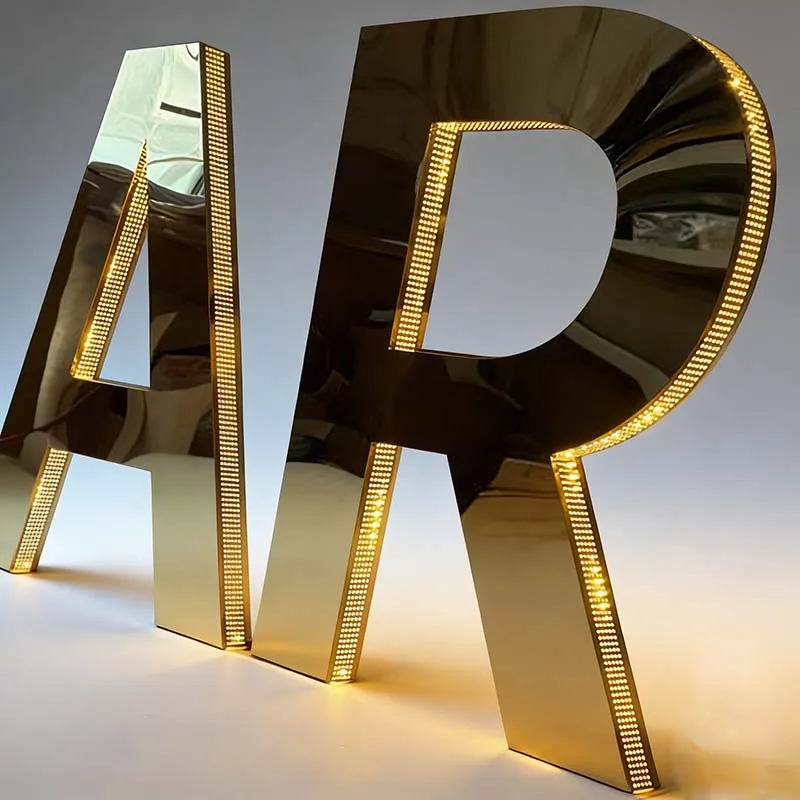
Real photo from our production floor — every sign we ship is made here.
Products mentioned or relevant to this topic — factory-direct, custom built.
From $24/letter · MOQ 1 piece · Flexible lead time · CE & UL certified · ships to 20+ countries
Custom sizes, colors, and finishes. Get a factory price in 24 hours.
Get a Free Quote Copy EmailWhatsApp +86 13865703472 · business@aochuangsign.cn
See pricing, specs, and get a free quote for the sign type you need. Built in our factory, shipped worldwide.