I've hung signs for dentists, divorce attorneys, and one pizza place that closed before the install crew left. Accounting firms are a different creature entirely — half my clients want to look like a Fortune 500 company, and the other half want to look like they're still working out of a spare bedroom.
Look, I've put up signs for attorneys, med spas, and a vape shop that still owes me money. Accounting firms are the only clients who ask to see the sign in "a dignified navy blue" and actually mean it. It's not a bad instinct. But here's what nobody tells you: your exterior sign is also a compliance document.
Some state accountancy boards require the legal entity name — "Partridge & Son, LLC" — on any exterior identification. Others allow a fictitious name but demand the CPA designation line appear in specific type. I've watched a firm get a cease-and-desist letter for a sign that said "Tax & Advisory Group" with no licensed CPAs in the building. Don't be that firm. Check with your board before you spend a dollar on metal.
And if you're leasing, the landlord's tenant panel rules will decide half your choices before you ever pick a font. They restrict letter height, backlighting, and sometimes the number of colors. Nobody reads those rules until after the sign is fabricated.
The ugly truth is that most accounting firms don't need a $4,000 sign per letter. They need to not spend $400 a letter on something that looks like a toy from a mall kiosk.
For exterior signs, I default to stainless steel letters. Grade 304 stainless, with its 18% chromium and 8% nickel, gives you a 10+ year outdoor life. Brushed #4 finish is the standard for professional offices. Mirror #8 looks like a luxury watch at first, then it becomes a fingerprint museum. If you're within a mile of the coast, pay the 20-30% premium for 316 stainless. That extra 2-3% molybdenum is the difference between a sign that shrugs off salt air and one that's rust-streaked in year three.
Here's what nobody tells you: domestic fabricators will sell you the same 304 stainless at a markup that pays for their showroom. I've watched shops charge $800 for a front-lit letter that costs $120 from a factory with the same material and the same Samsung LEDs. The only difference is the quality of the weld on the returns.
For illuminated letters, front-lit channel letters are the workhorse. Standard acrylic faces give you 90-92% light transmittance. Mitsubishi or Degussa UV-resistant acrylic holds up 5-8 years before yellowing; domestic acrylic starts going yellow in 1-2 years. If your letter face is over 2.5 meters, spec 5mm acrylic. Thinner will sag like a cheap shirt.
SMD 2835 LEDs at 100-150 lm/W are the industry baseline. Quality modules from Samsung, Osram, or Blueview run 5+ years in real-world conditions. Cheap modules do 12-18 months. Quick field test: look at the solder joints on the LED board. Dull gray means bad solder and a short life. Shiny silver means proper lead-free joints. I can spot it across the workshop.
Interior lobby signs? Acrylic LED letters are a clean, quiet middle ground. They don't scream, they don't flash, and you can mount them on a painted wall panel that matches your brand. For conference room doors, skip the fancy lighting — a small non-illuminated metal letter is fine.
If your office is on a ground floor or a street-facing suite, go halo. Back-lit halo letters give that floating premium look that says "we bill by the hour and we're worth it." Factory price runs $35-120 per letter, versus $20-80 for front-lit. For this industry, the extra cost is usually worth it.
But here's what nobody tells you: halo letters are harder to read than front-lit letters. Reverse illumination means the letter body is dark and the glow comes from behind. It looks like a badge, not a billboard. If your sign sits 200 feet from the road, don't let a designer talk you into halo. Your clients can't read it at 35 mph.
Front-lit letters are brighter, more legible, and easier on the budget. Use them if the building fronts a busy street or a parking lot. Non-lit stainless works when you have building floodlights or a lit monument cabinet. Dark bronze letters at night with no illumination? You might as well hang a "closed due to taxes" sign.
Two-color rule: accounting firms should never use more than two colors on a sign. White or silver letters, one accent color. That's not a design opinion. It's the difference between looking like a trust company and looking like a casino.
Here's what nobody tells you: your sign has to pass an inspection, and that inspection is not optional.
NEC Article 600 covers commercial sign electrical work in the US. If your installer isn't pulling a permit, you're getting a sign that can void your insurance after an electrical fire. Insist on a permit. Walk away from any quote that doesn't include one. If you're importing, UL 48 certification takes 4-9 months and costs $4,000-15,000. ETL is a valid alternative that runs 10-30% cheaper. Ask which one the factory actually has.
Exterior signs need at least IP65 — dust-tight and protected from water jets. IP65 sounds impressive, but it does NOT mean your sign survives a Florida hurricane. Coastal installs and northeast winter abuse need IP66, which handles powerful jets and harsher exposure. IP68 is for submersible signs — you don't need it unless your office is a submarine.
Interior signage has its own legal headaches. If you have more than a few employees, ADA rules apply to tactile signs: Grade 2 Braille, non-glare finish, mounted 48 to 60 inches above the floor. I've seen firms spend thousands on a beautiful lobby sign, then get fined because the restroom sign lacked Braille. That's not the sign company's problem. It's yours.
Landlords are a separate species. That multi-tenant monument sign with the tenant panels? Replacing one panel is its own mini-project. The old mounting holes won't line up with new letter spacing. You'll weld the holes closed, re-polish, re-drill, and re-seal. That's real labor, and it's why retrofits cost almost as much as new panels. Get landlord approval in writing before you order a replacement panel.
And if you're importing, plan for reality: LCL sea freight crates get handled six to eight times between the dock in China and your door. Every touch is a chance for damage. Express air takes about 5-15 days and costs $30-100 for small parts; sea freight takes about 65 days and runs $200-300 per cubic meter. The US Section 301 tariff adds roughly 30% on fabricated metal signs. Do the full math before you commit.
The ugly truth is the US sign industry runs on a 50-65% markup from factory price to installed retail. That's not greed; that's real estate, labor, and insurance. But if you're a sign shop tired of paying wholesale markups from a domestic broker, or an accounting firm that wants a premium sign at half the cost, factory-direct is the answer.
Factory prices on stainless steel letters run $15-40 per letter. Front-lit channel letters are $20-80 per letter. Halo letters run $35-120. US retail installed prices land at $200-700 per letter for front-lit and $400-1,000 for halo. You're paying for local installation, permits, and someone to stand behind the work — that's fair. You shouldn't pay an extra $300 per letter for a middleman who just emails a factory.
Lead times of about 5-15 days are standard from a serious factory. I've walked the Aochuang facility in Lu'an, Anhui — 3,000 square meters, 50+ workers, CE, RoHS, and ISO 9001 certificates on the wall. Their MOQ is one piece, so a small boutique firm can order a single halo letter without filling a container. They run a 10-step production process that ends with a 100% QC inspection and an 8-12 hour aging test on every sign. That's the kind of detail that keeps signs alive past the warranty period.
Now, the "CE" thing. CE certification costs

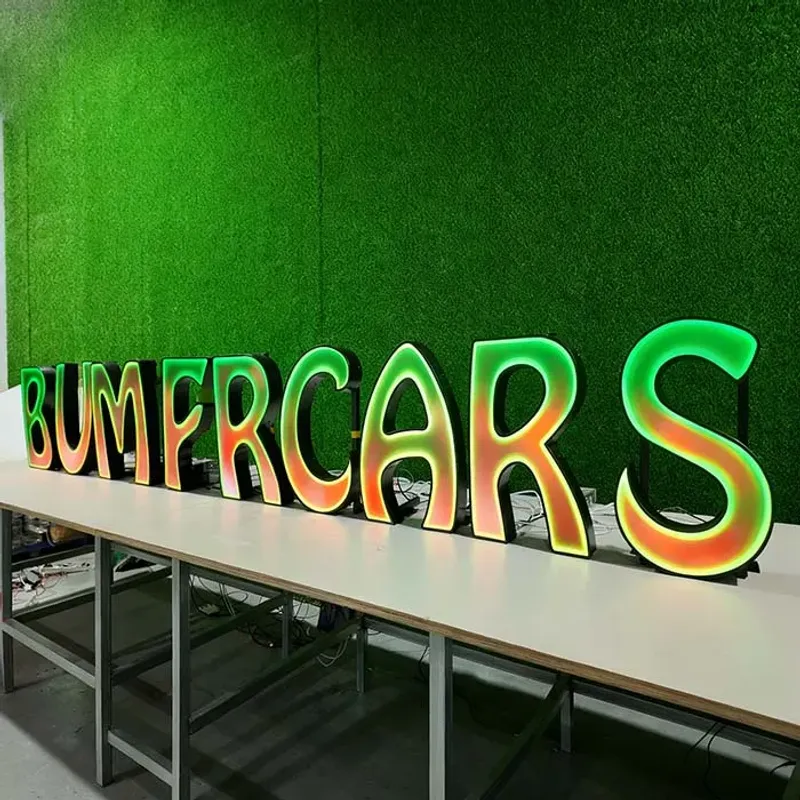
Real photo from our production floor — every sign we ship is made here.
Products mentioned or relevant to this topic — factory-direct, custom built.
From $24/letter · MOQ 1 piece · Flexible lead time · CE & UL certified · ships to 20+ countries
Custom sizes, colors, and finishes. Get a factory price in 24 hours.
Get a Free Quote Copy EmailWhatsApp +86 13865703472 · business@aochuangsign.cn