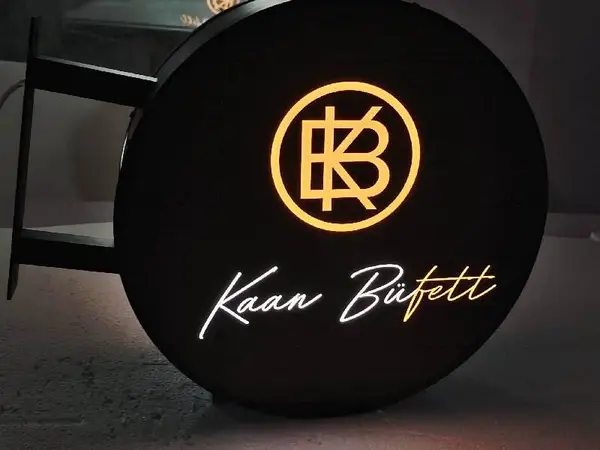
I just came off the floor at Aochuang Sign in Lu'an. 11pm. A customer called twice asking why his backlit sign face is yellowing after 14 months. I told him the truth his last supplier wouldn't: he bought domestic acrylic, not UV-resistant.
Backlit signs have gone almost entirely LED. Fluorescent tubes die fast, ballasts fail in cold weather, and relamping a 20-foot sign means renting a lift more times than your customer wants to pay for.
Look, the numbers don't lie. A quality SMD 2835 module runs 100–150 lumens per watt and carries an L70 rating of at least 50,000 hours. Cheap no-name modules? They die. I've pulled them out of signs at 18 months, dead and brown at the solder joints.
SMD 5050 handles RGB when you need color-changing. SMD 5730 pushes 40–60 lumens per chip when you need maximum punch on a highway sign.
If you're buying back-lit halo letters for a storefront, the LED choice is the whole ballgame. Specify Samsung, Osram, or Blueview. Pay less, and you'll be back on a ladder before the lease is up.
Acrylic is still king for backlit faces. Good UV-resistant acrylic from Mitsubishi or Degussa stays clear for 5–8 years outdoors. Domestic acrylic? 1–2 years before yellowing. I've seen it happen.
Most people miss this: a 3mm acrylic face transmits 92% of light output. A 2mm face transmits 90%. That 2% difference isn't worth the 40% cost bump unless the sign is over 2.5 meters wide. Then you step up to 5mm or thicker for structural strength, not brightness.
Acrylic transmits 90–92% of light. Polycarbonate's tougher, but it scratches and hazes faster under UV. Flexible vinyl belongs on cheap banners and short-term promotions—not permanent backlit signs. If you spec vinyl on a 10-year exterior sign, you're planning to fail.
For acrylic LED letters, use UV-resistant material. Your customer won't notice the invoice difference. They'll notice the yellowing two summers later.
Brightness isn't just lumens. That's where those lumens land.
A backlit sign with hot spots looks cheap from the parking lot. Uniformity comes from LED spacing, diffuser depth, and face material. SMD 2835 at 100–150 lm/W is the industry standard. SMD 5730 gives you 40–60 lumens per chip for high-brightness jobs, but you need more thermal headroom.
Color temperature matters more than raw output. 3000–3500K warm works for hospitality. 4000–5000K neutral fits corporate and retail. 6000–6500K cool belongs on industrial buildings and highways.
Nobody tells you this: a sign that's blinding up close disappears at 200 feet. You need contrast, not just brightness. If your white face glows like a flashlight, dial back the LEDs and add a diffuser.
I've tested signs with cheap modules that measured bright on the bench, then looked like a flickering strip mall sign after six months. Don't chase lumens. Chase real L70 hours and clean power supplies.
Size drives material. Thickness drives structure. Finish drives labor. Quantity drives setup.
Factory pricing for back-lit halo letters runs $35–$120 per letter. A front-lit channel letter is $20–$80. Light boxes run $80–$250 per square meter. Stainless steel non-lit letters are $15–$40. Those are factory prices from a Chinese shop with 50 workers and a 3,000m² floor. US retail installs run $400–$1,000 per halo letter.
The ugly truth? Most sign brokers mark up imported product 50–65% before it hits your PO. And they don't touch a single wire.
Quantity matters because we can nest letters in a crate and amortize tooling. Our MOQ is still 1 piece, because we've been burned by "sample" customers who turned into 50-location rollouts.
If you're ordering embedded lightbox signs for a shopping center, ask for 5mm acrylic on any face over 2.5m. The material cost difference is real. A failed face costs more than the whole sign.
Finish on stainless letters changes price too. Brushed #4 is standard. Mirror #8 takes more polishing. PVD coating adds another process. Don't pay for mirror finish if the sign sits above a drive-thru menu where nobody sees reflections.
Indoor signs die from heat. Outdoor signs die from water and heat.
IP65 is the minimum for outdoor backlit signs. That means dust-tight and protected against water jets from any direction. That doesn't mean your sign survives a Florida hurricane. I've said that until I'm hoarse.
IP66 handles powerful jets, which matters in coastal storms. IP68 is submersible—usually overkill unless you're mounting the sign in a fountain or a flood zone.
Thermal management is what rookies ignore. A sealed IP65 enclosure traps heat. Your power supply cooks. Cheap drivers fail in 12–18 months. Good drivers mounted with a thermal break last as long as the LEDs.
I've seen this go wrong. A customer ordered IP65 backlit signs for a beachfront bar. The faces survived. The drivers didn't. Water followed the conduit into the back and pooled in the enclosure. The sign went dark in four months.
For coastal installs, 316 stainless costs 20–30% more than 304 and it's worth every penny if you're within a mile of salt water. For a strip mall in Ohio, 304 with a powder-coated finish will hold up for 10+ years. If you need 304/316 stainless steel letters, don't guess the grade. Ask for the mill cert.
NEC Article 600 governs US electrical signage. UL 48 certification costs $4,000–$15,000 and takes 4–9 months. ETL works as an alternative and runs 10–30% cheaper. CE marking costs 20,000–50,000 RMB and takes 2–8 weeks. Most factories will tell you they have CE. Ask for the certificate with today's date. Watch them sweat.
I've watched sign shops pay $800 for a front-lit letter from a domestic fabricator. Same 304 stainless, same Samsung LEDs. We ship that letter for $120.
Factory-direct isn't for everyone. If you need it tomorrow, buy local. If you can plan 7–15 days, we cut, bend, weld, polish, assemble, age-test, and export-pack from our floor in Anhui. That's the same production time as most US shops running a backlog.
Shipping is where people get burned. Express takes 7–15 days and costs $30–$100 for small packages. Air freight takes 10–20 days at $4–$12 per kilogram. Sea freight takes 50–70 days; an LCL crate costs $80–$200 per cubic meter. FCL runs $1,200–$3,000. Don't forget the US Section 301 tariff, roughly 30%.
The ugly truth? LCL sea freight gets handled 6–8 times between our dock and yours. Every touch is a chance for damage. We crate with foam, carton, and plywood, but I can't control a longshoreman at 6am.
Our process: design confirmation, laser cutting at ±0.1mm, TIG welding, grinding, CNC acrylic, LED assembly, sealing with neutral silicone, an 8–12 hour aging test, QC, and export crate. Seven to fifteen days total. We've been on this floor since 2010.
We hold CE, RoHS, and ISO 9001. Here's what those certificates mean on a factory floor: the CE docs sit in a binder, RoHS means the solder is lead-free, and ISO means our QC guy actually measures instead of eyeballing.
Inspect the crate before you sign the delivery receipt. Check acrylic thickness with calipers. Check LED solder joints: dull gray means cheap solder and a short life, shiny silver means lead-free and clean. If the driver isn't mounted with a thermal gap, send it back.
Q: LED or fluorescent for a backlit sign?
LED. Fluorescent is dead in this trade. A quality SMD 2835 module runs 100–150 lm/W and lasts 50,000 hours. Cheap LED modules last 12–18 months, so don't buy no-name.
Q: What's the difference between IP65 and IP66?
IP65 handles water jets from any direction. IP66 handles powerful jets. On the coast, spec IP66. Inland, IP65 is enough. IP68 is submersible and usually just costs you money.
Q: How thick should the acrylic face be?
2mm or 3mm for most signs. Over 2.5 meters wide, use 5mm or thicker. Use UV-resistant acrylic from Mitsubishi or Degussa if you don't want yellowing in two years.
Q: Can I really order one sign from a factory?
Yes. Our MOQ is 1 piece. Lead time is 7–15 days. The catch is shipping cost, not minimum order. One small sign via express runs $30–$100. That's still cheaper than most domestic shops charge for the same letter.

Real photo from our production floor — every sign we ship is made here.
Products mentioned or relevant to this topic — factory-direct, custom built.
From $24/letter · MOQ 1 piece · Flexible lead time · CE & UL certified · ships to 20+ countries
Custom sizes, colors, and finishes. Get a factory price in 24 hours.
Get a Free Quote Copy EmailWhatsApp +86 13865703472 · business@aochuangsign.cn