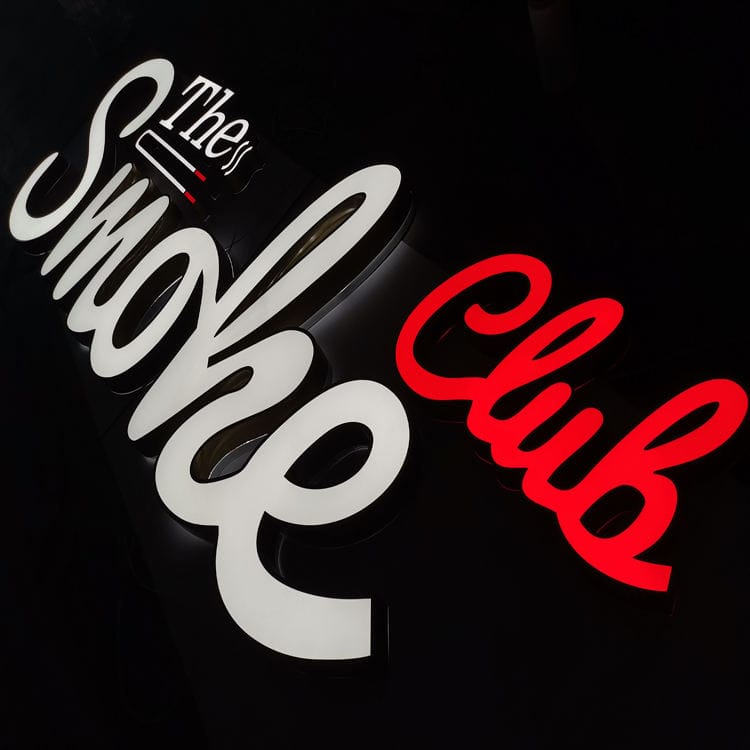
Can channel letters be used outdoors? Yes — a correctly built outdoor channel letter with 304 stainless returns, UV-stable acrylic faces, and IP65 LED modules will shrug off a decade of rain, snow, and Texas sun. A cheap indoor letter slapped on a storefront? Won't last 18 months.
The real question isn't can. What spec keeps them from turning into a corroded, flickering liability before the lease is up?
I've seen this go wrong: a sign shop sold a client indoor acrylic letters for a south-facing wall in Phoenix. Eighteen months later, the faces looked like a smoker's teeth and the LEDs were dead. The client paid twice — once for the cheap sign, once for the replacement. That's not weather. That's a spec problem.
Channel letters are the individual 3D letters you see on every strip mall, gas station canopy, and hospital facade. They're not printed signs. They're fabricated boxes — an aluminum or stainless steel return, an acrylic face, a trim cap, and internal LED modules. Outdoor use is the norm, not the exception.
For storefronts, front-lit channel letters are the bread-and-butter. Factory-direct front-lit letters run $20–80 per letter. The same letter installed by a US sign shop runs $200–700. That gap is why importers exist.
304 stainless returns last 10+ years outdoors. Aluminum returns weigh a third of steel and last 8–12 years. Acrylic LED letters with Mitsubishi or Degussa faces stay clear for 5–8 years. Domestic acrylic yellows in 1–2 years.
Over 2.5 meters tall? Use 5mm acrylic. Under that, 3mm is plenty for most facades.
Here's what nobody tells you: the plastic face and the metal return are only half the story. The real outdoor engineering is in the silicone, the drainage, and the LED driver.
The ugly truth? Most outdoor sign failures aren't from rain getting in. Heat and UV kill cheap materials.
We seal every outdoor letter with neutral silicone. Then we run an 8–12 hour aging test with the LEDs on, checking for hot spots and water leaks before it leaves the factory.
The acrylic face transmits 90–92% of the LED light depending on thickness. A 3mm face transmits 92%; a 2mm face transmits 90%. Your customer won't notice that 2% difference, but they'll notice the 40% cost bump if someone upsold them to 5mm.
Look, I've burned my hands on hot acrylic enough times to know UV resistance isn't marketing. UV resistance is a chemical package in the resin. Pay the extra 15–20% for branded acrylic and you won't see a yellow face before the lease renewal.
LED won. Traditional glass neon looks beautiful, but it's fragile, high-voltage, and maintenance-hungry outdoors. LED modules run at 12 or 24 volts DC and hit L70 at 50,000 hours — over 11 years if you run them 12 hours a night.
SMD 2835 modules are the industry standard, 100–150 lumens per watt. SMD 5730 is the brightness king at 40–60 lumens per chip. SMD 5050 is for RGB. Quality modules from Samsung, Osram, or Blueview last 5+ years in the field. Cheap unbranded modules die in 12–18 months, usually right after the warranty expires.
If you're after a premium architectural look outdoors, back-lit halo letters run $35–120 per letter factory-direct. But the halo effect lives and dies by LED placement and heat dissipation. Don't spec cheap modules just because they're hidden behind the face.
For a restaurant or hotel, 3000–3500K warm white. Retail and corporate? 4000–5000K neutral. A highway pylon or industrial building? 6000–6500K cool. That choice changes how the sign reads under sodium streetlights.
Sign shops get burned here. IP65 is the minimum for outdoor channel letters. That means dust-tight and protected against water jets from any direction.
That doesn't mean your sign survives a Florida hurricane.
IP66 is for coastal and high-pressure washdown areas. IP68 is submersible — overkill for a sign unless you're mounting it in a fountain, which I've actually seen.
UL 48 certification costs $4,000–15,000 and takes 4–9 months, with quarterly audits. ETL is 10–30% cheaper and accepted by most inspectors. If a supplier says they're UL-listed for outdoor signs, ask for the certificate with today's date. No certificate, no listing.
CE marking costs 20,000–50,000 RMB in China. Most factories will say they have it. Ask to see the certificate with today's date. Watch them sweat.
In the US, NEC Article 600 governs electric signs and outline lighting. Wet-location power supplies and sealed splices are non-negotiable. If your installer plans to use wire nuts in an open raceway, fire him.
Look, raceway mounts are ugly, but they work.
A raceway lets you pre-wire the entire sign on one aluminum extrusion, then hang it with four anchors. Flush mount with individual letters needs a penetration for every letter — and every penetration is a leak waiting to happen if the GC doesn't flash it right.
Stainless 304 is fine for a strip mall in Ohio. 316 stainless has 2–3% molybdenum and costs 20–30% more, but it's the only choice for Miami Beach or any coastal site. Otherwise you're replacing corroded letters in 3 years. If you're specifying stainless steel letters for a coastal property, demand 316. The upcharge is cheaper than a callback.
Wind load calculations matter more than most shop owners admit. A channel letter is a sail. If you're in a hurricane zone, the engineer wants stamped anchoring details for the substrate, not a generic "we'll figure it out on site."
Outdoor channel letters don't die all at once. They flicker, fade, and fill with dead bugs one module at a time.
Quickest way to spot bad LED modules: look at the solder joints. Dull gray = won't last 18 months. Shiny silver = proper lead-free solder.
304 stainless returns: 10+ years. Aluminum: 8–12 years. Branded acrylic: 5–8 years before yellowing. Quality LED modules: 5+ years. Cheap LED modules: 12–18 months. That's the whole maintenance schedule in five lines.
Power supplies usually die before LEDs. Our factory gives 2 years on LED modules and 1 year on the power supply, which tells you which component actually fails first.
We seal with neutral silicone. If it peels back after 3 years, reseal it. If water gets behind the acrylic face and the LED board corrodes, that's an installation or sealant failure, not a sign design failure.
Factory-direct doesn't mean cheap junk. You skip three layers of markup.
Front-lit channel letters from our factory in Lu'an run $20–80 per letter. Back-lit halos run $35–120. Stainless non-lit letters run $15–40. A US sign shop charges $200–700 per letter installed for front-lit. That's 50–65% product savings, minus shipping and tariff.
I've watched sign shops pay $800 for a front-lit letter from a domestic fabricator. Same 304 stainless, same Samsung LEDs. We ship that letter for $120.
MOQ is one piece. Lead time is 7–15 days. Express gets a small sign to you in 7–15 days for $30–100. Air freight runs 10–20 days at $4–12/kg. Sea freight takes 50–70 days at $80–200 per cubic meter LCL, or $1,200–3,000 for a full container. Add the Section 301 tariff — about 30% — and you still land well below domestic.
LCL sea freight: your crate gets handled 6–8 times between our dock and yours. Every touch is a chance for damage. That's not in the brochure.
Ask for actual material certs: 304 or 316 stainless mill certificates, invoices showing they actually bought branded acrylic, and LED module datasheets. If they can't produce them in 24 hours, walk.
Do I need 316 stainless for a normal midwest storefront? No. 304 is fine for 99% of inland sites. 316 is for coastal or industrial air. Paying 20–30% more for 316 in Ohio is just money on fire.
Is IP65 enough for rain and snow? Yes, when paired with a wet-location power supply and sealed splices. IP65 is dust-tight and water-jet protected. That's not a hurricane rating. If you're in a flood zone, mount it higher.
How long will outdoor channel letters actually last? The letters themselves, 10+ years for 304 stainless or 8-12 for aluminum. The acrylic face, 5-8 years with branded UV-stable material. LED modules, 5+ years with Samsung/Osram/Blueview. Cheap LEDs die in 12-18 months. Pick your poison.
Can I install factory-direct channel letters myself? You can, if you understand NEC Article 600 and have an electrician sign off. If you're asking this question, don't. A bad splice in a raceway is a fire hazard, not a DIY project.
Products mentioned or relevant to this topic — factory-direct, custom built.
From $16/letter · MOQ 1 piece · 7–15 day production · CE & UL certified · ships to 20+ countries
Custom sizes, colors, and finishes. Get a factory price in 24 hours.
Get a Free QuoteWhatsApp +86 13865703472 · cairuisheng@aochuangsign.cn