I've watched a $15,000 hotel sign in Miami turn into a chalky, pitted mess in 18 months. The spec said "anodized aluminum, marine grade." The budget said "cheapest bid." The installer shrugged and blamed the salt air. Nobody told the owner that cheap anodizing in a coastal zone is like wearing a screen door in a hurricane.
Anodized aluminum can last fifteen years. Powder coat can fail in three. Flip those numbers depending on the alloy, the pretreatment, and the day of the week the line operator had his coffee. I've burned both finishes — literal torch tests, salt spray cabinets, Florida sun racks — and I'm going to lay out what actually holds up and what leaves you re-ordering before the warranty paperwork clears.
Look, anodizing isn't paint. It's not a plastic skin sprayed on. It's a controlled corrosion. We run a DC current through a sulfuric acid bath, forcing the aluminum surface to build a sapphire-hard layer of aluminum oxide. That layer grows out of the metal, so it can't peel like paint. A proper Type II architectural anodize hits 15–20µm thick. That's half the diameter of a fine human hair, but it's dense enough to stop oxygen dead.
Here's what nobody tells you: that oxide layer is porous when it comes out of the bath. If you don't seal it, salt and acid eat right into the pores and start bubbling from underneath. We cold-seal with nickel acetate. Cheaper shops hot-water seal and it fails inside two winters. Anodized letters from our floor use a 20µm build plus a full cold seal, which gives you ten to twelve years before the color starts to drift — not because the aluminum's failing, but because the dye molecules finally tap out under UV.
Dye matters. Anodized finishes come in clear, bronze, black, champagne, gold — and 90% of the horror stories I hear come from third-party "gold" anodizing that fades to silver in two summers. We stick to inorganic tin-based dyes for architectural jobs. They cost more. They don't lie.
Powder coat is a completely different animal. We electrostatically spray a dry thermoplastic or thermoset powder onto the aluminum, then cure it at 180–200°C. The powder melts, flows, and cross-links into a solid layer 60–80µm thick. That's four times thicker than an anodized layer and it's a true continuous film — no pores. If you need a RAL-matched orange or a corporate teal, powder is your only real option. Anodized can't hit those chromatic notes.
The ugly truth is that not all powder is outdoor-grade. Epoxy powders are cheap and smooth, great for indoor shelf brackets. Put them outside, they chalk and delaminate in 12–24 months. Polyester TGIC powders — that's the stuff we spray on exterior signs — handle 10+ years of UV without glazing. Our standard outdoor powder runs a polyester triglycidyl isocyanurate chemistry, and we test sample panels to 1,000+ hours of salt spray per ASTM B117. If a client orders aluminum letters for a beach resort, I don't even offer epoxy. I just build the TGIC upcharge into the quote.
Scratch resistance? Anodized wins cold. That sapphire-like oxide layer hits 300–500 HV hardness. Powder coat sits around 80–120 HV. Drop a ring of keys on an anodized face, you'll see a faint white line that buffs out. Do the same to powder coat, you'll gouge right to the metal. But hardness cuts both ways — anodized is brittle. Bend the panel and it cracks. Powder coat flexes.
UV fading is where most sign shops screw up. Anodized with proper dyes and sealing can go 10–15 years before a measurable ΔE shift. I've pulled samples off our roof rack after eight years in Anhui's humid, 38°C summers, and the clear anodized still looked like brushed moonlight. Powder coat with TGIC resin also does a decade, but that's the ceiling for reds and blues. Dark colors absorb heat and break down faster. I tell clients to expect 7–9 years from a dark powder before they notice a matte veil. That's not failure; that's physics.
Corrosion is the fight that matters outdoors. Bare anodized (no scratch, seal intact) withstands 4,000+ hours of neutral salt spray — that's coastal-grade. But score it with a knife and salt creep tunnels under the oxide. Powder coat, if the film stays unbroken, is a continuous moisture barrier. Chip it, and electrolysis gets busy. I've seen a powder-coated letter in Boston look pristine for five years, then pop a 2mm chip from a rogue pebble, and within six months the aluminum underneath was a gray, powdery crater. Here's the fix: we specify a chromate conversion coating under the powder on outdoor letters. It adds a day to production but acts like a self-healing layer if the film breaches. Worth it.
I've seen this go wrong: a contractor imported "powder-coated" channel letter returns, hung them on a south-facing wall in Phoenix, and the entire face peeled off in sheets after one summer. The powder stuck to itself, not to the aluminum. Why? The metal was a recycled alloy full of zinc and silicon, zero pretreatment, and the "powder coat" was a polyester-epoxy hybrid meant for indoor shelving. The client saved $40 a letter. It cost them $6,000 to replace the sign.
Here's what nobody tells you: cheap anodized letters use 5µm oxide and organic dyes with no UV inhibitors. They look great in the showroom. Under direct sun, the dye bleaches out in 18 months and the thin oxide layer starts to pit, especially where morning dew sits. I've held competitor's letters that were anodized to look like brass but were actually dyed aluminum that oxidized to a dirty nickel color before the client's coffee shop even turned a profit.
We use 6061-T6 or 5052 aluminum sheet, 1.2mm minimum on most letters, 1.6mm for anything over 24 inches. The material thickness matters for wind load, but for finish longevity the alloy is critical. 5052 has better corrosion resistance than 6061, and I spec it for hospitals and museums within ten miles of saltwater. You can get both in anodized or powder — I just swap the mill sheet. Most import shops won't tell you the alloy. Ask. If they can't answer, walk.
Coastal, salty air, fog that tastes like a pretzel: anodized with cold sealing, minimum 20µm, or powder coated over chromate with TGIC polyester. I lean toward anodized for letters that need a metallic sheen — it won't blister. I push powder for bright corporate colors where corrosion resistance relies on an unbroken film. For stainless steel letters, I'd skip aluminum entirely and go 316, but that's a different price bracket.
High UV, dry desert: anodized dye fades slower, but powder coat's pigment can outlast the dye if it's a high-grade organic. Clear anodized is bulletproof in the sun. Black powder coat will hit 70°C surface temperature and eventually chalk; I tell clients in Arizona to choose a light color or clear anodize, and we'll emboss the brand with a brushed texture instead.
Urban pollution and freeze-thaw: powder coat wins here for color variety and is easier to clean graffiti off with solvent wipes. Anodized can stain from acidic grime if the seal isn't perfect. We've sent hundreds of aluminum letters to Chicago and Toronto — both finishes work if you get the prep right, but I've seen anodized panel joints trap road salt and corrode internally. We now specify edge wax or silicone seal on multipiece letters in those markets.
We don't play favorites. We run anodizing baths in-house for small to medium letters and have a dedicated powder coating line with a five-stage wash: alkaline degrease, rinse, acid etch, rinse, chromate coat, dry. The pretreatment adds cost but it's why our aluminum letters stay bonded after a decade in a Midwest strip mall. Every batch gets a cross-hatch adhesion test and a gloss meter check against the control panel. Anodized parts go through a 30-minute seal integrity test in boiling dye — if the color shifts, the seal's weak.
Here's what I can't do: I can't promise a 20-year warranty on anodized gold in a Florida marina. Nobody can. I'll give you two years on the structure and finish, but I'll tell you up front that you'll probably want to re-face after twelve years if you need perfect brand colors. I can't 100% guarantee a powder coat color match from batch to batch across years — we hold to a ΔE < 1, but if you order 40 letters now and a matching set in 2026, expect a tiny drift. That's honest manufacturing. I also can't make anodized look like a glossy wet paint; that's a powder coat's job. And if you need a finish that survives constant hydrocarbon fumes — say, inside a bus depot — I'll steer you to powder coat over anodize, because the sealed oxide can absorb solvents and lose gloss.
Anodizing adds roughly $8 to $15 per standard 18-inch letter, depending on color. Powder coating adds about the same if you're using a stock TGIC color. Custom RAL matching bumps it another $5. The real cost difference is in longevity: a properly anodized letter might look clean for 12 years, a good powder coat for 9–10. So your annualized cost is lower with anodized — unless you need a company crimson or teal, where powder is the only road. I've had clients pay a $40 premium per letter for anodized "gold" that lasted three years, then switch to a powder-coated champagne and get six. The right choice isn't about upfront price; it's about the light and salt your sign actually lives in.
You'll find aluminum letters priced between $10 and $25 apiece from our factory for non-lit, standard finishes, and we ship worldwide. That's a fraction of what a local shop charges for installed letters. And we'll put the finish spec right on the quote — alloy, pretreatment, oxide thickness, powder resin type. No vague "premium outdoor finish" nonsense.
Look, I've got calloused hands from 16 years of lifting sheet metal. I've argued with dye suppliers who swore their gold was UV-proof. I've repainted letters on a lift in August because a contractor chose the wrong finish. If you send me a Google Street View of your building and tell me what exposure it faces, I'll tell you straight: anodized or powder coat, right for your money. I won't push the expensive option just because. I've got three thousand square meters of factory floor and fifty craftsmen who can build either finish to outlast the lease. But only if you pick the right one. Let's get it right the first time.

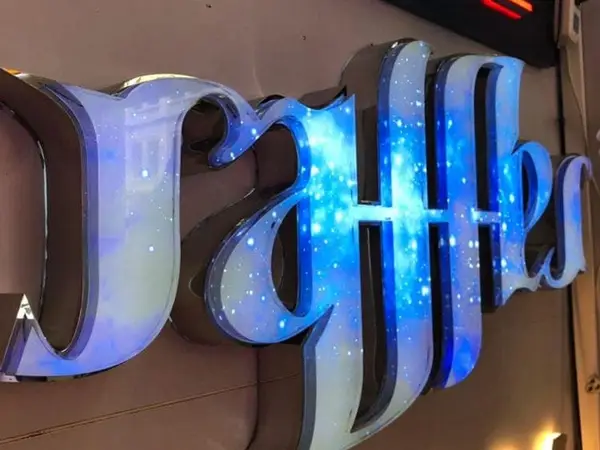
Real photo from our production floor — every sign we ship is made here.
Products mentioned or relevant to this topic — factory-direct, custom built.
From $24/letter · MOQ 1 piece · Flexible lead time · CE & UL certified · ships to 20+ countries
Custom sizes, colors, and finishes. Get a factory price in 24 hours.
Get a Free Quote Copy EmailWhatsApp +86 13865703472 · business@aochuangsign.cn
See pricing, specs, and get a free quote for the sign type you need. Built in our factory, shipped worldwide.