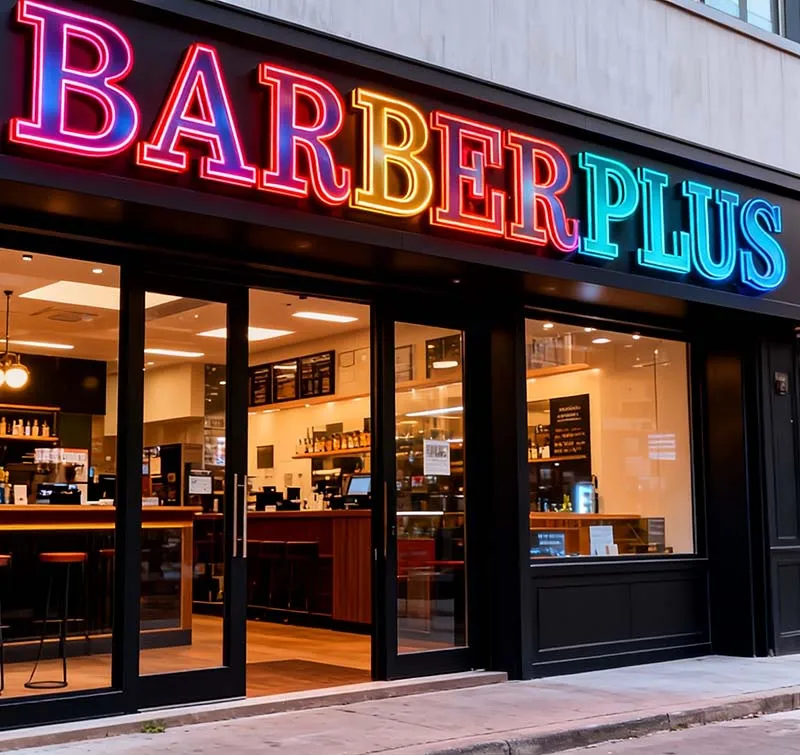
11:14 PM. Just got off the phone with a contractor who asked if channel letters come in "font size 16." Let's settle some things.
A channel letter is a three-dimensional sign letter with a hollow body—usually aluminum sides, an acrylic face, and internal LED lighting. The channel is the U-shaped body that gives the letter depth. Most storefront signs you've seen on a strip mall are exactly this.
That's it.
If you're ordering front-lit channel letters for a storefront, you're buying the workhorse of the signage trade. Retail installed price for a front-lit letter runs $200-700 per letter in the US. Factory-direct from a Chinese manufacturer, the same letter costs $20-80 per letter before freight. That's a 50-65% savings on product, not counting shipping and tariffs. That gap keeps importers and contractors calling us at Aochuang Sign after they swore they'd never import again.
Here's what nobody tells you: if a factory can't show you a 10-step production process, they're not making channel letters—they're assembling them from someone else's parts. Our floor in Lu'an, Anhui runs design confirmation, laser cutting, bending, welding, grinding, acrylic CNC, LED assembly, silicone sealing, aging test, QC, then export packing.
Laser cutting hits ±0.1mm. TIG welding takes 1-2 days. We CNC-cut the acrylic face in one day, assemble LED modules another day or two, then seal with neutral silicone and run an 8-12 hour aging test. Total lead time runs about 5-15 days. Not 45 days. If a factory quotes 30 days for standard letters, they're over-booked or they're lying to buy time.
Most failures happen at sealing. Cheap silicone lets water creep in after the first freeze-thaw cycle. We use neutral-cure silicone because acidic silicone eats the LED coating alive. You might not see it until the lights start flickering two years later, but it starts on day one.
Start with acrylic. Mitsubishi or Degussa UV-resistant acrylic lasts 5-8 years outdoors. Domestic acrylic from a no-name supplier starts yellowing in 1-2 years. You can't see the difference on day one, but your customer will on day 700.
Light transmittance runs 90-92%. The difference between a 2mm and 3mm face is only about 2% light output—but the cost spread is around 40% if you're buying premium. So don't spec 3mm unless the letter spans over 2.5 meters. Past that, go 5mm or it'll bow like a cheap bookshelf.
For stainless steel letters, 304 is the standard outdoor choice. It's got 18% chromium and 8% nickel, runs a 10+ year outdoor life, and costs $15-40 per non-lit letter at factory direct. 316 marine grade adds 2-3% molybdenum and lasts 15+ years in coastal and industrial air, but you'll pay a 20-30% premium. I've seen this go wrong: a Miami Beach restaurant bought 304 letters because the bid was $900 cheaper. Three years later, rust stains ran down the building face. The replacement cost twice the original. If you're within salt spray, pay for 316 or you'll lose the client.
Aluminum weighs a third of steel, won't rust, and lasts 8-12 years outdoors. For channel letter returns, 0.040-0.063 inch is standard. Nobody argues about aluminum. The arguments start with LED modules—that's next.
Front-lit is the default. The acrylic face glows evenly, and if you want a premium architectural look, go for back-lit halo letters. Those run $35-120 per letter factory direct and $400-1,000 installed retail. Halo letters are trickier: the light halos against the wall, so you need precise standoff distances and a clean mounting surface. Rookie mistake: ordering halo letters with cheap LED modules that don't diffuse evenly. You'll see hot spots and dim corners, and the client will call you at 9pm.
For LED, don't let anyone sell you on "high brightness" without asking the module type and lumens. SMD 2835 runs 100-150 lm/W and is the industry standard. SMD 5730 pushes 40-60 lm per chip—highest brightness for punch-through. SMD 5050 is for RGB. Color temperature matters: 3000-3500K warm for hospitality, 4000-5000K neutral for corporate and retail, 6000-6500K cool for industrial or highway signage. When a customer says "I just want white," ask what they're lighting. Then send them a sample, not a Pantone code.
If you're buying for the US, front-lit channel letters need to meet NEC Article 600 for electrical signage. UL 48 is the gold standard, but it'll cost you $4,000-15,000 and take 4-9 months plus quarterly audits. ETL is a legitimate alternative, usually 10-30% cheaper. Don't accept a factory that says "UL compliant" without a certificate number and date. That's not compliance; that's a bumper sticker.
CE marking costs 20,000-50,000 RMB and takes 2-8 weeks. But here's the industry lie: lots of factories say they have CE. Ask for the certificate with today's date. Watch them sweat. I've seen PDFs from 2014 circulated like they're fresh. For outdoor signs, IP65 is the minimum—dust-tight and resistant to water jets. IP66 handles powerful jets, and IP68 is submersible. IP65 doesn't mean hurricane-proof. Water jets from any direction aren't the same as a storm surge.
Look, you can't compare factory prices to retail installed prices. Factory direct per letter runs $20-80 front-lit, $35-120 back-lit, $15-40 non-lit stainless, $40-120 3D fabricated, $10-25 aluminum. Light boxes run $80-250 per square meter. Neon flex runs $30-200 per sign. That's product only, before freight and tariffs.
Freight is where rookies get hosed. Express on a small sign runs $30-100 and arrives in about 5-15 days. Air freight runs $4-12 per kg and takes about 10 days. Sea freight takes about 65 days, and LCL costs $80-200 per cubic meter, while a full container runs $1,200-3,000. Then add the US Section 301 tariff at roughly 30%. So a $100 letter can land at $140-$180 depending on freight and tariff. Still nowhere near the $700 installed retail.
I've seen this go wrong: a sign shop in Dallas ordered 40 letters LCL to save $600 on freight. Workers handled that crate six to eight times between our dock and theirs. Seven letters arrived with cracked acrylic faces. The repair cost $900 and a two-week delay. LCL is fine if you pack like it'll be dropped—because it will be dropped. That's not in the brochure.
Here's what nobody tells you: the lowest quote is usually the most expensive sign you'll ever buy. We've got a 3,000-square-meter production facility, 50+ skilled workers, and an MOQ of one piece. That's right. One piece. We run ISO 9001, CE, and RoHS. We warranty LEDs for 2 years and power supplies for 1 year. If a factory won't do one piece, they're set up for distributors, not sign shops. Walk away.
Ask for the LED module brand. Samsung, Osram, and Blueview modules last 5+ years in the real world. Cheap no-name modules die in 12-18 months. The quickest way to spot bad modules without a lab: look at the solder joints. Dull gray means the solder will crack. Shiny silver means proper lead-free solder. If the factory can't send macro photos of the LED boards, they're hiding something.
Ask for a certificate with today's date. Ask for the 8-12 hour aging test report. Ask to see packaging photos: foam, carton, then plywood crate. If any of those three are missing, your letters will arrive as a jigsaw puzzle. Then ask for a video of the laser cutting, not a stock photo. Any real factory can walk the floor and shoot a video on a phone in five minutes.
Can you match a brand's exact RAL color for powder coating? Yes, and if a factory says no, they're not a manufacturer. We match any RAL. Stop sending paint chips in the mail; a RAL code works. The only time it doesn't is if your client eyeballed a color from a photo on their phone. Then don't blame us when it's off by two shades.
Why is sea freight so slow? Because your crate sits in a port, then a truck, then a port, then a warehouse, then a truck. That's about 65 days. If you need it faster, pay for air. No, I can't "expedite" the Pacific Ocean.
Do I need UL certification for a small sign? If you're installing it in the US on a commercial building, your local inspector cares about NEC Article 600 and an electrical listing. UL 48 or ETL. "Small" isn't a loophole. If you don't want to pay for it, you're betting your license, not mine.
What's your MOQ? One piece. Yes, really. But the freight on one letter is stupid—$30-100 express. So you're better off batching multiple signs. But I won't make you buy 50. That's how factories clear inventory, not how they serve sign shops.

Real photo from our production floor — every sign we ship is made here.
Products mentioned or relevant to this topic — factory-direct, custom built.
From $24/letter · MOQ 1 piece · Flexible lead time · CE & UL certified · ships to 20+ countries
Custom sizes, colors, and finishes. Get a factory price in 24 hours.
Get a Free Quote Copy EmailWhatsApp +86 13865703472 · business@aochuangsign.cn