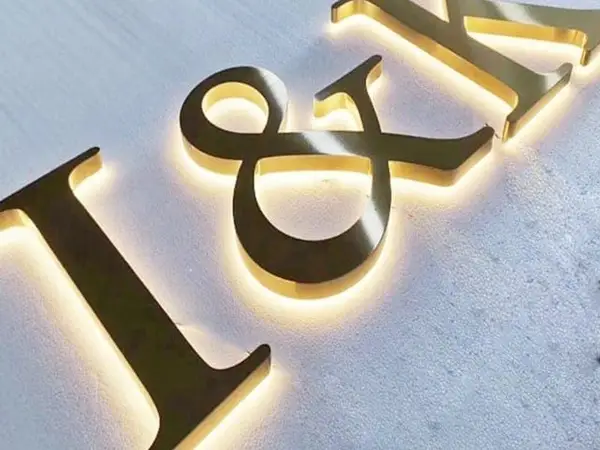
The ugly truth is most of you are overpaying for
channel letters, and you don't even know it yet. I've been in this industry for 16 years, and I can tell you the pricing gap between what a local shop charges and what a factory charges isn't just a little difference. It's a chasm.
I've watched sign shops pay $800 for a single front-lit letter. Same 304 stainless, same Samsung LEDs. We ship that letter for $120. Let that sink in for a second.
---
Let's start with the actual numbers. The channel letter signs cost per letter in 2026 breaks down like this on the factory side: front-lit channel letters run $20 to $80 each, back-lit halo letters go for $35 to $120, stainless steel non-lit letters are $15 to $40, and 3D fabricated letters run $40 to $120. Aluminum letters are the cheapest at $10 to $25.
Now here's the local side. In the US, retail installed pricing for front-lit letters is $200 to $700 per letter. Halo-lit letters? $400 to $1,000 per letter. That's not a markup. That's a three to five times multiplier on the product alone, before you even touch installation.
---
Here's what nobody tells you: local sign shops aren't gouging you on purpose. They've got overhead. A brick-and-mortar location in a decent metro, employees, workers' comp, insurance, vehicles, salespeople, project managers. That stuff eats margins alive. They quote you what they need to survive, not what the product is worth.
But you're not paying for the product when you go local. You're paying for convenience. Someone to answer the phone, measure the wall, pull the permits, and handle the install. There's real value there. The problem is when that convenience premium hits 400 percent, you've got to ask what you're actually getting for the money.
---
The factory-direct math is straightforward. Take a job with 20 front-lit letters, 18 inches tall. Factory cost at $60 per letter averages out to $1,200 for the product. Shipping via sea freight, maybe $200 to $400 depending on your port. Tariffs under Section 301 add roughly 30 percent, so that's another $360 to $480. Add simple installation by a local electrician or sign installer at $65 to $100 per hour, and you're looking at total installed cost of roughly $2,500 to $3,500.
Local shop quote for the same job? You're looking at $6,000 to $10,000 installed. For the same chinese factory letters that they import themselves. I've seen this go wrong: shops claiming "locally manufactured" while the UPS truck backs up to their loading dock with crates from Shanghai. The only thing local is their invoice.
---
But I want to be brutally honest with you. Factory-direct is not always the right call. If you need one letter replacement for an emergency repair and the sign's down, you don't ship from China. You call a local shop, you pay the premium, and you get it fixed in two days. That's the trade-off. Speed is money, and sometimes local is worth every penny.
---
Here's the real breakdown you should be asking about: material differences. Acrylic face quality varies enormously. Mitsubishi or Degussa UV-resistant acrylic will last 5 to 8 years outside before yellowing. Domestic Chinese acrylic? You're getting 1 to 2 years before it looks like a stained tooth. We charge more for the good stuff because it costs more. Most budget factories don't offer you the choice. They just ship the cheap stuff and hope you don't notice until the warranty expires.
LEDs are the same story. Quality modules from Samsung or Osram with L70 ratings of 50,000 hours will actually run 5 plus years. Cheap modules burn out in 12 to 18 months. That's not an opinion. That's physics and component quality. When a factory quotes you a price, ask what LED brand they're using. If they can't tell you, run.
---
Let's talk about stainless steel, because this is where rookie mistakes happen. Stainless 304 has 18 percent chromium and 8 percent nickel. It'll hold up 10 plus years outdoors. Fine for most applications. But if your job is near the coast — Miami Beach, Galveston, anywhere with salt air — you need 316 stainless with 2 to 3 percent molybdenum. That's a 20 to 30 percent cost premium, and it's worth every cent.
I've seen casinos in Macau install 304 outdoors and have corrosion marks within two years. The spec said 316. The factory shipped 304. The installer didn't verify. Everybody lost. You want to avoid that? Ask for material certificates. Any factory that's serious will send them without a fuss.
---
The factory-direct savings of 50 to 65 percent on product cost are real, but they come with strings attached. You're managing your own logistics. You're dealing with customs clearance. You're trusting a supplier 6,000 miles away to build your sign to spec. If you're not ready for that, if you can't write a proper spec sheet and check the QC photos before they ship, you might be better off paying the local premium.
The shipping math matters more than most people think. Express courier for small signs runs $30 to $100 and arrives in 7 to 15 days. Air freight is $4 to $12 per kilogram and takes 10 to 20 days. Sea freight is $80 to $200 per cubic meter for LCL, or $1,200 to $3,000 for a full container, and takes 50 to 70 days. If you're ordering one small sign, express is fine. If you're doing a franchise rollout with dozens of locations, you're shipping LCL and planning months ahead.
---
Here's another thing nobody mentions: UL certification. If you're selling electrical signage in the US, especially to national accounts or jurisdictions with strict inspection, you need UL 48 listed components. Getting a product UL certified runs $4,000 to $15,000 and takes 4 to 9 months, with quarterly audits afterward. ETL is a cheaper alternative, 10 to 30 percent less costly, but same general idea.
A factory can't get UL 48 certification overnight. It's a long process, and it's not cheap. If you need UL listed signs in 30 days, you're not getting them from China. Period. You're buying domestic or from a factory that already holds the listing.
---
The production timeframe for a typical channel letter order is 7 to 15 days. That includes design confirmation in one day, laser cutting with ±0.1mm precision in a day or two, bending and TIG welding for another day or two, grinding and polishing, CNC routing of the acrylic faces, LED assembly, silicone sealing, an 8-to-12-hour aging test on the LEDs, 100 percent QC inspection, and export packaging with foam, cartons, and plywood crates.
If a factory quotes you three days, they're lying or you're getting a sign someone else rejected. I've seen this go wrong: a "factory" that's actually a trading company promises fast turnaround, then fails to deliver because they don't control the production floor. Ask for photos of your specific job during production. That's the standard now. If they can't provide them, walk away.
---
Look, I'm not saying every local sign shop is overpriced and every Chinese factory is gold. I've seen garbage come out of China. I've seen factories use 1.0mm aluminum when the spec called for 1.6mm. I've seen "stainless steel" that rusted in six months because it was actually galvanized with a thin stainless wrap. The industry is full of shortcuts, and the only defense is knowing the numbers and asking the right questions.
The markup on cheap components is where shady factories make their profit. They quote you a great price on the letters, then quietly swap out the Samsung LEDs for generic Chinese ones. They use 2mm acrylic instead of 3mm on letters over 2.5 meters tall. They use clear silicone instead of neutral cure, and a year later the acrylic clouds up from off-gassing.
---
Here's my advice, and it's the same advice I'd give my own brother. For a single job or a small business that needs signs every few years, go local. Pay the premium for the relationship, the warranty someone can actually honor, and the install expertise. For sign shop owners, contractors, and franchise buyers who need volume, factory-direct is the only smart move. You keep 30 to 50 percent more margin in your pocket, and you control the quality process once you learn how.
The channel letter signs cost per letter difference between factory and local in 2026 is massive. But the real question isn't just price. It's whether you know what you're buying. If you're importing
stainless steel letters, verify the grade. If you're buying
front-lit channel letters, verify the LED brand. If you're ordering
back-lit halo letters, verify the acrylic thickness and the welding quality.
---
Let me give you a concrete example from an actual project. A restaurant chain needed 40
dual-lit channel letters across four locations. Local quotes came in at $850 per letter installed, brand new, warranty included — $34,000 total. Factory cost was $1,600, sea freight was $800, tariffs were $720, installation by a licensed local electrician was $2,800. Total cost: $5,920 plus the electrician's $1,500 labor. They saved over $26,000 on the same product, with the same LED components, and the signs are still running fine three years later.
That's the honest math. That's the definitive answer on cost. That's why we still have a job.
---
What we can do at Aochuang Sign: build quality channel letters with certified materials, ship them on time, warranty the LEDs for two years and the power supply for one year, and communicate honestly in English. Our production facility is 3,000 square meters in Lu'an, Anhui, with more than 50 experienced workers. We've been exporting since 2010 worldwide, and we hold CE, RoHS, and ISO 9001 certifications.
What we can't do: make a $20 channel letter that lasts 10 years. Impossible. The materials alone cost more than that. What we can't do is promise UL certification on a new SKU overnight, or guarantee delivery in five days when our production schedule is 10 days. We're a factory, not a magician. But we are upfront about it, which is more than I can say for half the trading companies out there.
---
You want the lowest price? We're not always the lowest. You'll find factories in Guangdong quoting 15 percent less. They're also using thinner aluminum, cheaper LEDs, and reconditioned acrylic. You get what you pay for, and when a sign fails on a storefront in Omaha or a tower in Toronto, the replacement cost dwarfs the savings.
If you're comparing channel letter quotes, ask every factory three questions. What brand of LEDs are you using? What grade of stainless or aluminum? Can you send photos of our specific job during production? Those three questions will eliminate more than half the quote list. And if a factory hesitates on any of them, that's your answer.
---
The market in 2026 isn't going back to the old days. Tariffs aren't vanishing. Shipping costs aren't dropping dramatically. But the gap between factory-direct and local installed pricing isn't closing either. It's widening. The smart money — the sign shop owners who've figured this out — designs their spec, handles certification requirements, and builds a relationship with a factory they trust. The not-so-smart money keeps writing big checks to the middleman and pretending it's fine.
Don't be that check writer. Do your math, ask your questions, and verify what you're buying. The channel letter signs cost per letter is what you and your supplier agree on, but the real cost is measured in years of service, brightness at 2 a.m., and your customer's brand on a wall that looks like it was done right.
---
A quick word on warranty, because this is where buyers get burned. We offer two years on LEDs and one year on power supplies. That's standard. What we don't offer is free replacement after you've driven a forklift through your fascia, or coverage when the local electrician hardwires the sign upside down. Warranty claims get denied for a lot of reasons, and most of them are legitimate.
You know what protects you better than warranty paperwork? A proper spec that you wrote yourself. A QC checklist you sent to the factory. Photos of your actual product before it got crated. A final inspection at your dock before the installer touches it. That's how you protect yourself. That's how you make sure charging ahead doesn't turn into paying for someone else's mistake.
---
Look, I've been doing this since before LEDs were the standard — we used neon glass and mercury tubes, and those signs are still running today. I've seen products nail the spec and products that should've been scrap metal. The difference is always process, honesty, and the people paying attention.
When you're ordering
neon flex signs for a restaurant or
acrylic light boxes for a franchise, the same rules apply. Verify the components, confirm the timeline, and understand the real delivered cost. If you need help with the numbers, our pricing page has the raw data. If you need a quote, send the drawing and dimensions, and expect a straight answer in 24 hours. We might not be the cheapest, but we'll never be the reason your sign fails.
---
The bottom line? Channel letter signs cost per letter in 2026 breaks into two worlds. Local and factory. Pay $200 to $700 for convenience and speed, or pay $20 to $120 and invest 20 hours of your own management time to save up to 65 percent. Both paths are legitimate. The only wrong answer is paying the premium without knowing why, or importing with zero oversight and claiming the factory ripped you off when the spec was never verified.
I'd rather you buy local, honestly, than buy from us and mess it up. But if you're going to buy from a factory, buy from a factory that treats the relationship like a partnership, shows you the proof in production, and sends you the same signs they showed you. That's what we do. Best part is, you're not $30,000 lighter if you're willing to learn how the process works.
You want the shortest version? Factory-direct letters are a tool for smart buyers. Local letters are a tool for fast buyers. The market has room for both. Just make sure you know which one you're being charged for.