I've burned my hands on hot acrylic, argued with a supplier over LED solder joints, and watched a crate of stainless letters get dropped off a forklift in Long Beach. You want clean theory? Call an architect. This is the stuff they don't put in the brochure.
Channel letters are the hardest-working sign in commercial signage. Period.
Front-lit channel letters are the bread-and-butter storefront sign. If you're ordering front-lit channel letters for a strip mall tenant, you need a 3mm acrylic face, aluminum returns, and SMD 2835 modules with a 50,000-hour L70 rating. That combo outlasts most leases.
Back-lit halo letters are the architect's pick when the budget allows. They run $35-120 per letter factory-direct and $400-1,000 installed retail in the US. The light bleeds off the wall, so mounting depth matters more than the face. If your wall isn't flat within 3mm over 3 meters, you'll see every wave. Spec back-lit halo letters only when you know the wall condition.
Rimless and domed letters are for brands that think they're too good for returns. Dual-lit letters do double duty: white face by day, halo at night. They cost more but save you from buying two signs.
Here's what nobody tells you: side-lit acrylic letters look elegant in a render, but if the factory doesn't polish the edge properly, you get hot spots that make a $2,000 sign look like a gas station window sign. Make the factory show you edge-polish photos before you commit.
Stainless 304 is the default. 18% chromium, 8% nickel, density 7.93g/cm³. It'll give you 10+ years outdoors in most climates. I've never seen 304 rust in Denver. Miami is a different animal.
The ugly truth is 316 stainless costs 20-30% more and most buyers can't tell the difference until the letters pit three years later. For coastal or industrial exposure, pay for 316 or you're doing warranty work. If you're quoting stainless steel letters for a beachfront hotel, spec 316 from day one.
Acrylic face material determines how long before your sign yellows. UV-resistant Mitsubishi or Degussa sheet runs 5-8 years. Domestic acrylic? 1-2 years and it looks like a chain-smoker's teeth. Over 2.5 meters, step up to 5mm or the face will bow like a cheap door.
Aluminum returns weigh one-third of steel. For a 40-foot pylon sign where every pound adds engineering cost, that matters. Powder coat it properly and it'll last 8-12 years outdoors. If the fab shop skips the chromate conversion coating, powder peels in six months. I've seen this go wrong more times than I can count.
Our floor runs a 10-step process: design confirmation, laser cutting at ±0.1mm, TIG welding, grinding/polishing, acrylic CNC, LED assembly, neutral silicone sealing, an 8-12 hour aging test, 100% QC, and export packaging. Total lead time about 5-15 days.
If your supplier doesn't do an aging test, you're the beta tester. Bad solder joints fail in the first 12-18 months. Look at the modules before the factory seals them: dull gray solder = trouble. Shiny silver = proper lead-free solder. That's the difference between a 5-year sign and an 18-month sign.
Sealing is where rookies die. Cheap silicone shrinks. Water gets in, and your nice SMD 2835 modules become tiny green corrosion gardens. We use neutral silicone and 100% QC. It costs maybe $2 more per letter. Cheap sign shops skip it.
SMD 2835 modules run 100-150 lumens per watt. That's the industry standard for a reason. SMD 5730 chips give you 40-60 lumens per chip with highest brightness, but they also produce more heat. Samsung, Osram, or Blueview modules will last 5+ years at L70. Cheap no-name modules die in 12-18 months. Don't buy from a factory that won't tell you the chip brand.
If you're ordering acrylic LED letters for a corporate lobby, ask for diffused acrylic and a 3000K color temperature. That's what keeps the sign from looking like a tanning bed.
Color temperature matters more than brightness. 3000-3500K warm for hospitality, 4000-5000K neutral for corporate and retail, 6000-6500K cool for industrial and highway. Pick the wrong one and a $10,000 sign looks like someone stapled a flashlight to the wall.
IP65 is the minimum for outdoor, but it doesn't mean hurricane-proof. It means dust-tight and water jets from any direction. IP66 handles powerful jets for coastal. IP68 is submersible and overkill unless you're mounting letters on a fishing pier.
UL 48 costs $4,000-15,000 and takes 4-9 months with quarterly audits. ETL is 10-30% cheaper and accepted by most AHJs. CE marking costs 20,000-50,000 RMB. Here's the lie: plenty of factories will say they have CE. Ask to see the certificate with today's date. Watch them sweat.
Here's what nobody tells you: your power supply has a 1-year warranty while the LEDs have 2 years. That's not an accident. Power supplies fail first. Budget for a replacement driver every 3-4 years if it's on 24/7.
Factory-direct pricing per letter: front-lit channel letters $20-80, back-lit halo $35-120, stainless non-lit $15-40, 3D fabricated $40-120, aluminum $10-25. Light boxes $80-250 per square meter. US retail installed: $200-700 per letter for front-lit, $400-1,000 for halo. You do the math.
I've watched sign shops pay $800 for a front-lit letter from a domestic fabricator. Same 304 stainless, same Samsung LEDs. We ship that letter for $120. The 50-65% savings isn't a marketing gimmick. The difference? A factory in Anhui with 50 workers versus a US shop paying California rent.
Shipping is where amateurs get gutted. Express takes about 5-15 days at $30-100 for small orders. Air freight is about 10 days at $4-12/kg. Sea freight takes about 65 days and costs $80-200/m³ for LCL or $1,200-3,000 for a full container. LCL means handlers touch your crate 6-8 times between our dock and yours. Every touch is a chance for damage. That's not in the brochure.
US Section 301 tariff runs roughly 30% on most fabricated signs. Classify correctly. If you fudge the HS code and customs catches it, the penalty dwarfs the savings. Rookie mistake.
Look, if your project timeline can't absorb about 65 days on the water, don't book sea freight and then call me in a panic. I've had contractors order in October for a January grand opening, choose sea freight to save $400, then rage when the letters are still on a ship off Long Beach. Plan the logistics like it's part of the sign, because it is.
Channel letters don't install themselves. You need mounting pattern, raceway or studs, and a licensed electrician for the 120V feed per NEC Article 600. Most municipalities want permit drawings with UL listing. If your factory sells you unlisted letters and you try to pass them off, the inspector will red-tag the job and your client will blame you, not the factory.
Here's what nobody tells you: the total cost of ownership over 10 years is LED, not labor. Modular LED systems let you swap a failed module instead of replacing a whole letter. That's $75 instead of $600. If you buy sealed integrated modules, you're betting $600 that nothing fails. Don't.
For wayfinding or interior signs, ADA rules apply: tactile letters mounted 48-60 inches, non-glare, Grade 2 Braille. Channel letters on a wall don't need Braille unless they're room signs. But don't quote a strip mall pylon without checking local sign code. Variance hearings are where good projects go to die.
Q: Do I really need UL certification for channel letters?
A: If it's going in a commercial space in the US, yes. I can't believe I still have to explain this. NEC Article 600 requires listed signs. A low price doesn't matter when the inspector red-tags your job and the fine costs more than the certification.
Q: Why does sea freight take about 65 days?
A: Because it's a boat, not email. Plus customs, port congestion, trucking. If you need it in 2 weeks, pay for air. If you need it in 3 days, I can't help you.
Q: Can I use 2mm acrylic on a 4-foot letter?
A: No. Over 2.5 meters you need 5mm or it bows. This isn't a suggestion, it's physics.
Q: What's the difference between IP65 and IP66?
A: IP65 handles water jets from any direction. IP66 handles powerful jets. Neither survives a hurricane. Read the spec.

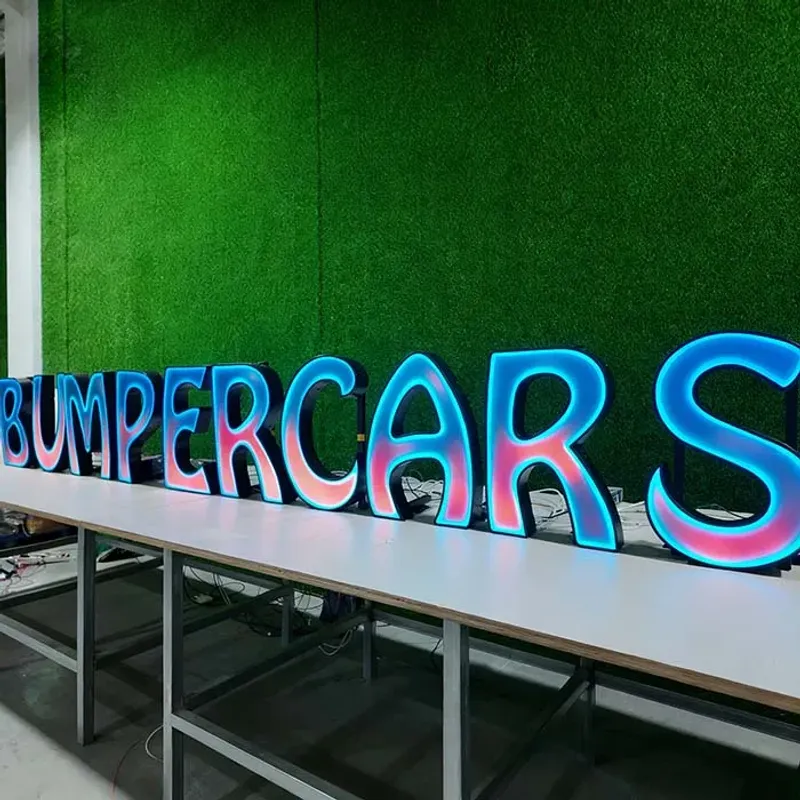
Real photo from our production floor — every sign we ship is made here.
Products mentioned or relevant to this topic — factory-direct, custom built.
From $24/letter · MOQ 1 piece · Flexible lead time · CE & UL certified · ships to 20+ countries
Custom sizes, colors, and finishes. Get a factory price in 24 hours.
Get a Free Quote Copy EmailWhatsApp +86 13865703472 · business@aochuangsign.cn