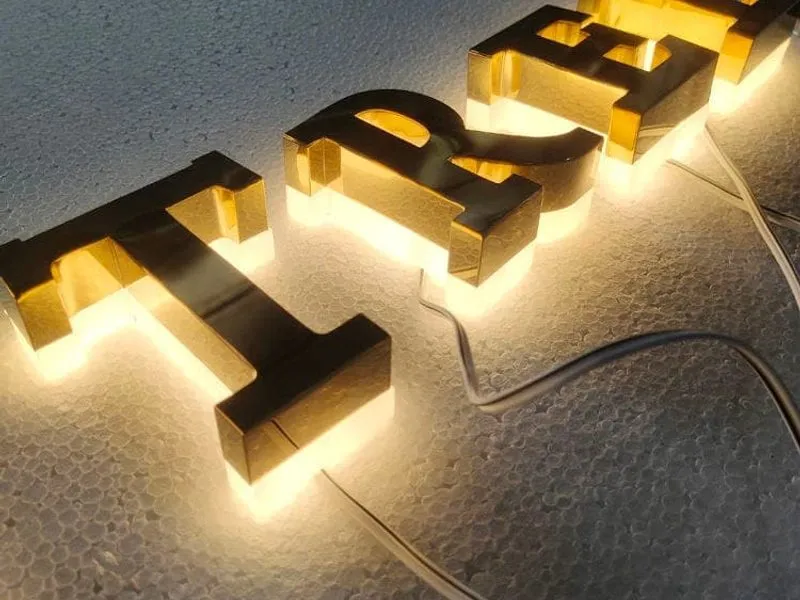
I’ve been on this factory floor 16 years. I’ve watched LED technology cycle through three “revolutions” that promised to change everything and mostly just changed how many modules end up in the dumpster behind the strip mall. COB versus SMD — it’s the argument every sign buyer hits when they’re sourcing illuminated channel letters, light boxes, or halo-lit logos. The sales guys will tell you COB is “zero hotspot” and looks like liquid neon. The budget suppliers will push SMD because they’ve got warehouse racks full of it. Neither side is telling you the whole story.
Here’s what nobody tells you: the right answer depends on whether your sign is getting installed behind a translucent acrylic face 2 inches deep or mounted flat against a stucco wall in Phoenix where summer surface temps hit 160°F. And it depends on whether you’re the contractor who has to service that sign in two years. We build front-lit channel letters, back-lit halo letters, and acrylic light boxes every day at our factory in Lu’an. We’ve used both LED types. I’ll give you the breakdown without the polish.
SMD stands for Surface Mounted Device. Think tiny individual LED chips — 2835, 5050, 5730 — mounted onto a flexible PCB strip or rigid module. Each chip is its own light engine. You’ve seen them: those little yellow squares on a roll of tape, spaced every 25mm or 50mm. COB is Chip-on-Board. Instead of individual packages, the LED die are mounted directly onto the substrate and covered with a continuous phosphor layer. What you get looks like a single glowing ribbon with no visible dots.
The ugly truth is that most people think COB is “new” technology. It’s not. It’s been around for over a decade in architectural lighting. The signage industry just caught on late because — surprise — sign makers were stubborn and didn’t want to retool their assembly lines. Now COB is everywhere in premium applications, and some installers are treating it like magic. It’s not magic. It’s a different set of trade-offs.
Let’s get the numbers out of the way. A good SMD 2835 chip hits 100-150 lumens per watt. SMD 5730 chips crank out 40-60 lumens per chip — the highest brightness per point in our inventory. COB strips typically run 100-160 lumens per watt, depending on the chip density and phosphor quality. On paper, it’s a tie. In a dark room, it’s a tie. In a 3-inch-deep channel letter with a 3mm ivory acrylic face, it’s not even close.
Here’s what nobody tells you: SMD light is directional and concentrated. The individual chips fire straight up. If your letter stroke is 1.5 inches wide and you’re using modules spaced every 3 inches, you’ll get hot spots — bright circles visible through the face, especially with thinner acrylic or lighter colors. You can fix that by spacing the modules tighter or using a deeper can, but that costs more in aluminum and LED. COB eliminates the problem entirely because the light emission is continuous. No spacing, no hot spots. You can run a COB strip right down the center of a narrow stroke and the face glows evenly from edge to edge. For shallow-rim channel letters or rimless designs, that’s a game changer — and I hate that word, but there’s no other way to put it.
I’ve seen this go wrong: a sign shop in Texas won a contract for a medical building with 4-foot-tall rimless channel letters. They used standard SMD modules. The client rejected the whole sign because you could count the LED dots through the face from the parking lot. They had to rip out the modules, buy COB strips, and redo the whole thing at a $2,700 loss. Learn from that.
At factory-direct pricing, a roll of SMD 2835 strip (5 meters, 120 LEDs per meter) costs $6-12. A comparable COB strip runs $12-20. The module cost difference is real — about 50-100% more for COB. But that’s only the BOM line item. When you’re building a set of back-lit halo letters and you need uniform illumination behind a push-through acrylic face or a halo return, the installation labor flips the equation. COB is one continuous roll; you peel, press, done. SMD requires careful spacing measurements, multiple cut points, and more wiring connections — more failure points, more QC time, more electrician hours. I’ve clocked it: a 2-meter letter outline takes 20% less time with COB. If you’re paying a sign tech $85 an hour, that adds up fast.
For front-lit channel letters with standard depths (80mm or deeper), SMD is still the cost king. We build hundreds of these every month. A typical 304 stainless steel 18-inch letter with a 3mm acrylic face and SMD 2835 modules ships for $45-65. The same letter with COB would run closer to $75-95. The visual difference is negligible when you’ve got 3 inches of depth to diffuse the light. So why pay extra? You wouldn’t. Don’t let anyone upsell you on COB for deep-channel letters if you’re not chasing a specific uniform-glow aesthetic.
LED efficiency is about lumens per watt, sure. But thermal efficiency is about whether your modules live past year two. SMD modules have small solder points and gaps between chips, so they dissipate heat reasonably well into the PCB and then into the metal letter can. COB’s continuous structure concentrates more chips in less space. If you’re running high-density COB (more than 400 LEDs per meter) at full 12V, the strip gets warm. In a sealed channel letter baking in direct sun, that strip can hit 70°C internally. You just halved your LED lifespan.
Look, I’ve seen COB strips fail in under 12 months because a sign shop mounted them inside a painted aluminum letter with zero ventilation and thought the IP65 rating meant it was indestructible. IP65 means dust-tight and protected against water jets — it doesn’t mean it can survive being a miniature oven. We solved that problem by using aluminum channel profiles as heat sinks in deep-return installations. It adds $3-5 per meter but keeps the junction temperature under 60°C. That’s the difference between a 50,000-hour L70 rating and a 15,000-hour failure. Nobody walks you through that on Alibaba.
SMD modular systems fail one chip at a time. You lose one 2835, you see a slight dim spot. You send a tech with a pre-wired module, they splice it in, 20 minutes, done. I keep a box of spare modules in my truck for exactly that. COB strips fail in sections. The phosphor layer degrades unevenly under heat stress, turning yellow or just going dark in patches. And because the strip is a continuous circuit, one internal bond wire break can kill a 5cm segment — or the whole strip if it’s wired in series without bypass diodes. Replacing a COB segment in a sealed letter means peeling out the old strip, cleaning the adhesive residue with solvent, cutting and soldering a new section in a space smaller than your hand, and praying the waterproof sealant bonds properly when you’re done. I’ve done it. It sucks. It takes 4 times longer than an SMD module swap. Charge accordingly.
Here’s what nobody tells you: COB lifespan specs from manufacturers assume perfect thermal management and constant-current power supplies with less than 3% ripple. The reality of field installations is that electricians use whatever driver the distributor had in stock, voltage fluctuates, and the strip gets bent around corners in ways it wasn’t designed for. If you’re sourcing signs from a factory like ours, we test every single illuminated piece for 8-12 hours on a burn-in rack before packaging. We catch infant mortality. But we can’t catch a two-year yellowing issue if the end user’s power supply is crap. That’s on the installer. With SMD, you can blame individual module failures. With COB, you’re often looking at a systemic problem and the whole invoice comes back to you.
SMD is your workhorse for:
COB earns its keep here:
We build mainly with SMD because 80% of our orders are standard channel letters and light boxes, and for those, SMD 2835 and 5730 deliver the right brightness at a price that saves our clients 50-65% versus US retail. We stock Samsung and Osram-grade modules, and we’ve got Lan Jing as a cost-competitive option that still hits the 5-year real lifespan. Our warranty is 2 years on LEDs, 1 year on power supplies, and we’ll extend that spec if you’re willing to pay for UL-listed premium drivers.
We can build with COB. We’ve done it for rimless letter jobs in Dubai, for a high-end retail chain in Melbourne that wanted zero-visible-light-source window signage, and for a acrylic light box project where the face was only 20mm from the LEDs. But I won’t quote COB on a standard 5-inch-deep pylon sign letter. It’s overkill, it costs you more, and if something fails, you’ll curse the day you insisted on it. I’d rather lose a small upsell than sell you a maintenance headache that damages a 20-year relationship.
Look, I’ve argued with suppliers who push COB as the universal upgrade. It’s not. It’s a specialized tool. Use it where shallow depth, narrow strokes, or premium aesthetics demand it. Use SMD everywhere else and spend the money you save on better acrylic — Mitsubishi or Degussa UV-resistant acrylic that won’t yellow in 2 years — because a lit face with degraded plastic looks bad no matter how perfect your LED arrangement is. That’s the kind of trade-off that actually extends a sign’s life.
A set of 10 front-lit stainless steel letters, 20 inches tall each, with SMD 2835 costs you $380-650 factory-direct from us, plus shipping. The same set with COB would run $650-900. Sea freight on that crate — roughly 0.3 cubic meters — costs $40-60 LCL, and it arrives in about 65 days. Airfreight would add $150-250 and get it to you in about 10 days. The tariff situation adds about 30% under Section 301. I’m giving you these numbers because you need to calculate landed cost, not just the LED type. If COB pushes you from sea freight to airfreight because you need it faster for a grand opening, the real cost difference triples.
Here’s what nobody tells you: factories that underprice COB are often using recycled phosphor or low-bin chips that start yellowing at 8,000 hours. They’ll claim CE and RoHS, but if you ask for the actual test report dated within 6 months, they go quiet. We pay 20,000-50,000 RMB to maintain valid CE certifications and have an in-house integrating sphere to verify lumen output. It’s not cheap. It’s also non-negotiable if you want signs that still look good when the lease is up for renewal.
COB vs SMD isn’t a holy war. It’s a question of application, depth, stroke width, and maintenance access. You’ve got builders telling you COB is the future. You’ve got old-timers swearing by SMD modules because they’ve used them for 15 years. They’re both right, in the right context. The mistake is letting a spec sheet or a sales pitch override the physical reality of the sign cavity you’re building.
We’ll ship you either. We’ll CNC the acrylic face to ±0.1mm, weld the stainless returns, TIG the joints, and run it through an 8-12 hour aging test regardless of what’s inside. But I’ll always ask what depth you’re working with, what face material you’re using, and who’s installing it. Because the LED you choose means nothing if the sign can’t be serviced or looks like a polka dot pattern from the customer’s driveway. Pick based on the build, not the brochure.

Real photo from our production floor — every sign we ship is made here.
From $24/letter · MOQ 1 piece · Flexible lead time · CE & UL certified · ships to 20+ countries
Custom sizes, colors, and finishes. Get a factory price in 24 hours.
Get a Free Quote Copy EmailWhatsApp +86 13865703472 · business@aochuangsign.cn
See pricing, specs, and get a free quote for the sign type you need. Built in our factory, shipped worldwide.