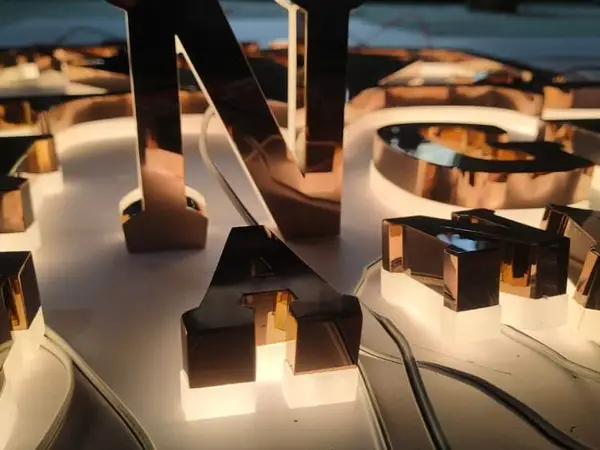
Here's what nobody tells you: the $200 per letter quote you got from that US sign company? They're buying the same product from a factory like mine for $60, slapping a 40% markup on it, and calling it "custom fabrication."
I've run production at Aochuang Sign for 14 years. We fill shipping containers with
channel letters bound for New York storefronts, Texas strip malls, and Canadian shopping centers. So let's talk real numbers — the ones that survive contact with actual invoices.
The Simple Answer: What Channel Letters Actually Cost
Front-lit channel letters run $20-80 per letter at the factory. Backlit halo letters run $35-120. Stainless steel non-lit runs $15-40. These aren't retail fantasy numbers. These are the quotes we send to sign shops and contractors who know what they're doing.
The real question isn't "how much does a letter cost" — it's "what the hell are you actually buying?"
A 5-foot tall illuminated letter with 3mm acrylic, 304 stainless returns, and Samsung LEDs costs different than a 6-inch letter with domestic acrylic and cheap Chinese modules. Anyone quoting you a flat "per letter" price without asking about size, material, and lighting is guessing. And you're paying for their guess.
Here's what a typical storefront sign package looks like: 10 letters at 18 inches tall, front-lit, stainless steel trim caps, aluminum backs. That runs $800-1,200 at our factory. In the US, the installed price lands at $6,000-12,000. The difference isn't profit margin — it's labor rates, permits, electrical work, and the fact that someone has to drive a truck to your site.
Why Chinese Factory Quotes Vary So Damn Much
I've seen this go wrong: a buyer gets three quotes from Chinese factories. One says $35 per letter. Another says $85. They assume the $35 factory is screwing them somewhere and the $85 factory is honest.
The truth is more annoying: the $35 quote is probably 3mm acrylic with a 1mm aluminum back and non-branded LEDs. The $85 quote uses 5mm acrylic, 1.5mm stainless, and Samsung modules. Both factories deliver what they quoted. The problem is you didn't specify what you wanted.
You need a Bill of Materials. Not a vague "good quality" request. You need to know:
- LED brand and model (Samsung, Osram, or no-name)
- Acrylic thickness and brand (Mitsubishi/Degussa versus domestic)
- Metal type and gauge (304 vs 316 stainless, 1.0 vs 1.5mm)
- Paint or powder coating spec
- Power supply brand and IP rating
Here's a brutal truth: if you ask for "good quality" without specifying, you'll get whatever the factory thinks they can get away with. That's not malice — that's how you quote a job in 24 hours when you've got 50 other inquiries in your inbox.
What Determines Your Real Quote
Look, the "per letter" pricing I gave you above is the starting point. Real quotes depend on six variables. Let me walk you through each one because this is where novice buyers get burned.
**Size matters more than volume.** A 12-inch letter doesn't cost twice what a 6-inch letter costs. It costs maybe 30% more. A 4-foot letter costs 3-4 times what a 12-inch costs. The relationship isn't linear because labor per letter stays fairly constant — your costs are dominated by material and packing.
**Material selection shifts everything.** Acrylic at 90-92% light transmittance from Mitsubishi costs 3-4 times domestic acrylic. The domestic stuff yellows in 1-2 years. The import lasts 5-8. Stainless 316 runs 20-30% more than 304, and you should absolutely pay it if your sign is within 3 miles of salt water. For a suburban mall in Kansas? 304 is fine. Stop overengineering.
**LED quality is the biggest hidden variable.** Samsung or Osram modules give you a genuine 5+ year lifespan with L70 rating of 50,000 hours. Cheap modules from non-brand factories? 12-18 months, and that's generous. I've seen signs go dark in 9 months because the buyer saved $40 on a sign that cost $2,000 to install. You don't need an engineering degree to understand that math.
**Power supplies are non-negotiable.** This is where I'll be brutal: most failures on cheap signs come from garbage power supplies, not LEDs. Mean Well supplies cost more, but they don't die at 2am on a Saturday. Your customer's sign going dark on a weekend costs you more in service calls than you'll ever save buying cheap drivers.
Common Lies And Rookie Mistakes
Let's talk about the "quality guarantee" myth.
Every factory says they use "high quality LEDs." Ask to see the datasheet. Ask about lumen per watt. Ask for the L70 number. If they can't answer within 30 seconds, they're buying modules from the same guy selling Cree alternatives on Alibaba.
IP65 sounds impressive. It means dust-tight and protected against water jets from any direction. It does NOT mean your sign survives a Florida hurricane. We spec IP65 as minimum outdoor standard. If the sign is on a coast or industrial area, upgrade to IP66. If it's going to be submerged in flood-prone areas? IP68. We're building a sign, not designing a submarine.
Another rookie mistake: assuming galvanic isolation is the same as grounding. They're not. NEC Article 600 for US electrical isn't optional just because your sign came from overseas. You still need to comply with local code. No factory certificate changes what your local inspector will accept.
Reading Our Quote: An Honest Breakdown
Since you're here to understand real factory quotes, let me show you what our typical quote includes:
- Laser cutting at ±0.1mm tolerance
- TIG welding on all return joints
- Grinding and polishing to remove weld marks
- CNC-cut acrylic faces
- LED assembly with weather-tight connections
- Neutral silicone sealing
- 8-12 hour aging test on every run
- 100% QC inspection before packing
- Foam, carton, and plywood crate export packaging
That's the full production sequence. It takes about 5-15 days total. Some shops quote you "expedited production" — we just quote you the real timeline. If your sign needs to ship in 5 days, ask yourself if the factory cutting corners on QC is worth the rush.
Front-lit channel letters are the workhorse. They're the absolute standard for storefronts because they deliver solid visibility without the premium cost of halo lighting. Most of our retail clients use these.
Backlit halo letters cost more — expect $35-120 per letter — because they require a double-layer construction that creates that architectural glow around each letter. If a customer calls asking for "that floating letter look" in a design meeting, this is what they want.
For anything coastal or industrial,
stainless steel letters are worth the upgrade. Just be honest about whether you need 316 or if 304 gets the job done.
Shipping: The Hidden Half of Your Real Cost
Nobody talks about shipping enough, so I will.
Express: about 5-15 days, $30-100 for small samples. This is how you test a factory before committing to a full order. I recommend this to every first-time buyer. Don't trust a factory's photos and videos — get a physical sample in your hands.
Air freight: about 10 days, $4-12 per kilogram. For a typical 24-letter sign at maybe 150 kilos, you're looking at $600-1,800. This is the speed/sanity tradeoff for most orders.
Sea freight: about 65 days. LCL (less than container load) runs $80-200 per cubic meter. A full container runs $1,200-3,000 depending on the route. You can fit a lot of channel letters in a 40-foot container, so if you're ordering signs for multiple projects, FCL makes sense.
Now the ugly truth: US Section 301 tariffs add roughly 30% on top of your product cost. We don't control that. Your import broker handles it. Anyone telling you they have a "workaround" is either lying or committing fraud — neither of which you want on your project.
How to Get a Real Quote From Our Factory
Here's what nobody tells you about getting quotes from Chinese factories: we want decent information. Send us your design file with actual dimensions. Tell us the environment (indoor, outdoor, coastal, industrial). Specify your mounting surface. Give us your brightness requirements.
Vague inquiries get vague quotes. Clear specifications get firm pricing.
When you email us, you don't need a formal RFP document. Just say "I need 14 letters, 24 inches tall, 3mm white Mitsubishi acrylic, 304 stainless steel returns with brushed finish, 1.2mm aluminum backs, Samsung 2835 LEDs, 5,000K color temperature, one transformer, UL-listed power supply" — and we'll respond with a real number.
Do you need to order a sample first? Yes. Even if it costs you $150 with shipping, it's the cheapest insurance you'll buy this year. We've seen sign shops order $50,000 in signs from a factory they never tested. Some survive. Some end up on Reddit complaining about handshake quality and dead LEDs.
Payment Terms and Minimum Orders
Our MOQ is one piece. That's not a marketing claim — that's how we operate. You can order a single 14-inch letter if that's your project. But the price per letter drops significantly when you bundle a complete sign package with 10+ letters.
Expect to pay 30-50% deposit upfront and the balance before shipping. That's standard across the industry. If a factory offers net-30 terms on your first order, they're either desperate or they priced you accordingly. Walk away from both.
Our standard warranty: 2 years on LEDs, 1 year on power supplies. That's not generous — that's honest. If you want a longer warranty, pay us for better components. The warranty should match the product, not a sales pitch.
Which Letters Should You Buy
Rimless channel letters give you that clean modern vibe without visible trim caps. They cost halfway between front-lit and halo. For tech companies and trendy retail, they read as higher-end.
Dual-lit channel letters combine front and back illumination. They're ideal for signs that need to work at high noon and compete with other illuminated signs at night. Expect a premium over single-lit options.
For restaurants and interior wayfinding,
neon flex signs cost $30-200 and can be shipped flat for cheap. They don't hold up to the same abuse as channel letters, but they give you that neon look without glass tubes.
When to Question the Quote
I'll end with this: trust but verify.
Ask for a video of your actual letters running their aging test. Ask for photos of every weld joint. Ask which acrylic brand is going into your letters and where the LED modules come from. Ask for the power supply model number.
If a factory hesitates on any of those answers, there's a reason. Our production floor is open — we'll show you our 8-12 hour aging test, our QC checklists, our packing process. We've got 3,000 square meters and 50 workers. We can't afford to hide behind marketing language.
The best time to test a factory is before you need it. Not when your client pushed the deadline and you're panic-ordering.
Send us your design, get a real quote, order a sample. If we're the right factory, you'll know after one shipment. If we're not, you'll have only spent a few hundred bucks to learn that lesson. That's the cheapest education you'll ever get in this business.