I’ve spent 16 years on sign factory floors. I’ve burned my hands on hot acrylic, argued with LED suppliers, and watched too many business owners flush money on signs that didn’t last two winters. If you’re here, you want the real deal. No fluff.
This guide isn’t theory.
I’m going to give you the numbers we use in our own pricing, the material specs that actually matter, and the ugly truths most suppliers won’t mention. Because when you order from Aochuang Sign in Lu’an, China—a 3,000m² facility with 50+ skilled workers and exports worldwide—you’re dealing with a factory, not a sales pitch. We cut out the middleman. That’s how you save 50-65% on the actual product compared to US installed prices.
Look, a front-lit channel letter from a US sign shop installed might run you $500–700 per letter. I can ship you that same letter, with better steel and Samsung LEDs, for $80. The difference is labor, overhead, and layers of markup. If you’re a sign contractor or business buyer willing to handle installation yourself, you keep those margins.
Here’s what nobody tells you: import signs aren’t cheap if you order wrong.
You still have to deal with the 30% Section 301 tariff, freight, and your own labor. But when you compare factory-direct pricing—aluminum non-lit letters for $10–25 each, back-lit halo letters starting at $35—to retail, the math is brutal in your favor. I’ve run spreadsheets for shop owners who were paying $1,200 for a single halo letter. We ship that in 316 stainless for $120. You do the math. The real cost isn’t the product; it’s not knowing what you’re buying before you wire money.
The ugly truth is, some factories quote low and then switch to cheap acrylic that yellows in a year. I’ll open our material stock any day. Ask for a video. If they won’t show you the SKU on the protective film, walk away.
Acrylic is the face of your sign. Mitsubishi or Degussa acrylic gives you 90-92% light transmittance and UV resistance for 5-8 years before any yellowing. Domestic acrylic? I’ve pulled faces that looked like bad teeth after 12-18 months. For anything over 2.5 meters wide, you need minimum 5mm thickness, not the 3mm someone will try to sell you to save $2. Don’t let them.
Stainless steel 304 is your workhorse.
It’ll give you 10-plus years outdoors, with 18% chromium and 8% nickel. Density is 7.93g/cm³, and we can do brushed #4, mirror #8, PVD coating, or powder coat. For a strip mall in Ohio, 304 is bulletproof. But if this sign is going on a Miami Beach hotel or a seafood restaurant on the Gulf, you pay 20-30% more for 316 marine grade with molybdenum. Salt air eats 304 like candy over time. I’ve seen it pockmarked in three years.
Aluminum’s weight is one-third of steel, it’s naturally rust-proof, and anodized or powder coated it’ll last 8-12 years outside. Common thickness is 1.0–1.6mm. If you’re shipping across the country and mounting on a lightweight facade, it’s the smart choice. LED-wise, don’t accept anything less than SMD 2835 at 100-150 lm/W unless you want a dim storefront. Quality modules from Samsung, Osram, or Lan Jing you a real 5+ years of lifespan from L70 ≥ 50,000 hours. Cheap no-name modules? I’ve seen 12-18 months before they start flickering like a dying firefly. That’s the difference between a $40 letter and an $80 letter.
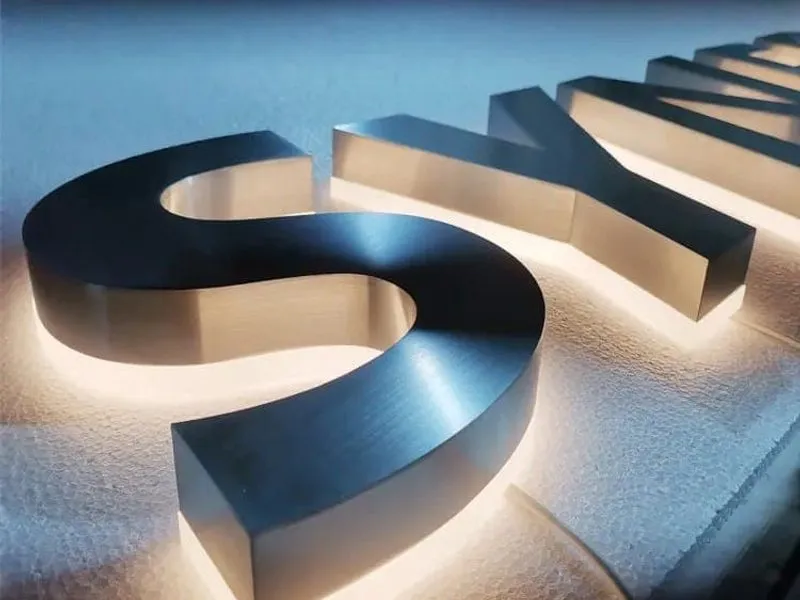
If your priority is maximum daytime punch and low cost, go with front-lit channel letters. They’re the storefront standard. Built with an acrylic face, stainless or aluminum returns, and internal LED strips. They throw light forward like a beacon. For corporate lobbies or high-end retail where you want that floating halo glow on the wall, back-lit halo letters are the move. They cost more—$35-120 factory price versus $20-80 for front-lit—because the light spills behind the letter, requiring precise standoffs and open backs.
Here’s what nobody tells you: back-lit letters are wasp magnets if you don’t seal the gaps with neutral silicone. I’ve seen a nest short out a $2,000 sign after one season. We silicone-seal every penetration and run an 8-12 hour aging test to catch leaks. You want stainless steel letters for pure durability and a high-end metal look, no lighting required. Fabricated 3D letters from plate steel can be polished or brushed to a mirror finish—you’d swear they’re solid cast. They’re $15-40 each before lighting, and they’ll outlive the building.
For a modern, clean look, rimless channel letters eliminate the trim cap and let the acrylic appear flush with the wall. Dual-lit letters give you illumination from the face and the back, so you’re visible day and night. I’ve fabricated thousands of combinations. Send me your elevation drawing.
Look, UL 48 is a money pit and time sink. A real UL field evaluation or listing costs $4,000–15,000 and takes 4–9 months with ongoing quarterly audits. We don’t hold a blanket UL listing, and any factory that says they do needs to show you a current certificate with the correct company name and scope. I’ll coordinate with your testing lab if your project demands it, but you pay the fees. We hold CE (20,000-50,000 RMB to certify), RoHS, and ISO 9001. Those are real, audited, and on file.
IP ratings are non-negotiable for outdoor signs.
IP65 means the sign is dust-tight and protected against water jets from any direction—that’s your absolute minimum for an exterior channel letter. For coastal hurricane zones, you want IP66. IP68 is submersible, which is overkill unless your sign’s in a flood zone. The NEC Article 600 governs how those signs get wired in the US. I can build the sign, but you need a licensed electrician on your end for the final connection. And if you’re buying for a public building, ADA compliance rules matter: tactile letters with Grade 2 Braille, mounting between 48 and 60 inches, non-glare finish. We can fabricate those, but you must specify at ordering, not after the fact.
I’ve seen this go wrong: A contractor chose sea freight in August, didn’t account for pre-Christmas port congestion, and missed their grand opening. By two months. Sea takes about 65 days LCL ($80-200 per cubic meter), and that’s only the transit. Add customs clearance and inland trucking. Full container loads run $1,200-3,000. If timing is tight, air freight is about 10 days at $4-12 per kilogram—painful on heavy stainless letters, but your lead time drops from 7 weeks to under 3. Express couriers will get a small sample to you in 7-10 days for $30-100.
We pack every sign in foam, then a double-wall carton, then a plywood crate if needed. I’ve shipped worldwide, and I’ve learned: over-packing is cheaper than re-making. Our MOQ is one piece, but honestly, shipping one small sign will eat you alive. Smart buyers batch their orders to spread freight cost. The US Section 301 tariff is still around 30% on many sign products. I’ll provide the correct HTS code so your customs broker doesn’t misclassify and trigger a hold. That’s on you to confirm, but I’ll arm you with the data.
You confirm the design drawing—day one. Then laser cutting within ±0.1mm on our German and Chinese machines, takes a day or two. TIG welding and bending, another two days max. Grinding and polishing follows, and a skilled hand polisher is worth his weight in 316 scrap. The acrylic face gets CNC routed, LED modules get assembled with proper current limiting, and we seal everything with neutral silicone.
Then the test. Every single sign runs for 8-12 hours in our aging room. If it flickers or dims, we rip out the module and do it again. 100% QC inspection after that—not a sample check. Export packaging is crated with desiccant packs. Lead time lands at about 5-15 days for most orders. If you need rush, I can compress to 5 days, but I’ll tell you if it risks quality. I don’t play games with a 16-year reputation.
We’re manufacturers. Not a graphic design studio. Send us production-ready vector files (AI, CDR, DXF) with pantones or CMYK breakdowns, and we’ll fabricate. If you need creative design, hire a local designer. I’ll give them the panel size constraints, but I’m not going to sketch your logo concepts at midnight.
We can’t install your sign. I can provide mounting templates and recommend anchors, but I’m standing in Anhui, not on a scissor lift in Dallas. We also won’t falsify a UL sticker. I’ve lost bids over this, and I’m okay with that. If a client demands a UL mark without going through the legal process, I walk. Too many fly-by-night exporters slap fake logos on junction boxes and hope customs doesn’t check. That’s a 30% duty plus potential seizure and fine. Not worth it.
Beware the factory that promises “LEDs will last 10 years” without asking where the sign goes. South-facing sun in Phoenix? That’s thermal torture. We spec our modules conservatively and give a 2-year warranty on LEDs, 1 year on power supplies. After that, components may fail—that’s physics, not fraud.
Start with a clear spec list: material, thickness, finish, color temperature (3000K warm for hospitality, 4000K neutral for retail, 6000K cool for industrial), mounting type, and quantity. I’ll price it within hours. Payment is 50% deposit, 50% before shipping, or use Alibaba Trade Assurance if you need a safety net. I’ve been doing this since 2010—I don’t disappear after a wire transfer.
Don’t ask for a quote on “some aluminum signs” and expect me to read your mind. I need dimensions and an artwork file. And please, don’t wait until Friday afternoon for a quote on a sign you need Tuesday. I’ll deliver, but I’ll also tell you the truth: rush jobs stress the welding team, and stress creates pinholes. Pinholes invite water, water kills LEDs. No thank you.
Buying custom signs factory-direct in 2026 is the smartest financial move a sign shop or business owner can make, but only if you arm yourself with real specs and a bullshit detector. I’ve given you mine. Call me, send me your drawings, and I’ll tell you exactly what this will cost, what it will weigh, and how long it’ll live. If you hear something that sounds too good, it probably has cheap domestic acrylic inside. I’d rather lose a sale than watch a sign fail with my name behind it.
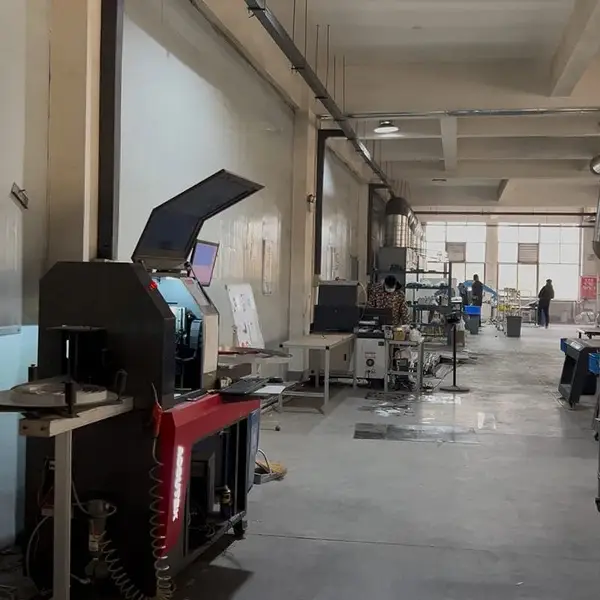
Real photo from our production floor — every sign we ship is made here.
From $24/letter · MOQ 1 piece · Flexible lead time · CE & UL certified · ships to 20+ countries
Custom sizes, colors, and finishes. Get a factory price in 24 hours.
Get a Free Quote Copy EmailWhatsApp +86 13865703472 · business@aochuangsign.cn
See pricing, specs, and get a free quote for the sign type you need. Built in our factory, shipped worldwide.